
Pulp Fiction, 1923 · page 132 of 196
Argosy All-Story Weekly, October 6, 1923 — page 132: what you’re looking at
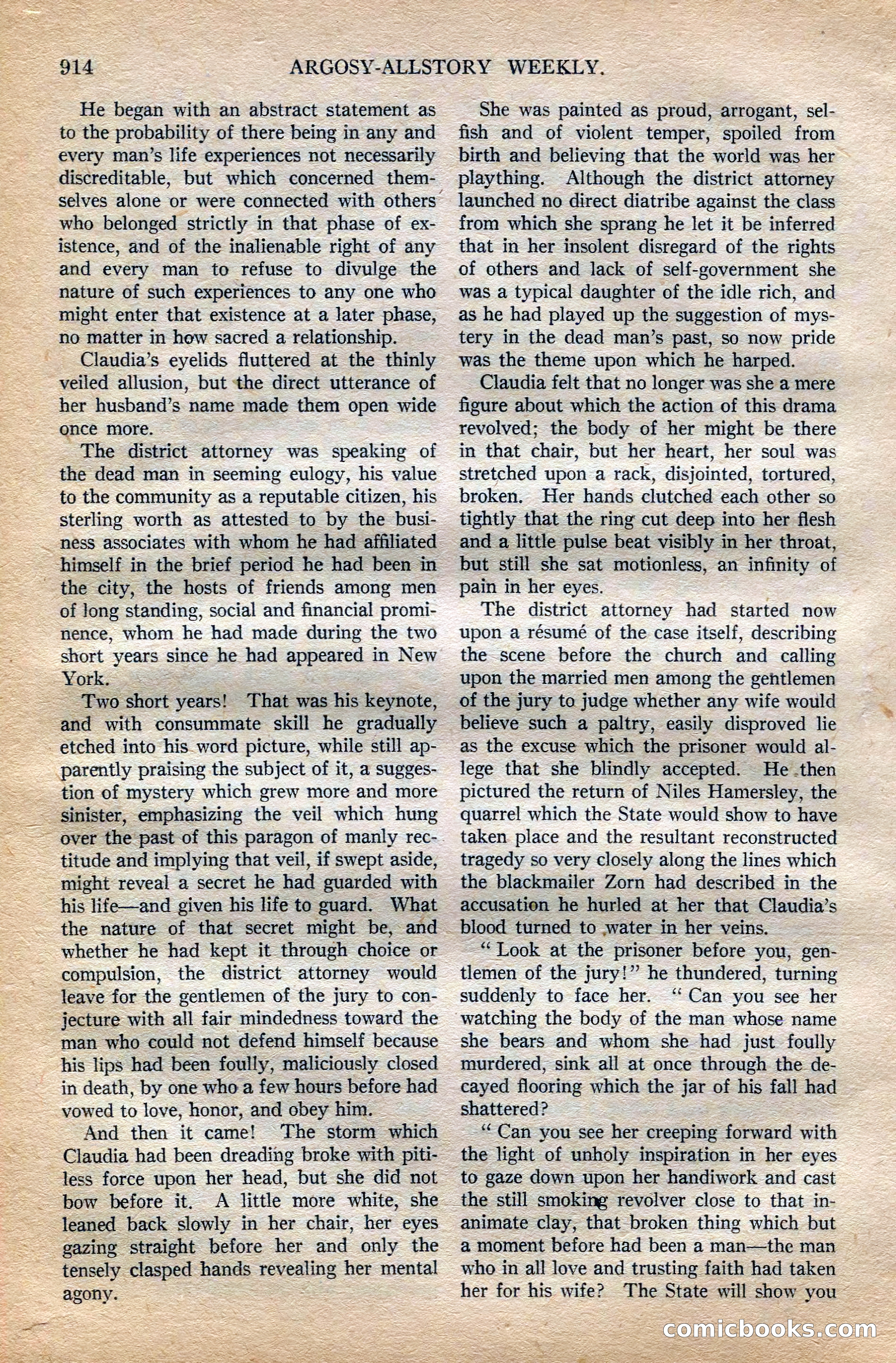
A restored page from Pulp Fiction, 1923. Page through the whole issue in the reader above.
📄 Transcribed text from this page (OCR, searchable)
Machine-transcribed from the original scan — historical spelling and the odd misread are preserved.
914 He began with an abstract statement as to the probability of there being in any and every man’s life experiences not necessarily discreditable, but which concerned them- selves alone or were connected with others who belonged strictly in that phase of ex- istence, and of the inalienable right of any and every man to refuse to divulge the nature of such experiences to any one who might enter that existence at a later phase, no matter in hew sacred a relationship. Claudia’s eyelids fluttered at the thinly veiled allusion, but the direct utterance of her husband’s name made them open wide once more. The district attorney was speaking of the dead man in seeming eulogy, his value to the community as a reputable citizen, his sterling worth as attested to by the busi- _ ness associates with whom he had affiliated himself in the brief period he had been in the city, the hosts of friends among men of long standing, social and financial promi- nence, whom he had made during the two short years since he had appeared in New SOR ae Two short years! tion of mystery which grew more and more _ sinister, emphasizing the veil which hung over” the past of this paragon of manly rec- - titude and implying that veil, if swept aside, - might reveal a secret he had guarded with his life—and given his life to guard. What the nature of that secret might be, and -. whether he had kept it through choice or compulsion, the district attorney would leave for the gentlemen of the jury to con- ~ jecture with all fair mindedness toward the ~~ man who could not defend himself because his lips had been foully, maliciously closed in death, by one who a few hours before had vowed to love, honor, and obey him. The storm which And then it came! Claudia had been dreading broke with piti- less force upon her head, but she did not -— — bow before it. SS leaned back slowly in her chair, her eyes gazing straight before her and only the _ tensely clasped hands eae her mental = agony. | A little more white, she That was his keynote, and with consummate skill he gradually etched into his word picture, while still ap- parently praising the subject of it, a sugges- ARGOSY-ALESTORY WEEKLY, She was painted as proud, arrogant, sel- fish and of violent temper, spoiled from birth and believing that the world was her plaything. Although the district attorney launched no direct diatribe against the class from which she sprang he let it be inferred that in her insolent disregard of the rights of others and lack of self-government she was a typical daughter of the idle rich, and as he had played up the suggestion of mys- tery in the dead man’s past, so now pride was the theme upon which he harped. Claudia felt that no longer was she a mere figure about which the action of this drama revolved; the body of her might be there in that chair, but her heart, her soul was stretched upon a rack, disjointed, tortured, broken. Her hands clutched each other so tightly that the ring cut deep into her flesh and a little pulse beat visibly in her throat, but still she sat motionless, an infinity of pain in her eyes. The district attorney had started now upon a résumé of the case itself, describing the scene before the church and calling upon the married men among the gehtlemen of the jury to judge whether any wife would believe such a paltry, easily disproved lie as the excuse which the prisoner would al- lege that she blindly accepted. He .then pictured the return of Niles Hamersley, the quarrel which the State would show to have taken place and the resultant reconstructed tragedy so very closely along the lines which the blackmailer Zorn had described in the accusation he hurled at her that Claudia’s blood turned to water in her veins. “Look at the prisoner before you, gen- tlemen of the jury!” he thundered, turning suddenly to face her. ‘“‘ Can you see her watching the body of the man whose name she bears and whom she had just foully murdered, sink all at once through the de- cayed flooring which the jar of his fall had shattered? ““Can you see her creeping forward with the light of unholy inspiration in her eyes to gaze down upon her handiwork and cast the still smoking revolver close to that in- animate clay, that broken thing which but ~a moment before had been a man—the man who in all love and trusting faith had taken = her for his wife? The State will show you S ie — mar n> a a a SS 3 = = * ote * _ 4 a “am : : PS nt? ee - ; Pe Fa ont ee OTS z : ties oa ~ ~ en = = ee 6 Re “a ~ > ~ en ALS, r eee ee ae - hs <