
Pulp Fiction, 1923 · page 131 of 196
Argosy All-Story Weekly, October 6, 1923 — page 131: what you’re looking at
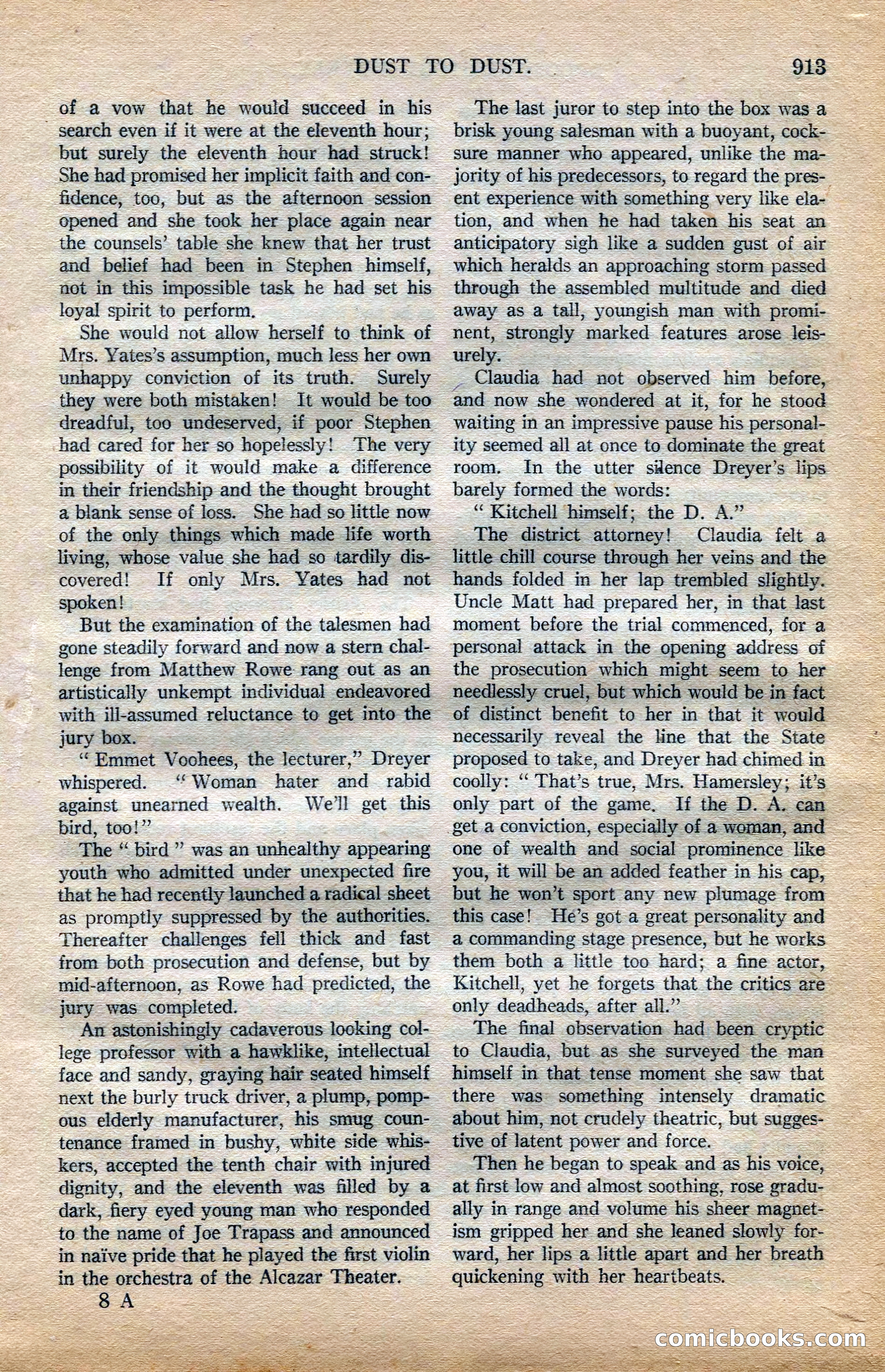
A restored page from Pulp Fiction, 1923. Page through the whole issue in the reader above.
📄 Transcribed text from this page (OCR, searchable)
Machine-transcribed from the original scan — historical spelling and the odd misread are preserved.
_ they were both mistaken! DUST TO DUST. of a vow that he would succeed in his _ search even if it were at the eleventh hour; but surely the eleventh hour had struck! She had promised her implicit faith and con- fidence, too, but as the afternoon session epened and she took her place again near the counsels’ table she knew that her trust and belief had been in Stephen himself, not in this impossible task he had set his loyal spirit to perform. She would not allow herself te think of Mrs. Yates’s assumption, much less her own unhappy conviction of its truth. Surely It would be too dreadful, too undeserved, if poor Stephen had cared for her so hopelessly! ‘The very possibility of it would make a difference in their friendship and the thought brought a blank sense of loss. She had so little now of the only things which made life worth living, whose value she had so tardily dis-_ covered! If only Mrs. Yates had not spoken! But the examination of the talesmen had gone steadily forward and now a stern chal- lenge from Matthew Rowe rang out as an artistically unkempt individual endeavored with ill-assumed reluctance to get into the jury box. ‘““ Emmet Wecaes the icccmer” Dreyer whispered. ‘“ Woman hater and rabid against unearned wealth. We'll get this bird, too!” “The “ bird” was an unhealthy appearing youth who admitted under unexpected fire that he had recently launched a radical sheet as promptly suppressed by the authorities. Thereafter challenges fell thick and fast from both prosecution and defense, but by mid-afternoon, as Rowe had predicted, the jury was completed. - An astonishingly cadaverous looking col- lege professor with a hawklike, intellectual face and sandy, graying hair seated himself next the burly truck driver, a plump, pomp- ous elderly manufacturer, his smug coun- tenance framed in bushy, white side whis- kers, accepted the tenth chair with injured dignity, and the eleventh was filled by a dark, fiery eyed young man who responded to the name of Joe Trapass and announced in naive pride that he played the first violin in the orchestra of the Alcazar Theater. The last juror to step into the box was a brisk young salesman with a buoyant, cock- sure manner who appeared, unlike the ma- jority of his predecessors, to regard the pres- ent experience with something very like ela- tion, and when he had taken his seat an anticipatory sigh like a sudden gust of air which heralds an approaching storm passed through the assembled multitude and died away as a tall, youngish man with promi- nent, strongly marked features arose leis- urely. Claudia bad not observed him soo and now she wondered at it, for he stood waiting in an impressive pause his personal- ity seemed all at once to dominate the great room. barely formed the words: “ Kitchell himself; the D. A.” The district atiomey! Claudia felt a little chill course through her veins and. the hands folded in her lap trembled slightly. 3 Uncle Matt had prepared her, in that last moment before the trial commenced, for a personal attack in the opening address of the prosecution which might seem to her — needlessly cruel, but which would be in fact of distinct benefit to her in that it would — : necessarily reveal the line that the State proposed to take, and Dreyer had chimed in coolly: “ That’s true, Mrs. Hamersley; it’s — If the D. A. can get a conviction, especially of a. woman, and one of wealth and social prominence like. only part of the game. you, it will be an added feather in his cap, but he won’t sport any new plumage from this case! He’s got a great personality and a commanding stage presence, but he works them both a little too hard; a fine actor, —— Kitchell, yet he forgets that. the critics are i only deadheads, after all.” The final observation had been. cryptic Se to Claudia, but as she surveyed the man _ himself in that. tense moment she saw that there was something intensely dramatic about him, not crudely theatric, but sugges == tive of latent power and force. Then he began to speak and as his voice, —— at first low and almost soothing, rose gradu- : ally i in range and volume his sheer magnet- ism gripped her and she Jeaned slowly for- ward, her lips a little apart and her breath Ss quickening with her heartbeats. In the utter sence Dreyer’s lips _