
Pulp Fiction, 1923 · page 85 of 196
Argosy All-Story Weekly, October 6, 1923 — page 85: what you’re looking at
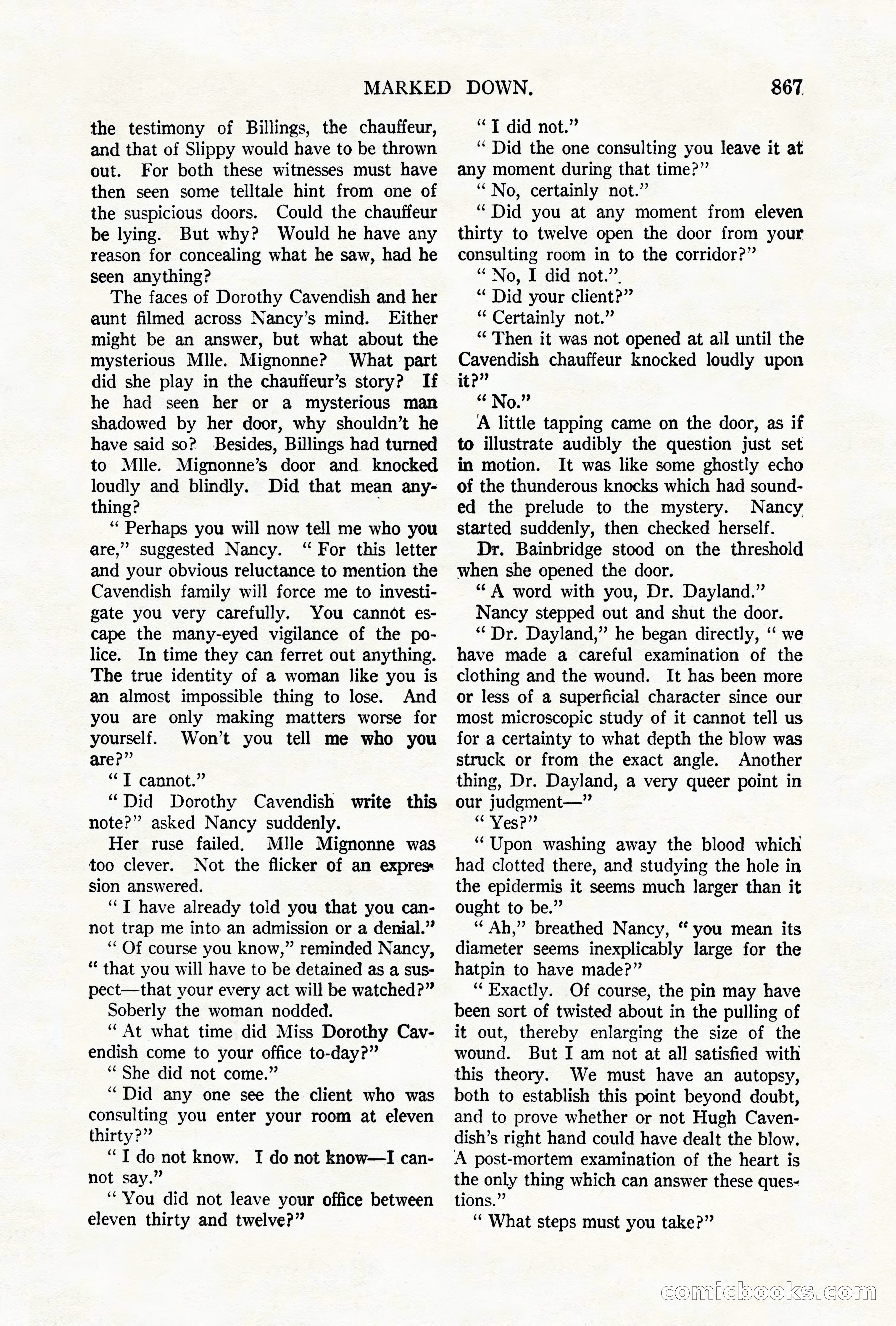
A restored page from Pulp Fiction, 1923. Page through the whole issue in the reader above.
📄 Transcribed text from this page (OCR, searchable)
Machine-transcribed from the original scan — historical spelling and the odd misread are preserved.
MARKED DOWN. the testimony of Billings, the chauffeur, and that of Slippy would have to be thrown out. For both these witnesses must have then seen some telltale hint from one of the suspicious doors. Could the chauffeur be lying. But why? Would he have any reason for concealing what he saw, had he seen anything? The faces of Dorothy Cavendish and her aunt filmed across Nancy’s mind. Either might be an answer, but what about the mysterious Mile. Mignonne? What part did she play in the chauffeur’s story? If he had seen her or a mysterious man shadowed by her door, why shouldn’t he have said so? Besides, Billings had turned to Mlle. Mignonne’s door and knocked loudly and blindly. Did that mean any- thing? “Perhaps you will now tell me who you are,” suggested Nancy. ‘“ For this letter and your obvious reluctance to mention the Cavendish family will force me to investi- gate you very carefully. You cannot es- cape the many-eyed vigilance of the po- lice. In time they can ferret out anything. The true identity of a woman like you is an almost impossible thing to lose. And you are only making matters worse for yourself. Won’t you tell me who you are?” **T cannot.” “Did Dorothy Cavendish write this note?” asked Nancy suddenly. Her ruse failed. Mlle Mignonne was too clever. Not the flicker of an expres sion answered. ‘““T have already told you that you can- not trap me into an admission or a denial.” ‘“ Of course you know,” reminded Nancy, *‘ that you will have to be detained as a sus- pect—that your every act will be watched?” Soberly the woman nodded. ‘““At what time did Miss Dorothy Cav- endish come to your office to-day?” ““ She did not come.” ‘“Did any one see the client who was consulting you enter your room at eleven thirty?” ‘““T do not know. I do not know—I can- not say.” ‘You did not leave your office between eleven thirty and twelve?” 867 ‘“T did not.” ‘Did the one consulting you leave it at any moment during that time?” ‘No, certainly not.” “Did you at any moment from eleven thirty to twelve open the door from your consulting room in to the corridor?” “No, I did not.’ ‘“* Did your client?” “ Certainly not.” “‘ Then it was not opened at all until the Cavendish chauffeur knocked loudly upon it?” 6c No.” A little tapping came on the door, as if to illustrate audibly the question just set in motion. It was like some ghostly echo of the thunderous knocks which had sound- ed the prelude to the mystery. Nancy started suddenly, then checked herself. Dr. Bainbridge stood on the threshold when she opened the door. ‘A word with you, Dr. Dayland.” Nancy stepped out and shut the door. ** Dr. Dayland,” he began directly, ‘‘ we have made a careful examination of the clothing and the wound. It has been more or less of a superficial character since our most microscopic study of it cannot tell us for a certainty to what depth the blow was struck or from the exact angle. Another thing, Dr. Dayland, a very queer point in our judgment—” 4 Yes?” ‘* Upon washing away the blood which had clotted there, and studying the hole in the epidermis it seems much larger than it ought to be.” ‘* Ah,” breathed Nancy, “‘ you mean its diameter seems inexplicably large for the hatpin to have made?” ‘“‘ Exactly. Of course, the pin may have been sort of twisted about in the pulling of it out, thereby enlarging the size of the wound. But I am not at all satisfied with this theory. We must have an autopsy, both to establish this point beyond doubt, and to prove whether or not Hugh Caven- dish’s right hand could have dealt the blow. A post-mortem examination of the heart is the only thing which can answer these ques- tions.” ‘“ What steps must you take?” COMmiclooe (©