
Pulp Fiction, 1923 · page 84 of 196
Argosy All-Story Weekly, October 6, 1923 — page 84: what you’re looking at
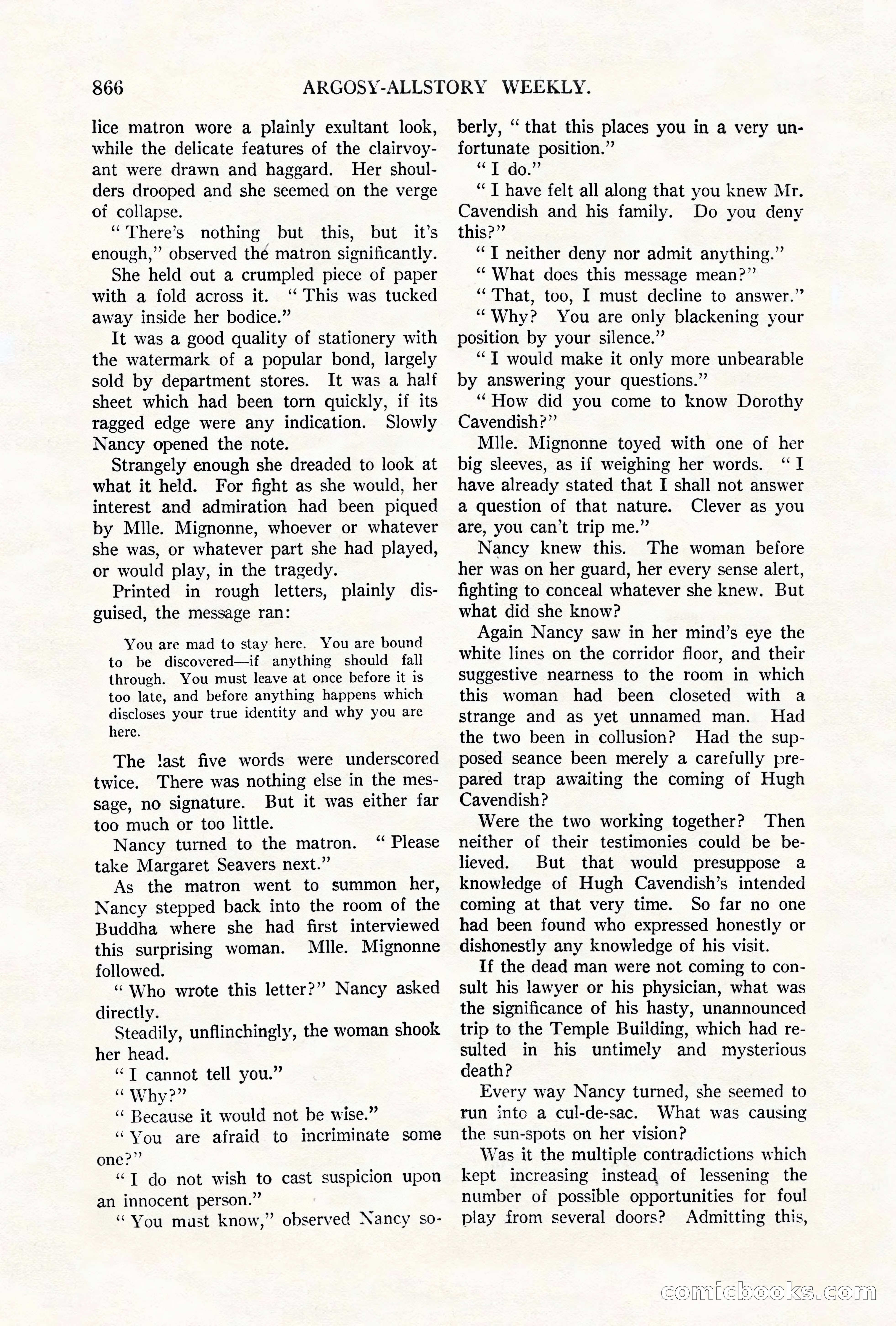
A restored page from Pulp Fiction, 1923. Page through the whole issue in the reader above.
📄 Transcribed text from this page (OCR, searchable)
Machine-transcribed from the original scan — historical spelling and the odd misread are preserved.
866 lice matron wore a plainly exultant look, while the delicate features of the clairvoy- ant were drawn and haggard. Her shoul- ders drooped and she seemed on the verge of collapse. “There’s nothing but this, but it’s enough,” observed thé matron significantly. She held out a crumpled piece of paper with a fold across it. ‘‘ This was tucked away inside her bodice.” It was a good quality of stationery with the watermark of a popular bond, largely sold by department stores. It was a hali sheet which had been torn quickly, if its ragged edge were any indication. Slowly Nancy opened the note. Strangely enough she dreaded to look at what it held. For fight as she would, her interest and admiration had been piqued by Mlle. Mignonne, whoever or whatever she was, or whatever part she had played, or would play, in the tragedy. Printed in rough letters, plainly dis- guised, the message ran: You are mad to stay here. You are bound to be discovered—if anything should fall through. You must leave at once before it is too late, and before anything happens which discloses your true identity and why you are here. The !ast five words were underscored twice. There was nothing else in the mes- sage, no signature. But it was either far too much or too little. Nancy turned to the matron. take Margaret Seavers next.” As the matron went to summon her, Nancy stepped back into the room of the Buddha where she had first interviewed this surprising woman. Mlle. Mignonne followed. “Who wrote this letter?” Nancy asked directly. Steadily, unflinchingly, the woman shook her head. “T cannot tell you.” ce Why?” ‘ Because it would not be wise.” “Vou are afraid to incriminate some one?” — “1 do not wish to cast suspicion upon an innocent person.” “Vou must know,” observed Nancy so- “* Please ARGOSY-ALLSTORY WEEKLY. berly, “ that this places you in a very un- fortunate position.” cc I do.”’ “T have felt all along that you knew Mr. Cavendish and his family. Do you deny this?” ‘“‘T neither deny nor admit anything.” ‘“‘'What does this message mean?” “That, too, I must decline to answer.” “Why? You are only blackening your position by your silence.” ‘“T would make it only more unbearable by answering your questions.” ‘“ How did you come to know Dorothy Cavendish?”’ Mile. Mignonne toyed with one of her big sleeves, as if weighing her words. ‘“ I have already stated that I shall not answer a question of that nature. Clever as you are, you can’t trip me.” Nancy knew this. The woman before her was on her guard, her every sense alert, fighting to conceal whatever she knew. But what did she know? Again Nancy saw in her mind’s eye the white lines on the corridor floor, and their suggestive nearness to the room in which this woman had been closeted with a Strange and as yet unnamed man. Had the two been in collusion? Had the sup- posed seance been merely a carefully pre- pared trap awaiting the coming of Hugh Cavendish? Were the two working together? Then neither of their testimonies could be be- lieved. But that would presuppose 2 knowledge of Hugh Cavendish’s intended coming at that very time. So far no one had been found who expressed honestly or dishonestly any knowledge of his visit. If the dead man were not coming to con- sult his lawyer or his physician, what was the significance of his hasty, unannounced trip to the Temple Building, which had re- sulted in his untimely and mysterious death? Every way Nancy turned, she seemed to run intc a cul-de-sac. What was causing the sun-spots on her vision? Was it the multiple contradictions which kept increasing instead of lessening the number of possible opportunities for foul play from several doors? Admitting this, COMiICcloOO® (©