
Pulp Fiction, 1923 · page 61 of 184
Argosy All-Story Weekly, January 13, 1923 — page 61: what you’re looking at
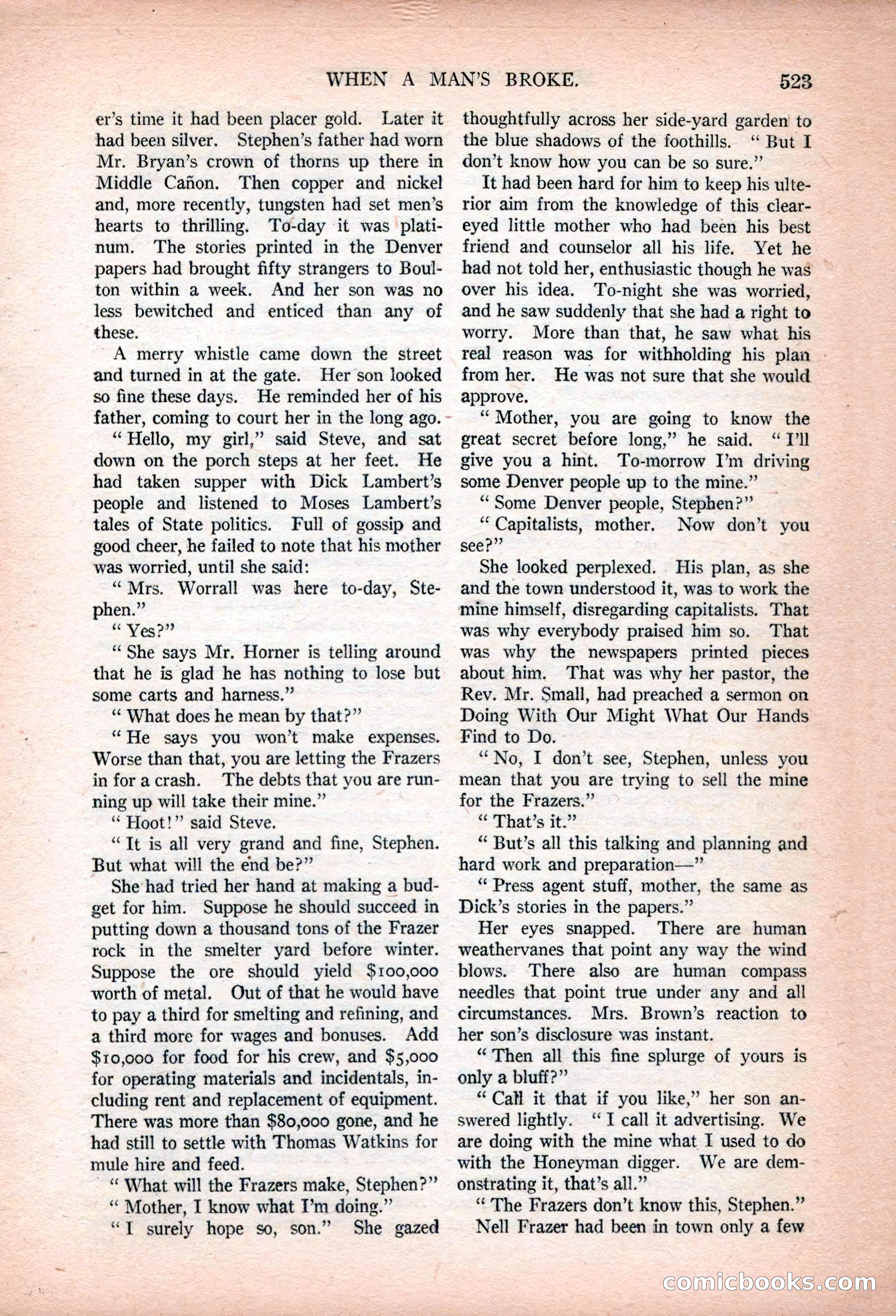
A restored page from Pulp Fiction, 1923. Page through the whole issue in the reader above.
📄 Transcribed text from this page (OCR, searchable)
Machine-transcribed from the original scan — historical spelling and the odd misread are preserved.
> —- ae - WHEN A MAN’S BROKE, er’s time it had been placer gold. Later it had been silver. Stephen’s father had worn Mr. Bryan’s crown of thorns up there in Middle Canton. Then copper and _ nickel and, more recently, tungsten had set men’s hearts to thrilling. To-day it was plati- num. The stories printed in the Denver papers had brought fifty strangers to Boul- ton within a week. And her son was no less bewitched and enticed than any of these. A merry whistle came down the street and turned in at the gate. Her son looked so fine these days. He reminded her of his father, coming to court her in the long ago. - “Hello, my girl,” said Steve, and sat down on the porch steps at her feet. He had taken supper with Dick Lambert’s people and listened to Moses Lambert’s tales of State politics. Full of gossip and good cheer, he failed to note that his mother was worried, until she said: “Mrs. Worrall was here to-day, Ste- phen.” «¢ Yes?” ‘She says Mr. Horner is telling around that he is glad he has nothing to lose but some carts and harness.” “¢ What does he mean by that?” “He says you won’t make expenses. Worse than that, you are letting the Frazers in foracrash. The debts that you are run- ning up will take their mine.” “Hoot!” said Steve. “Tt is all very grand and fine, Stephen. But what will the end be?” She’‘had tried her hand at making a bud- get for him. Suppose he should succeed in putting down a thousand tons of the Frazer rock in the smelter yard before winter. Suppose the ore should yield $100,000 worth of metal. Out of that he would have to pay a third for smelting and refining, and a third more for wages and bonuses. Add $10,000 for food for his crew, and $5,000 for operating materials and incidentals, in- cluding rent and replacement of equipment. There was more than $80,000 gone, and he had still to settle with Thomas Watkins for mule hire and feed. _ “ What will the Frazers make, Stephen?” “ Mother, I know what I’m doing.” “T surely hope so, son.” She gazed a a < = > ~~ <n SR a a eg ee Pee 523 thoughtfully across her side-yard garden to the blue shadows of the foothills. ‘“ But I don’t know how you can be so sure.”’ It had been hard for him to keep his ulte- rior aim from the knowledge of this clear- eyed little mother who had been his best friend and counselor all his life. Yet he had not told her, enthusiastic though he was over his idea. To-night she was worried, and he saw suddenly that she had a right to worry. More than that, he saw what his real reason was for withholding his plan ~ from her. He was not sure that she would approve. “Mother, you are going to know the great secret before long,” he said. “Tl give you a hint. To-morrow I’m driving some Denver people up to the mine.” “Some Denver people, Stephen?” “‘ Capitalists, mother. Now don’t you see?” She looked perplexed. His plan, as she and the town understood it, was to work the mine himself, disregarding capitalists. That was why everybody praised him so. That was why the newspapers printed pieces about him. That was why her pastor, the Rev. Mr. Small, had preached a sermon on Doing With Our Might What Our Hands Find to Do. ‘““No, I don’t see, Stephen, unless you mean that you are trying to sell the mine for the Frazers.”’ “That's it?” “ But’s all this talking and planning and hard work and preparation—” “Press agent stuff, mother, the same as Dick’s stories in the papers.” Her eyes snapped. There are human weathervanes that point any way the wind blows. There also are human compass needles that point true under any and all circumstances. Mrs. Brown’s reaction to her son’s disclosure was instant. “Then all this fine splurge of yours is only a bluff?” “Call it that if you like,” her son an- swered lightly. ‘I call it advertising. We are doing with the mine what I used to do with the Honeyman digger. We are dem- onstrating it, that’s all.” “ The Frazers don’t know this, Stephen.” Nell Frazer had been in town only a few CORMICLOO© <S (E(0)