
Pulp Fiction, 1923 · page 60 of 184
Argosy All-Story Weekly, January 13, 1923 — page 60: what you’re looking at
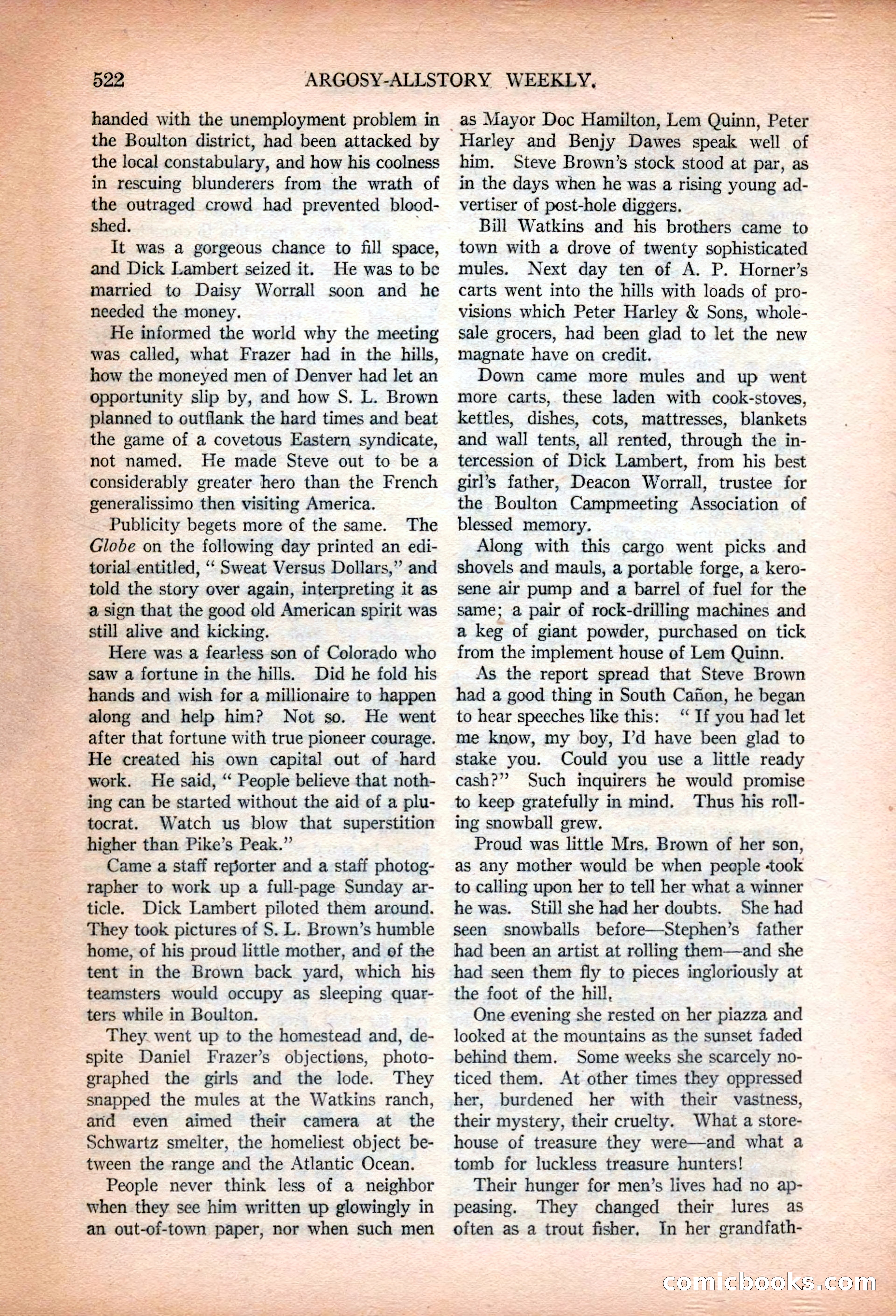
A restored page from Pulp Fiction, 1923. Page through the whole issue in the reader above.
📄 Transcribed text from this page (OCR, searchable)
Machine-transcribed from the original scan — historical spelling and the odd misread are preserved.
handed with the unemployment problem in the Boulton district, had been attacked by the local constabulary, and how his coolness in rescuing blunderers from the wrath of the outraged crowd had prevented blood- shed. It was a gorgeous chance to fill space, and Dick Lambert seized it. He was to be married to Daisy Worrall soon and he needed the money. He informed the world why the meeting was called, what Frazer had in the hills, how the moneyed men of Denver had let an opportunity slip by, and how S. L. Brown planned to outflank the hard times and beat the game of a covetous Eastern syndicate, not named. He made Steve out to be a considerably greater hero than the French generalissimo then visiting America. Publicity begets more of the same. The Globe on the following day printed an edi- torial entitled, ‘‘ Sweat Versus Dollars,” and told the story over again, interpreting it as a sign that the good old American spirit was still alive and kicking. Here was a fearless son of Colorado who saw a fortune in the hills. Did he fold his hands and wish for a millionaire to happen along and help him? Not so. He went after that fortune with true pioneer courage. He created his own capital out of -hard work. He said, “ People believe that noth- ing can be started without the aid of a plu- tocrat. Watch us blow that superstition higher than Pike’s Peak.” Came a staff reporter and a staff photog- rapher to work up a full-page Sunday ar- ticle. Dick Lambert piloted them around. They took pictures of S. L. Brown’s humble home, of his proud little mother, and of the tent in the Brown back yard, which his teamsters would occupy as sleeping quar- ters while in Boulton. They. went up to the homestead and, de- spite Daniel Frazer’s objections, photo- graphed the girls and the lode. They snapped the mules at the Watkins ranch, and even aimed their camera at the Schwartz smelter, the homeliest object be- tween the range and the Atlantic Ocean. People never think less of a neighbor when they see him written up glowingly in an out-of-town paper, nor when such men ARGOSY-ALLSTORY WEEKLY, _as Mayor Doc Hamilton, Lem Quinn, Peter Harley and Benjy Dawes speak well of him. Steve Brown’s stock stood at par, as in the days when he was a rising young ad- vertiser of post-hole diggers. Bill Watkins and his brothers came to town with a drove of twenty sophisticated mules. Next day ten of A. P. Horner’s carts went into the hills with loads of pro- visions which Peter Harley & Sons, whole- sale grocers, had been glad to let the new magnate have on credit. Down came more mules and up went more carts, these laden with cook-stoves, kettles, dishes, cots, mattresses, blankets and wall tents, all rented, through the in- tercession of Dick Lambert, from his best girl’s father, Deacon Worrall, trustee for the Boulton Campmeeting Association of blessed memory. Along with this cargo went picks and shovels and mauls, a portable forge, a kero- sene air pump and a barrel of fuel for the same; a pair of rock-drilling machines and a keg of giant powder, purchased on tick from the implement house of Lem Quinn. As the report spread that Steve Brown had a good thing in South Cafion, he began to hear speeches like this: ‘“‘ If you had let me know, my boy, I’d have been glad to stake you. Could you use a little ready cash?” Such inquirers he would promise to keep gratefully in mind. Thus his roll- ing snowball grew. Proud was little Mrs, Brown of her son, as any mother would be when people -took to calling upon her to tell her what a winner he was. Still she had her doubts. She had seen snowballs before—Stephen’s father had been an artist at rolling them—and she had seen them fly to pieces ingloriously at the foot of the hill, One evening she rested on her piazza and looked at the mountains as the sunset faded behind them. Some weeks she scarcely no- ticed them. At other times they oppressed her, burdened her with their vastness, their mystery, their cruelty. What a store- house of treasure they were—and what a tomb for luckless treasure hunters! Their hunger for men’s lives had no ap- peasing. They changed their lures as often as a trout fisher, In her grandfath- EOPMICLOOKS (E@)