
Pulp Fiction, 1922 · page 69 of 176
Argosy All-Story Weekly, December 2, 1922 — page 69: what you’re looking at
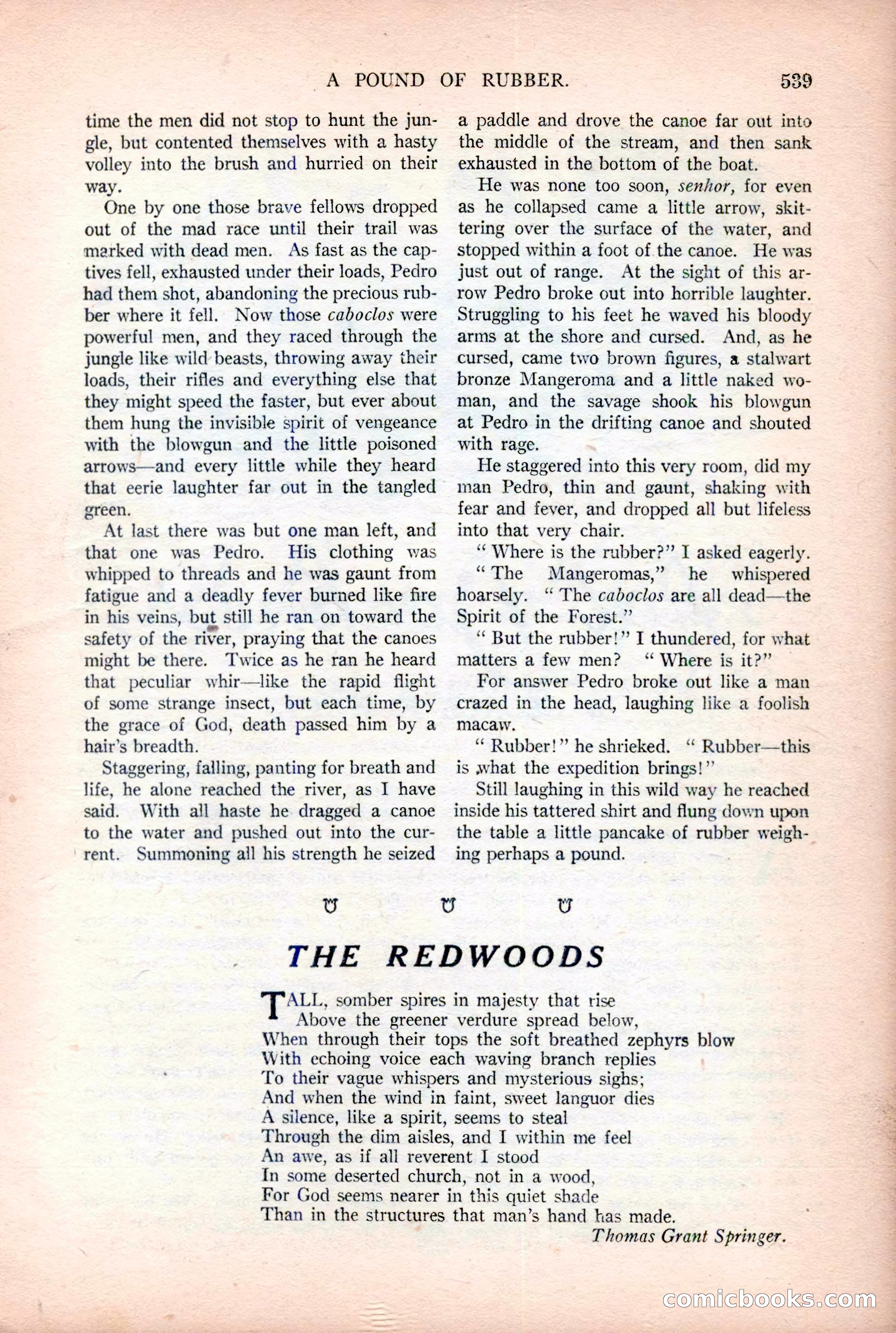
A restored page from Pulp Fiction, 1922. Page through the whole issue in the reader above.
📄 Transcribed text from this page (OCR, searchable)
Machine-transcribed from the original scan — historical spelling and the odd misread are preserved.
A POUND OF RUBBER. 539 time the men did not stop to hunt the jun- gle, but contented themselves with a hasty volley into the brush and hurried on their way. One by one those brave fellows dropped out of the mad race until their trail was marked with dead men. As fast as the cap- tives fell, exhausted under their loads, Pedro had them shot, abandoning the precious rub- ber where it fell. Now those caboclos were powerful men, and they raced through the jungle like wild beasts, throwing away their loads, their rifles and everything else that they might speed the faster, but ever about them hung the invisible spirit of vengeance with the blowgun and the little poisoned arrows—and every little while they heard that eerie laughter far out in the tangled green. At last there was but one man left, and that one was Pedro. His clothing was whipped to threads and he was gaunt from fatigue and a deadly fever burned like fire in his veins, but still he ran on toward the safety of the river, praying that the canoes might be there. Twice as he ran he heard that peculiar whir—like the rapid flight of some strange insect, but each time, by the grace of God, death passed him by a hair’s breadth. Staggering, falling, panting for breath and life, he alone reached the river, as I have said. With all haste he dragged a canoe to the water and pushed out into the cur- rent. Summoning all his strength he seized U a paddle and drove the canoe far out into the middle of the stream, and then sank exhausted in the bottom of the boat. He was none too soon, sexior, for even as he collapsed came a little arrow, skit- tering over the surface of the water, and stopped within a foot of the canoe. He was just out of range. At the sight of this ar- row Pedro broke out into horrible laughter. Struggling to his feet he waved his bloody arms at the shore and cursed. And, as he cursed, came two brown figures, a stalwart bronze Mangeroma and a little naked wo- man, and the savage shook his blowgun at Pedro in the drifting canoe and shouted with rage. He staggered into this very room, did my man Pedro, thin and gaunt, shaking with fear and fever, and dropped all but lifeless into that very chair. ‘‘ Where is the rubber?” I asked eagerly. “The Mangeromas,” he whispered hoarsely. “ The caboclos are all dead—the Spirit of the Forest.” ‘* But the rubber!” I thundered, for what matters a few men? ‘“ Where is it?” For answer Pedro broke out like a man crazed in the head, laughing like a foolish macaw. ‘““ Rubber!” he shrieked. “ Rubber—this is what the expedition brings!” Still laughing in this wild way he reached inside his tattered shirt and flung down upon the table a little pancake of rubber weigh- ing perhaps a pound. . U U THE REDWOODS ALL, somber spires in majesty that rise Above the greener verdure spread below, When through their tops the soft breathed zephyrs blow With echoing voice each waving branch replies To their vague whispers and mysterious sighs; And when the wind in faint, sweet languor dies A silence, like a spirit, seems to steal Through the dim aisles, and I within me feel An awe, as if all reverent I stood {n some deserted church, not in a wood, For God seems nearer in this quiet shade Than in the structures that man’s hand has made. Thomas Grant Springer. Gomichbooks;com ue - j 25 sy! ee: A Pad 4%.