
Pulp Fiction, 1922 · page 68 of 176
Argosy All-Story Weekly, December 2, 1922 — page 68: what you’re looking at
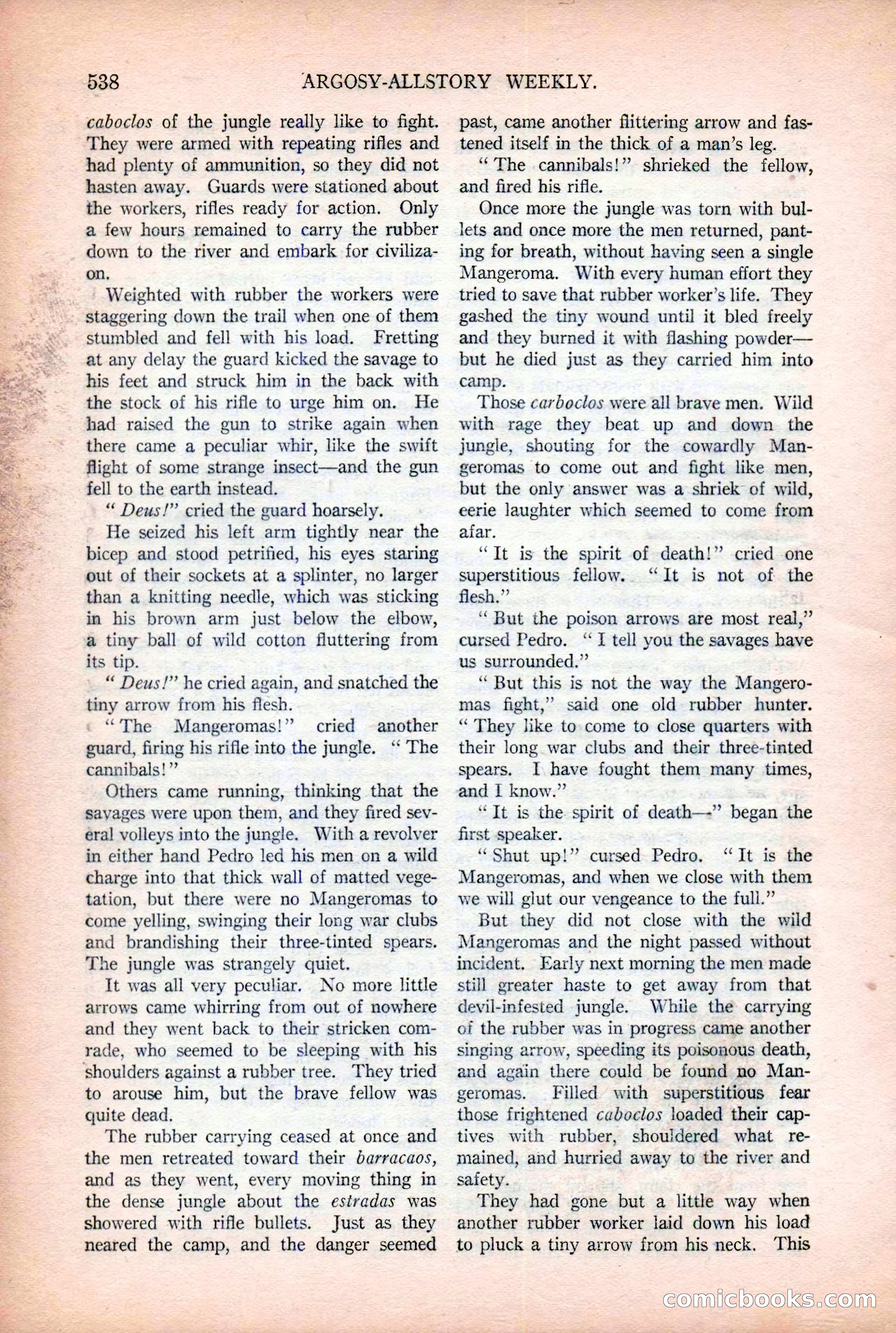
A restored page from Pulp Fiction, 1922. Page through the whole issue in the reader above.
📄 Transcribed text from this page (OCR, searchable)
Machine-transcribed from the original scan — historical spelling and the odd misread are preserved.
the y 5 ‘ Pay Fh iss . . Ppa + i/7 ee _. 2 a and fry sets o' 8 ~ Ae RE 2 fait Tu Re ot ‘hee vie” le oS ee y) ey us - Le Re “4 . We ks re Me St 5 ae 4 : sf " cys ‘ aR 7 538 caboclos of the jungle really like to fight. They were armed with repeating rifles and had plenty of ammunition, so they did not hasten away. (Guards were stationed about the workers, rifles ready for action. Only a few hours remained to carry the rubber down to the river and embark for civiliza- on, Weighted with rubber the workers were 3 staggering down the trail when one of them stumbled and fell with his load. Fretting at any delay the guard kicked the savage to his feet and struck him in the back with the stock of his rifle to urge him on. He had raised the gun to strike again when there came a peculiar whir, like the swift flight of some strange insect—and the gun fell to the earth instead. “ Deus!” cried the guard hoarsely. He seized his left arm tightly near the bicep and stood petrified, his eyes staring out of their sockets at a splinter, no larger than a knitting needle, which was sticking in his brown arm just below the elbow, a tiny ball of wild cotton fluttering from its tip. “ Deus!” he cried again, and snatched the tiny arrow from his flesh. “The Mangeromas!”’ cried another guard, firing his rifle into the jungle. “ The cannibals!” Others came running, thinking that the savages were upon them, and they fired sev- eral volleys into the jungle. With a revolver in either hand Pedro led his men on a wild charge into that thick wall of matted vege- tation, but there were no Mangeromas to come yelling, swinging their long war clubs and brandishing their three-tinted spears. The jungle was strangely quiet. It was all very peculiar. No more little arrows came whirring from out of nowhere and they went back to their stricken com- rade, who seemed to be sleeping with his shoulders against a rubber tree. They tried to arouse him, but the brave fellow was quite dead, The rubber carrying ceased at once and the men retreated toward their barracaos, and as they went, every moving thing in the dense jungle about the estradas was showered with rifle bullets. Just as they neared the camp, and the danger seemed ARGOSY-ALLSTORY WEEKLY. past, came another flitiering arrow and fas- tened itself in the thick of a man’s leg. “The cannibals!” shrieked the fellow, and fired his rifle. Once more the jungle was torn with bul- lets and once more the men returned, pant- ing for breath, without having seen a single Mangeroma. With every human effort they tried to save that rubber worker’s life. They gashed the tiny wound until it bled freely and they burned it with flashing powder— but he died just as they carried him into camp. Those carboclos were all brave men. Wild with rage they beat up and down the jungle, shouting for the cowardly Man- geromas to come out and fight like men, but the only answer was a shriek of wild, eerie laughter which seemed to come from afar. “Tt is the spirit of death!” cried one superstitious fellow. “It is not of the flesh.” ‘But the poison arrows are most real,” cursed Pedro. “I tell you the savages have us surrounded.” “But this is not the way the Mangero- mas fight,” said one old rubber hunter. “They like to come to close quarters with their long war clubs and their three-tinted spears. I have fought them many times, and I know.” “It is the. spirit of death—-” began the first speaker. “Shut up!” cursed Pedro. “It is the Mangeromas, and when we close with them we will glut our vengeance to the full.” But they did not close with the wild Mangeromas and the night passed without incident. Early next morning the men made still greater haste to get away from that devil-infested jungle. While the carrying of the rubber was in progress came another singing arrow, speeding its poisonous death, and again there could be found no Man- geromas. Filled with superstitious fear those frightened caboclos loaded their cap- tives with rubber, shouldered what re- mained, and hurried away to the river and safety. They had gone but a little way when another rubber worker laid down his load to pluck a tiny arrow from his neck. This Gomichooksreom ee ee ie Rit = eg