
Pulp Fiction, 1922 · page 14 of 176
Argosy All-Story Weekly, Vol. 146 No. 4 — page 14: what you’re looking at
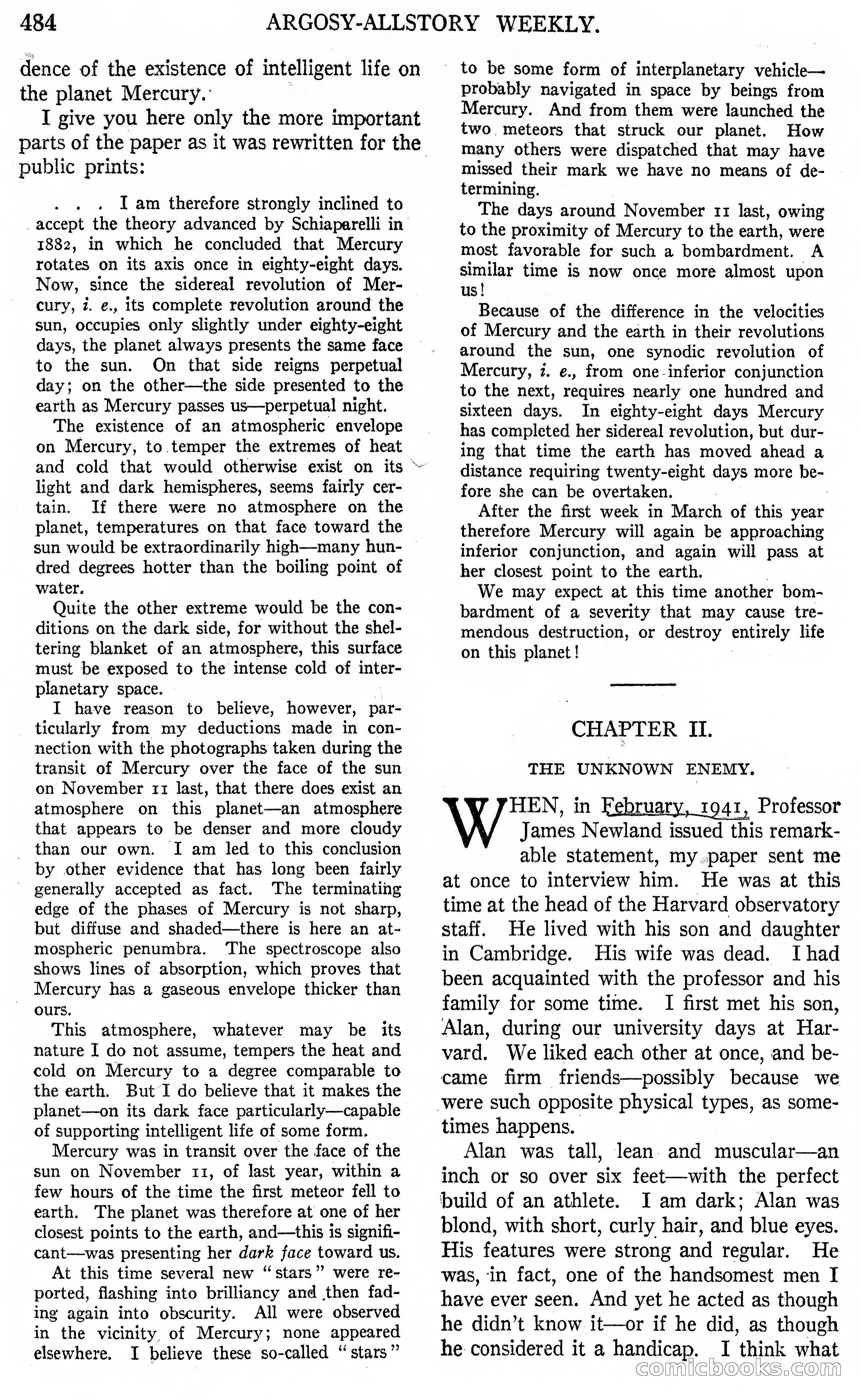
A restored page from Pulp Fiction, 1922. Page through the whole issue in the reader above.
📄 Transcribed text from this page (OCR, searchable)
Machine-transcribed from the original scan — historical spelling and the odd misread are preserved.
A484 dence of the existence of intelligent life on the planet Mercury.’ I give you here only the more important parts of the paper as it was rewritten for the public prints: I am therefore strongly inclined to dacepi the theory advanced by Schiaperelli in 1882, in which he concluded that Mercury rotates on its axis once in eighty-eight days. Now, since the sidereal revolution of Mer- cury, 7. e., its complete revolution around the sun, occupies only slightly under eighty-eight days, the planet always presents the same face to the sun. On that side reigns perpetual day; on the other—the side presented to the earth as Mercury passes us—perpetual night. The existence of an atmospheric envelope on Mercury, to.temper the extremes of heat and cold that would otherwise exist on its “ light and dark hemispheres, seems fairly cer- tain. If there were no atmosphere on the planet, temperatures on that face toward the sun would be extraordinarily high—many hun- — dred degrees hotter than the boiling point of water. Quite the other extreme would be the con- ditions on the dark side, for without the shel- tering blanket of an atmosphere, this surface must be exposed to the intense cold of inter- planetary space. I have reason to believe, however, par- ticularly from my deductions made in con- nection with the photographs taken during the transit of Mercury over the face of the sun on November 11 last, that there does exist an atmosphere on this planet—an atmosphere that appears to be denser and more cloudy than our own. I am led to this conclusion by other evidence that has long been fairly generally accepted as fact. The terminating edge of the phases of Mercury is not sharp, but diffuse and shaded—there is here an at- mospheric penumbra. ‘The spectroscope also shows lines of absorption, which proves that Mercury has a gaseous envelope thicker than ours. This atmosphere, whatever may be its nature I do not assume, tempers the heat and cold on Mercury to a degree comparable to the earth. But I do believe that it makes the planet—on its dark face particularly—capable of supporting intelligent life of some form. Mercury was in transit over the face of the sun on November 11, of last year, within a few hours of the time the first meteor fell to earth. The planet was therefore at one of her closest points to the earth, and—this is signifi- cant—was presenting her dark face toward us. At this time several new “stars” were re- ported, flashing into brilliancy and then fad- ing again into obscurity. All were observed in the vicinity, of Mercury; none appeared elsewhere. I believe these so-called “ stars ra puild of an athlete. ARGOSY-ALLSTORY WEEKLY. ' to be some form of interplanetary vehicle— probably navigated in space by beings from Mercury. And from them were launched the two, meteors that struck our planet. How many others were dispatched that may have missed their mark we have no means of de- termining. The days around November 11 last, owing to the proximity of Mercury to the earth, were most favorable for such a bombardment. A similar time is now once more almost upon us ! Because of the difference in the velocities of Mercury and the earth in their revolutions around the sun, one synodic revolution of Mercury, z. e., from one-inferior conjunction to the next, requires nearly one hundred and sixteen days. In eighty-eight days Mercury has completed her sidereal revolution, but dur- ing that time the earth has moved ahead a distance requiring twenty-eight days more be- fore she can be overtaken. : After the first week in March of this year therefore Mercury will again be approaching inferior conjunction, and again will pass at her closest point to the earth. We may expect at this time another bom- bardment of a severity that may cause tre- mendous destruction, or destroy entirely life on this planet! CHAPTER II. THE UNKNOWN ENEMY. HEN, in February, 1941, Professor James Newland issued this remark- able statement, my..paper sent me at once to interview him. He was at this time at the head of the Harvard observatory staff. He lived with his son and daughter in Cambridge. His wife was dead. I had been acquainted with the professor and his family for some time. I first met his son, Alan, during our university days at Har- vard. We liked each other at once, and be- came firm friends—possibly because we ‘were such opposite physical types, as some- times happens. Alan was tall, lean. and muscular—an inch or so over six feet—with the perfect I am dark; Alan was blond, with short, curly hair, and blue eyes. His features were strong and regular. He was, in fact, one of the handsomest men I have ever seen. And yet he acted as though he didn’t know it—or if he did, as though he considered it a handicap. I think what comiclbooks.com