
Pulp Fiction, 1922 · page 13 of 176
Argosy All-Story Weekly, Vol. 146 No. 4 — page 13: what you’re looking at
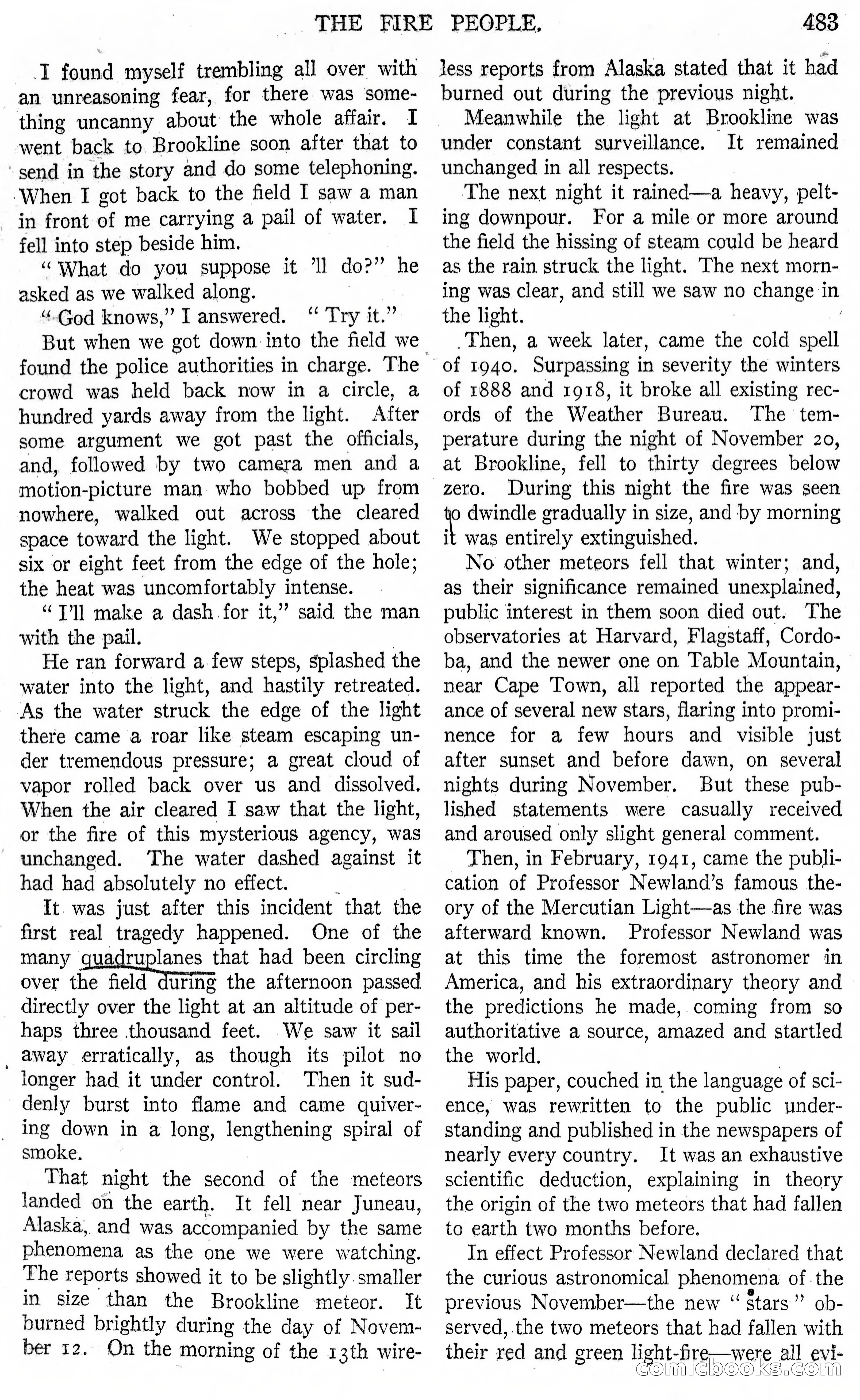
A restored page from Pulp Fiction, 1922. Page through the whole issue in the reader above.
📄 Transcribed text from this page (OCR, searchable)
Machine-transcribed from the original scan — historical spelling and the odd misread are preserved.
_ THE I found myself trembling all over with an unreasoning fear, for there was some- thing uncanny about the whole affair. I went back to Brookline soon after that to ‘send in the story and do some telephoning. ‘When I got back to the field I saw a man in front of me carrying a pail of water. I fell into step beside him. “What do you suppose it Il do?” he asked as we walked along. “.God knows,” I answered. ‘“ Try it.” But when we got down into the field we found the police authorities in charge. The crowd was held back now in a circle, a hundred yards away from the light. After some argument we got past the officials, and, followed by two camera men and a motion-picture man who bobbed up from nowhere, walked out across the cleared space toward the light. We stopped about six or eight feet from the edge of the hole; the heat was uncomfortably intense. “Tll make a dash.for it,” said the man with the pail. He ran forward a few steps, splashed the water into the light, and hastily retreated. As the water struck the edge of the light there came a roar like steam escaping un- der tremendous pressure; a great cloud of vapor rolled back over us and dissolved. When the air cleared I saw that the light, or the fire of this mysterious agency, was unchanged. ‘The water dashed against it had had absolutely no effect. It was just after this incident that the first real tragedy happened. One of the many guadruplanes that had been circling over the field during the afternoon passed _ directly over the light at an altitude of per- haps three thousand feet. We saw it sail _ away erratically, as though its pilot no longer had it under control. Then it sud- denly burst into flame and came quiver- ing down in a long, lengthening spiral of smoke. That night the second of the meteors landed on the earth. It fell near Juneau, Alaska, and was accompanied by the same phenomena as the one we were watching. The reports showed it to be slightly. smaller in size than the Brookline meteor. It burned brightly during the day of Novem- ber 12. On the morning of the 13th wire- FIRE Zero. PEOPLE, A83 less reports from Alaska stated that it had burned out during the previous night. Meanwhile the light at Brookline was under constant surveillance. It remained unchanged in all respects. The next night it rained—a heavy, pelt- ing downpour. For a mile or more around the field the hissing of steam could be heard as the rain struck the light. The next morn- ing was clear, and still we saw no change in the light. ( ‘Then, a week later, came the cold spell of 1940. Surpassing in severity the winters of 1888 and 1918, it broke all existing rec- ords of the Weather Bureau. The tem- perature during the night of November 20, at Brookline, fell to thirty degrees below During this night the fire was seen Mi dwindle gradually in size, and by morning it was entirely extinguished. No other meteors fell that winter; and, as their significance remained unexplained, public interest in them soon died out. The observatories at Harvard, Flagstaff, Cordo- ba, and the newer one on Table Mountain, near Cape Town, all reported the appear- ance of several new stars, flaring into promi- nence for a few hours and visible just after sunset and before dawn, on several nights during November. But these pub- lished statements were casually received and aroused only slight general comment. Then, in February, 1941, came the publi- cation of Professor Newland’s famous the- ory of the Mercutian Light—as the fire was afterward known. Professor Newland was at this time the foremost astronomer in America, and his extraordinary theory and the predictions he made, coming from so authoritative a source, amazed and startled the world. | Flis paper, couched in the language of sci- ence, was rewritten to the public under- standing and published in the newspapers of nearly every country. It was an exhaustive scientific deduction, explaining in theory the origin of the two meteors that had fallen to earth two months before. In effect Professor Newland declared that the curious astronomical phenomena ofthe previous November—the new “ Stars” ob- served, the two meteors that had fallen with their red and green light-Dre—were all evi- On