
Pulp Fiction, 1922 · page 125 of 176
Argosy All-Story Weekly, Vol. 146 No. 4 — page 125: what you’re looking at
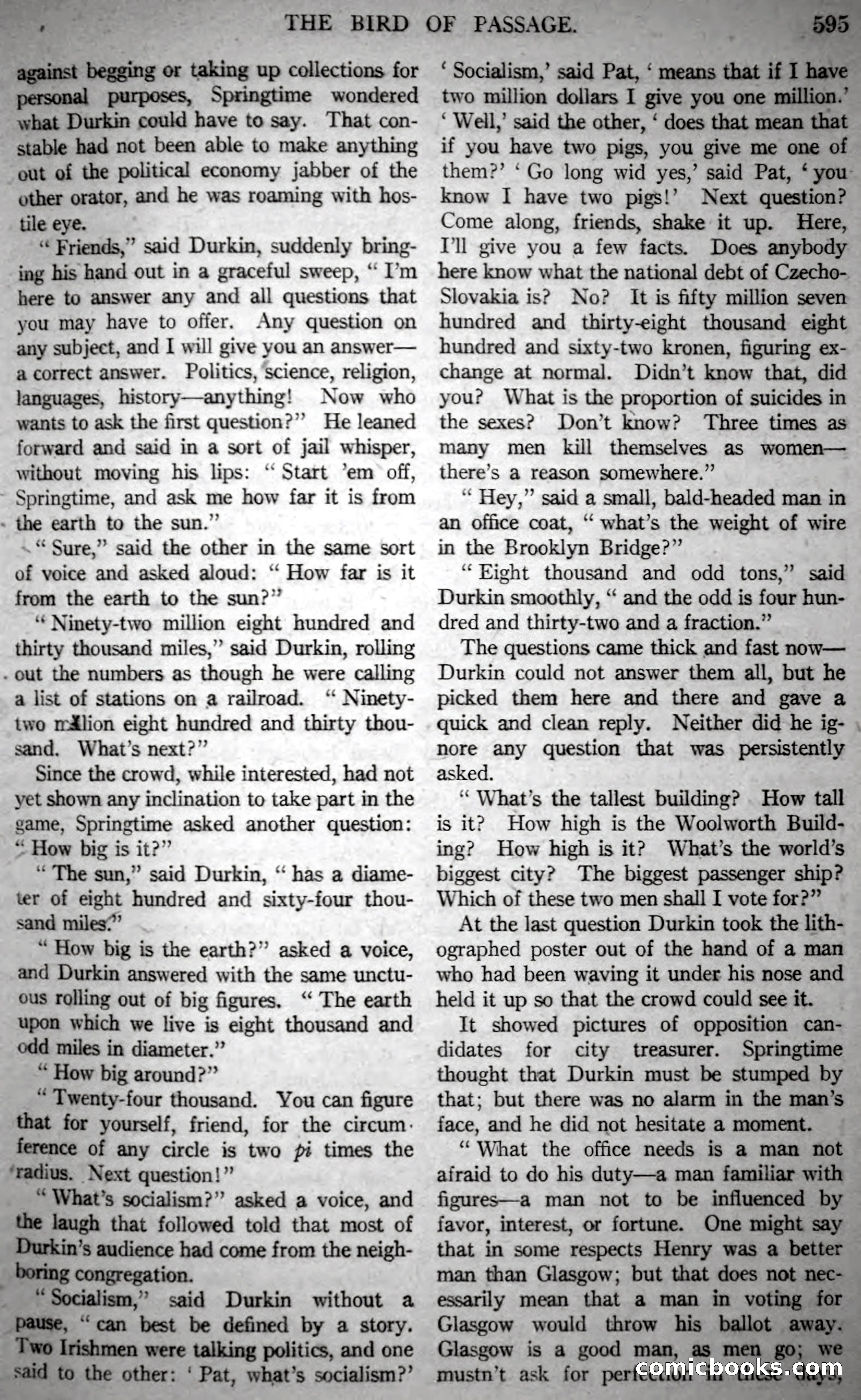
A restored page from Pulp Fiction, 1922. Page through the whole issue in the reader above.
📄 Transcribed text from this page (OCR, searchable)
Machine-transcribed from the original scan — historical spelling and the odd misread are preserved.
cai begging or taking up collections for personal purposes, Springtime wondered what Durkin could have to say. That con- stable had not been able to make anything out of the political economy jabber of the other orator, and he was roaming with hos- tile eye. “ Friends,” said Durkin, suddenly bring- ing his hand out in a graceful sweep, “ I’m here to answer any and all questions that you may have to offer. Any question on any subject, and I will give you an answer— a correct answer. Politics, ‘science, religion, languages, history—anything! Now who wants to ask the first question?’’ He leaned forward and said in a sort of jail whisper, without moving his lips: “Start ‘em off, Springtime, and ask me how far it is from - the earth to the sun.”’ ~“ Sure,” said the other in the same sort of voice and asked aloud: “ How far is it from the earth to the sun?” “ Ninety-two million eight hundred and thirty thousand miles,” said Durkin, rolling . out the numbers as though he were calling a list of stations on a railroad. “ Ninety- two malion eight hundred and thirty thou- sand. What’s next?” Since the crowd, while interested, had not yet shown any inclination to take part in the game, Springtime asked another question: * How big is it?” “ The sun,” said Durkin, “ has a diame- ter of eight hundred and sixty-four thou- sand miles”” ~ How big is the earth?” asked a voice, and Durkin answered with the same unctu- ous rolling out of big figures. ‘“ The earth upon which we live is eight thousand and odd miles in diameter.” “ How big around?” “ Twenty-four thousand. You can figure that for yourself, friend, for the circum. ference of any circle is two pi times the ‘radius. Next question!” “ What’s socialism?” asked a voice, and the laugh that followed told that most of -Durkin’s audience had come from the neigh- ee eereention. “Socialism,” said Durkin without a “can best be defined by a story. 0 Irishmen were talking politics, and one “silt the other: ‘ Pat, what’s socialism?’ THE BIRD OF PASSAGE. two million dollars I give you one million - ‘Well,’ said the other, ‘ does that mean that if you have two pigs, you give me one of them?’ ‘Go long wid yes,’ said Pat, ‘ you know I have two pigs!’ Next question? Come along, friends, shake it up. Here, I'll give you a few facts. Does anybody here know what the national debt of Czecho- Slovakia is? No? It is fifty million seven hundred and thirty-eight thousand eight hundred and sixty-two kronen, figuring ex- change at normal. Didn’t know that, did you? What is the proportion of suicides in the sexes? Don’t know? Three times as many men kill themselves as women— there’s a reason somewhere.” ‘ Hey,” said a small, bald-headed man in an office coat, “ what’s the weight of wire in the Brooklyn Bridge?” “Eight thousand and odd tons,” said Durkin smoothly, “ and the odd is four hun- dred and thirty-two and a fraction.” The questions came thick and fast now— Durkin could not answer them all, but he picked them here and there and gave a quick and clean reply. Neither did he ig- , nore any question that was persistently asked. ‘“What’s the tallest building? How tall is it? How high is the Woolworth Build- ing? How high is it? What’s the world’s biggest city? The biggest passenger ship? Which of these two men shall I vote for?” At the last question Durkin took the lith- ographed poster out of the hand of a man who had been waving it under his nose and held it up so that the crowd could see it. It showed pictures of opposition can- didates for city treasurer. S thought that Durkin must be stumped by that; but there was no alarm in the man’s face, and he did not hesitate a moment. — “ What the office needs is a man not afraid to do his duty—a man familiar with — figures—a man not to be influenced by © favor, interest, or fortune. One might say that in some respects Henry was a better man than Glasgow; but that does net nec- essarily mean that a man in otin : for Glasgow would throw his ballot away. Glasgow is a good man, as men go; ¥ mustn’t ask for perfocdihi 4 Book ks,