
Pulp Fiction, 1922 · page 124 of 176
Argosy All-Story Weekly, Vol. 146 No. 4 — page 124: what you’re looking at
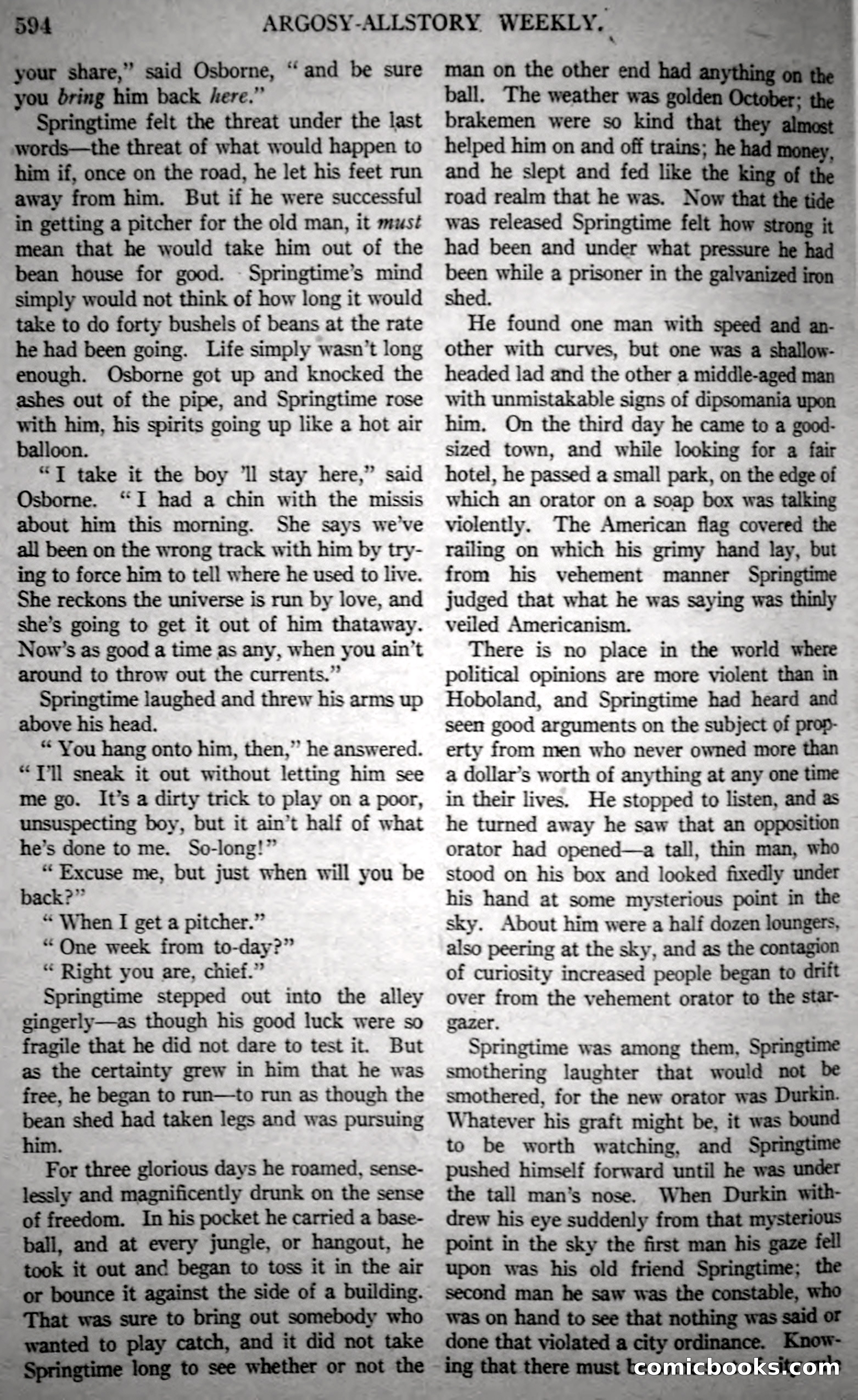
A restored page from Pulp Fiction, 1922. Page through the whole issue in the reader above.
📄 Transcribed text from this page (OCR, searchable)
Machine-transcribed from the original scan — historical spelling and the odd misread are preserved.
“J Bring him back here ” oringtime felt the threat under the last _words—the threat of what would happen to him if, once on the road, he let his feet run away from him. But if he were successful in getting a pitcher for the old man, it must mean that he would take him out of the bean house for good. Springtime’s mind simply would not think of how long it would take to do forty bushels of beans at the rate he had been going. Life simply wasn’t long enough. Osborne got up and knocked the ashes out of the pipe, and Springtime rose with him, his spirits going up like a hot air balloon. “I take it the boy ‘ll stay here,” said Osborne. “I had a chin with the missis about him this morning. She says we’ve all been on the wrong track with him by try- ing to force him to tell where he used to live. She reckons the universe is run by love, and she’s going to get it out of him thataway. Now’s as good a time as any, when you ain’t around to throw out the currents.” Springtime laughed and threw his arms up above his head. * You hang onto him, then,” he answered. “Tl sneak it out without letting him see me go. It’s a dirty trick to play on a poor, unsuspecting boy, but it ain’t half of what he’s done to me. So-long!” “Excuse me, but just when will you be back?” “ When I get a pitcher.” “One week from to-day?” ** Right you are, chief.” Springtime stepped out into the alley gingerly—as though his good luck were so fragile that he did not dare to test it. But as the certainty grew in him that he was free, he began to run—to run as though the bean shed had taken legs and was pursuing him. For three glorious days he roamed, sense- lessly and magnificently drunk on the sense _ of freedom. In his pocket he carried a base- Sede ee oer jungle, or hangout, he helped him on and off trains; he had money. and he slept and fed like the king of th road realm that he was. Now that # had been and under what pressure he had been while a prisoner in the galvanized iron shed. He found one man with speed ant tes other with curves, but one was a shallow- headed lad and the other a middle-aged man with unmistakable signs of dipsomania upon him. On the third day he came to a good- sized town, and while looking for a fair hotel, he passed a small park, on the edge of which an orator on a soap box was talking violently. The American flag covered the railing on which his grimy hand lay, but from his vehement manner i judged that what he was saying was thinly veiled Americanism. There is no place in the world where political opinions are more violent than in Hoboland, and Springtime had heard and seen good arguments on the subject of prop- erty from men who never owned more than a dollar’s worth of anything at any one time in their lives. He stopped to listen, and as he turned away he saw that an opposition orator had opened—a tall, thin man, who stood on his box and looked fixedly under his hand at some mysterious point in the sky. About him were a half dozen loungers, also peering at the sky, and as the contagion of curiosity increased people began to drift over from the vehement orator to the star- gazer. Springtime was among them, Springtime smothering laughter that would not be smothered, for the new orator was Durkin. Whatever his graft might be, it was bound to be worth watching, and Springtime pushed himself forward until he was under the tall man’s nose. When Durkin with- drew his eye suddenly from that my: point in the sky the first man n bie we | fell