
Pulp Fiction, 1920 · page 116 of 208
Argosy All-Story Weekly — "The Purple Limited" — page 116: what you’re looking at
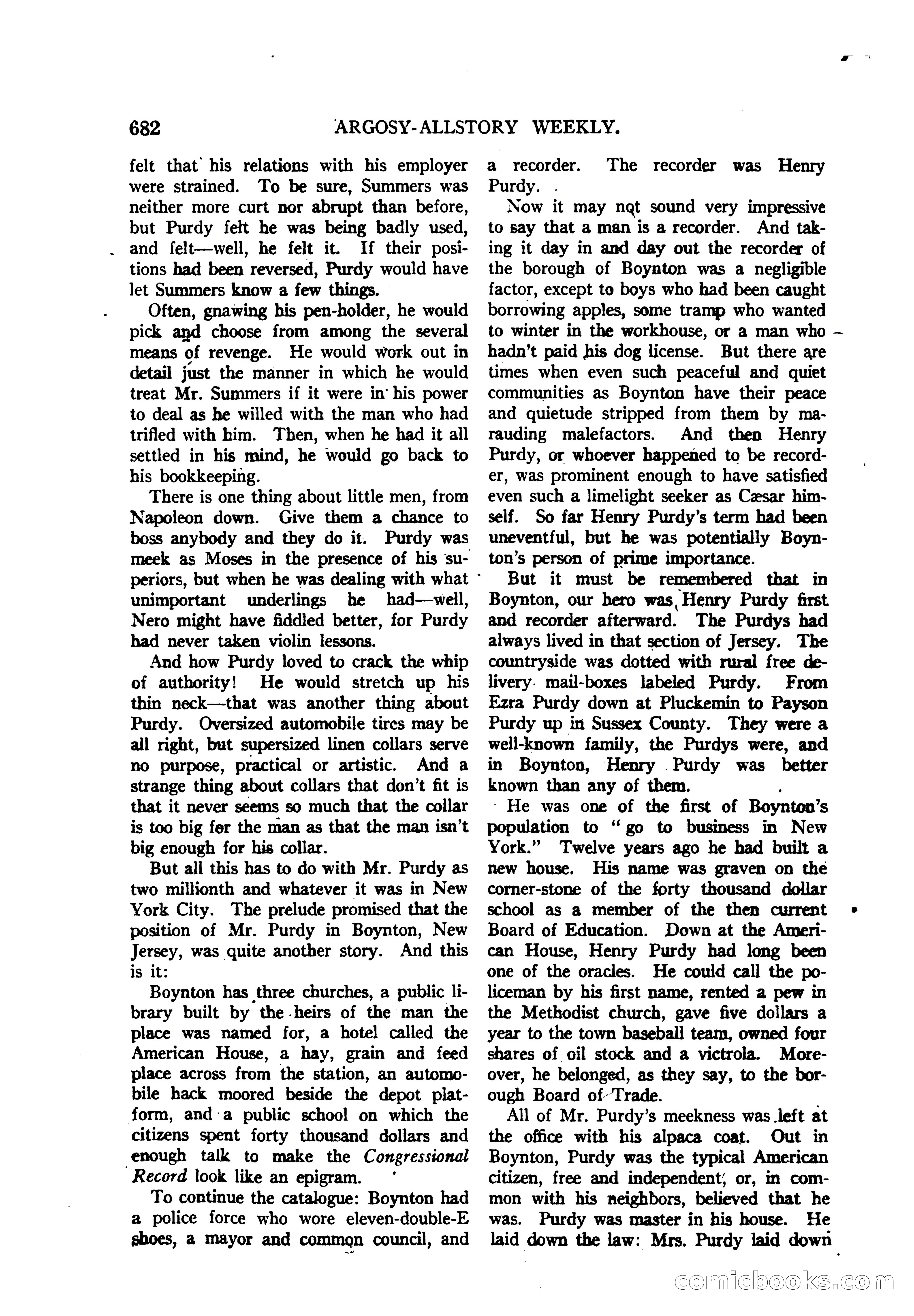
A restored page from Pulp Fiction, 1920. Page through the whole issue in the reader above.
📄 Transcribed text from this page (OCR, searchable)
Machine-transcribed from the original scan — historical spelling and the odd misread are preserved.
_ and felt—well, he felt it. 682 felt that his relations with his employer were strained. To be sure, Summers was neither more curt nor abrupt than before, but Purdy fett he was being badly used, If their posi- tions had been reversed, Purdy would have let Summers know a few things. Often, gnawing his pen-holder, he would pick and choose from among the several means of revenge. He would work out in detail just the manner in which he would treat Mr. Summers if it were in’ his power to deal as he willed with the man who had trifled with him. Then, when he had it all settled in his mind, he would go back to his bookkeeping. There is one thing about little men, from Napoleon down. Give them a chance to boss anybody and they do it. Purdy was meek as Moses in the presence of his su- periors, but when he was dealing with what ~ unimportant underlings he had—well, Nero might have fiddled better, for Purdy had never taken violin lessons. And how Purdy loved to crack the whip of authority! He would stretch up his thin neck—that was another thing about Purdy. Oversized automobile tires may be all right, but supersized linen collars serve no purpose, practical or artistic. And a strange thing about collars that don’t fit is that it never seems so much that the collar is too big fer the man as that the man isn’t big enough for his collar. But all this has to do with Mr. Purdy as two millionth and whatever it was in New York City. The prelude promised that the position of Mr. Purdy in Boynton, New Jersey, was quite another story. And this is it: Boynton has three churches, a public li- brary built by the heirs of the man the place was named for, a hotel called the American House, a hay, grain and feed place across from the station, an automo- bile hack moored beside the depot plat- form, and-a public school on which the citizens spent forty thousand dollars and enough talk to make the Congressional Record look like an epigram. To continue the catalogue: Boynton had a police force who wore eleven-double-E shoes, a mayor and common council, and ARGOSY-ALLSTORY WEEKLY. a recorder. Purdy. Now it may nat sound very impressive to say that a man is a recorder. And tak- ing it day in and day out the recorder of the borough of Boynton was a negligible factor, except to boys who had been caught borrowing apples, some tramp who wanted to winter in the workhouse, or a man who hadn’t paid his dog license. But there are times when even such peaceful and quiet communities as Boynton have their peace and quietude stripped from them by ma- rauding malefactors: And then Henry Purdy, or whoever happened to be record- er, was prominent enough to have satisfied even such a limelight seeker as Cesar him- self. So far Henry Purdy’s term had been uneventful, but he was potentially Boyn- ton’s person of prime importance. But it must be remembered that in Boynton, our hero was, Henry Purdy first and recorder afterward. The Purdys had always lived in that section of Jersey. The countryside was dotted with rural free de- livery. mail-boxes labeled Purdy. From Ezra Purdy down at Pluckemin to Payson Purdy up in Sussex County. They were a well-known family, the Purdys were, and in Boynton, Henry Purdy was better known than any of them. - He was one of the first of Boynton’s population to “go to business in New York.” Twelve years ago he had built a new house. His name was graven on the corner-stone of the forty thousand dollar school as a member of the then current Board of Education. Down at the Ameri- can House, Henry Purdy had long been one of the oracles. He could call the po- liceman by his first name, rented a pew in the Methodist church, gave five dollars a year to the town baseball team, owned four shares of oil stock and a victrola. More- over, he belonged, as they say, to the bor- ough Board of-’Trade. All of Mr. Purdy’s meekness was left at the office with his alpaca coat. Out in Boynton, Purdy was the typical American citizen, free and independent, or, in com- mon with his neighbors, believed that he was. Purdy was master in his house. He The recorder was Henry laid down the law: Mrs. Purdy laid down 6)(0)©) MG (C(O) S (C(O)