
Pulp Fiction, 1920 · page 115 of 208
Argosy All-Story Weekly — "The Purple Limited" — page 115: what you’re looking at
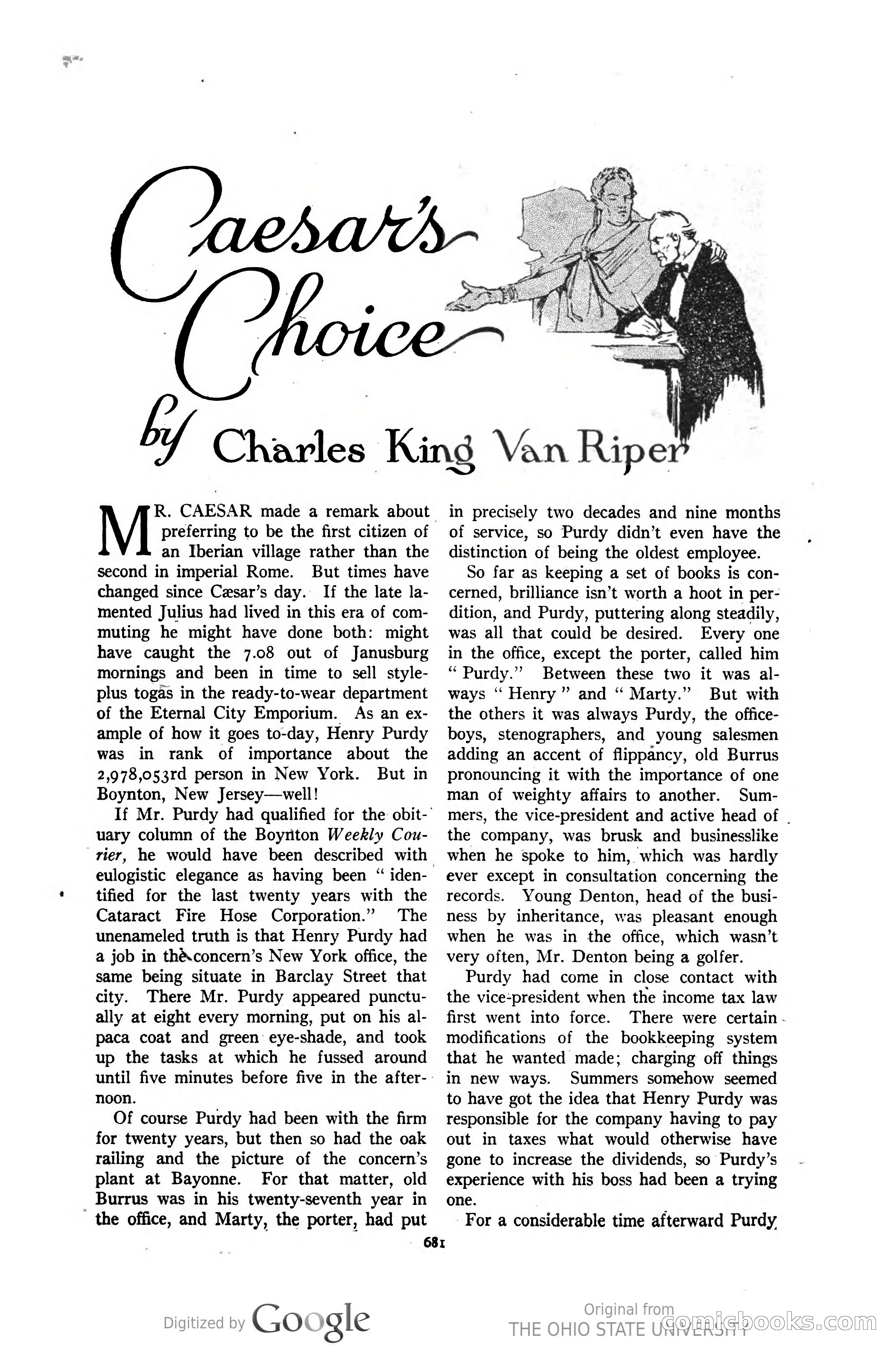
A restored page from Pulp Fiction, 1920. Page through the whole issue in the reader above.
📄 Transcribed text from this page (OCR, searchable)
Machine-transcribed from the original scan — historical spelling and the odd misread are preserved.
R. CAESAR made a remark about MI preferring to be the first citizen of an Iberian village rather than the Second in imperial Rome. But times have changed since Cesar’s day. If the late la- mented Julius had lived in this era of com- muting he might have done both: might have caught the 7.08 out of Janusburg mornings and been in time to sell style- plus togas in the ready-to-wear department of the Eternal City Emporium. As an ex- ample of how it goes to-day, Henry Purdy was in rank of importance about the 2,978,053rd person in New York. But in Boynton, New Jersey—well! If Mr. Purdy had qualified for the obit- uary column of the Boynton Weekly Cou- rier, he would have been described with ce eulogistic elegance as having been “ iden- tified for the last twenty years with the Cataract Fire Hose Corporation.” The unenameled truth is that Henry Purdy had a job in thé&\concern’s New York office, the same being situate in Barclay Street that city. There Mr. Purdy appeared punctu- ally at eight every morning, put on his al- paca coat and green eye-shade, and took up the tasks at which he fussed around until five minutes before five in the after-- noon. Of course Purdy had been with the firm for twenty years, but then so had the oak railing and the picture of the concern’s plant at Bayonne. For that matter, old Burrus was in his twenty-seventh year in _ the office, and Marty, the porter, had put 681 in precisely two decades and nine months of service, so Purdy didn’t even have the distinction of being the oldest employee. So far as keeping a set of books is con- cerned, brilliance isn’t worth a hoot in per- dition, and Purdy, puttering along steadily, was all that could be desired. Every one in the office, except the porter, called him “ Purdy.”’ Between these two it was al- ways “ Henry” and “ Marty.” But with the others it was always Purdy, the office- boys, stenographers, and young salesmen adding an accent of flippancy, old Burrus pronouncing it with the importance of one man of weighty affairs to another. Sum- mers, the vice-president and active head of . the company, was brusk and _ businesslike when he spoke to him, which was hardly ever except in consultation concerning the records. Young Denton, head of the busi- ness by inheritance, was pleasant enough when he was in the office, which wasn’t very often, Mr. Denton being a golfer. Purdy had come in close contact with the vice-president when the income tax law first went into force. There were certain - modifications of the bookkeeping system that he wanted made; charging off things in new ways. Summers somehow seemed to have got the idea that Henry Purdy was responsible for the company having to pay out in taxes what would otherwise have gone to increase the dividends, so Purdy’s experience with his boss had been a trying one. | For a considerable time afterward Purdy 0)(0)©) S CONN