
Pulp Fiction, 1920 · page 146 of 160
Argosy, Vol. 120, No. 1 — page 146: what you’re looking at
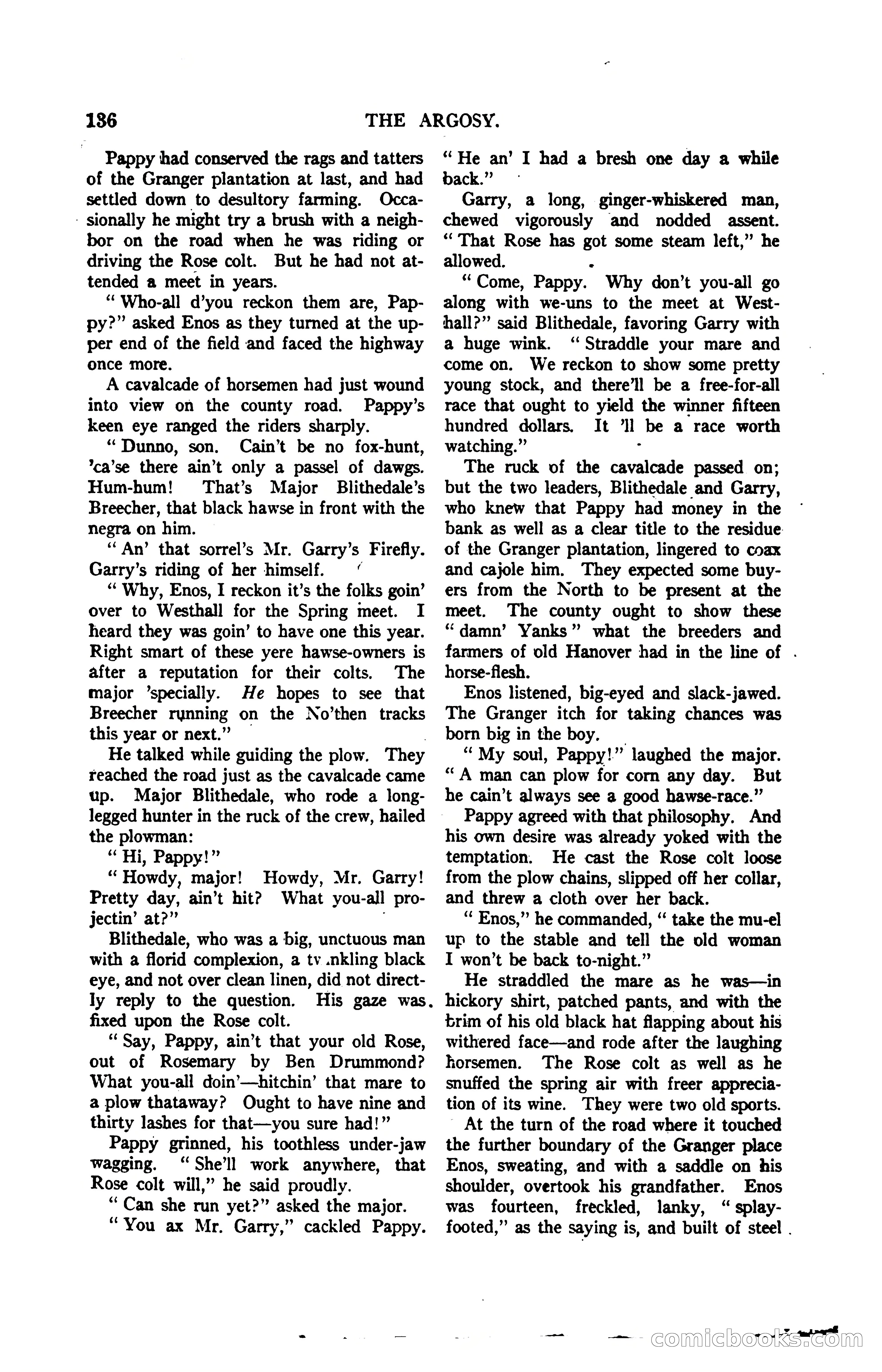
A restored page from Pulp Fiction, 1920. Page through the whole issue in the reader above.
📄 Transcribed text from this page (OCR, searchable)
Machine-transcribed from the original scan — historical spelling and the odd misread are preserved.
136 THE ARGOSY. Pappy had conserved the rags and tatters of the Granger plantation at last, and had settled down to desultory farming. Occa- - sionally he might try a brush with a neigh- bor on the road when he was riding or driving the Rose colt. But he had not at- tended a meet in years. “'Who-all d’you reckon them are, Pap- py?” asked Enos as they turned at the up- per end of the field and faced the highway once more. A cavalcade of horsemen had just wound into view on the county road. Pappy’s keen eye ranged the riders sharply. “Dunno, son. Cain’t be no fox-hunt, ’ca’se there ain’t only a passel of dawgs. Hum-hum! That’s Major Blithedale’s Breecher, that black hawse in front with the negra on him. ‘An’ that sorrel’s Mr. Garry’s Firefly. Garry’s riding of her himself. “Why, Enos, I reckon it’s the folks goin’ over to Westhall for the Spring meet. I heard they was goin’ to have one this year. Right smart of these yere hawse-owners is after a reputation for their colts. The major ’specially. He hopes to see that Breecher running on the No’then tracks this year or next.” He talked while guiding the plow. They reached the road just as the cavalcade came up. Major Blithedale, who rode a long- legged hunter in the ruck of the crew, hailed ~ the plowman: ““ Howdy, major! Pretty day, ain’t hit? jectin’ at?” Blithedale, who was a big, unctuous man with a florid complexion, a tv .nkling black eye, and not over clean linen, did not direct- ly reply to the question. fixed upon the Rose colt. “Say, Pappy, ain’t that your old Rose, out of Rosemary by Ben Drummond? What you-all doin’—hitchin’ that mare to a plow thataway? Ought to have nine and thirty lashes for that—you sure had!” Pappy grinned, his toothless under-jaw wagging. “Shell work anywhere, that Rose colt will,” he said proudly. “Can she run yet?” asked the major. “ You ax Mr. Garry,” cackled Pappy. Howdy, Mr. Garry! What you-all pro- His gaze was. “He an’ I had a bresh one day a while back.” Garry, a long, ginger-whiskered man, chewed vigorously and nodded assent. “That Rose has got some steam left,’”’ he allowed. ** Come, Pappy. Why don’t you-all go along with we-uns to the meet at West- hall?” said Blithedale, favoring Garry with a huge wink. ‘“ Straddle your mare and come on. We reckon to show some pretty young stock, and there’ll be a free-for-all race that ought to yield the winner fifteen hundred dollars. It os be a race worth watching.” The ruck of the cavalcade passed on; but the two leaders, Blithedale and Garry, who knew that Pappy had money in the bank as well as a clear title to the residue. of the Granger plantation, lingered to coax and cajole him. They expected some buy- ers from the North to be present at the meet. The county ought to show these ‘damn’ Yanks” what the breeders and farmers of old Hanover had in the line of . horse-flesh. Enos listened, big-eyed and slack-jawed. The Granger itch for taking chances was born big in the boy. ‘“* My soul, Pappy!” laughed the major. “ A man can plow for corn any day. But he cain’t always see a good hawse-race.”’ Pappy agreed with that philosophy. And his own desire was already yoked with the temptation. He cast the Rose colt loose from the plow chains, slipped off her collar, and threw a cloth over her back. ‘“ Enos,” he commanded, “ take the mu-el up to the stable and tell the old woman I won’t be back to-night.” He straddled the mare as he was—in hickory shirt, patched pants, and with the brim of his old black hat flapping about his withered face—and rode after the laughing horsemen. The Rose colt as well as he snuffed the spring air with freer apprecia- tion of its wine. They were two old sports. _ At the turn of the road where it touched the further boundary of the Granger place Enos, sweating, and with a saddle on his shoulder, overtook his grandfather. Enos was fourteen, freckled, lanky, “ splay- footed,” as the saying is, and built of steel . _ — - COIN @ DOOKSTEO