
Pulp Fiction, 1920 · page 76 of 160
Argosy, Vol. 119, No. 2 — page 76: what you’re looking at
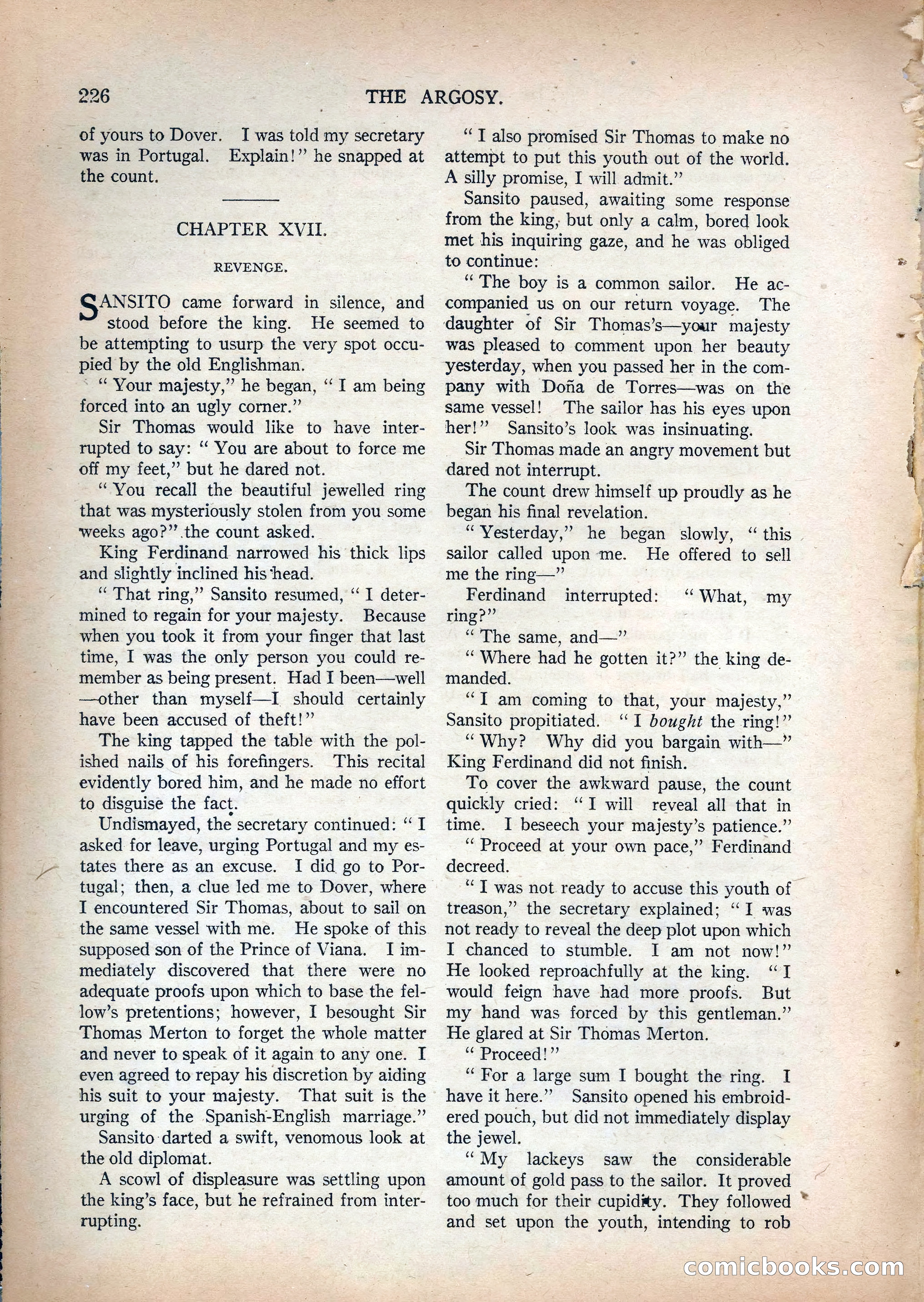
A restored page from Pulp Fiction, 1920. Page through the whole issue in the reader above.
📄 Transcribed text from this page (OCR, searchable)
Machine-transcribed from the original scan — historical spelling and the odd misread are preserved.
wre ais ee OO ee oh as Bae ; : ee ee er ee eee NM ee ee TRO ep Sk NT eye Me ‘5 . ‘ ‘ Pi bsy ils H . 226 _ THE ARGOSY. I was told my secretary Explain!’ he snapped at of yours to Dover. was in Portugal. the count. CHAPTER XVIL. REVENGE. ANSITO came forward in silence, and stood before the king. He seemed to be attempting to usurp the very spot occu- pied by the old Englishman. ~ “ Your majesty,” he began, ‘“ I am being forced into an ugly corner.”’ Sir Thomas would like to have inter- rupted to say: “ You are about to force me off my feet,” but he dared not. “You recall the beautiful jewelled ring that was mysteriously stolen from you some weeks ago?’’ the count asked. King Ferdinand narrowed his thick lips and slightly inclined his ‘head. ‘That ring,’ when you took it from your finger that last time, I was the only person you could re- member as being present. Had I been—vwell -—other than myself—I should certainly have been accused of theft!” The king tapped the table with the pol- ished nails of his forefingers. This recital evidently bored him, and “he made no effort to disguise the fact. Undismayed, the secretary continued: “I asked for leave, urging Portugal and my es- tates there as an excuse. I did go to Por- tugal; then, a clue led me to Dover, where I encountered Sir Thomas, about to sail on the same vessel with me. He spoke of this supposed son of the Prince of Viana. I im- mediately discovered that there were no adequate proofs upon which to base the fel- low’s pretentions; however, I besought Sir Thomas Merton to forget the whole matter and never to speak of it again to any one. I even agreed to repay his discretion by aiding his suit to your majesty. That suit is the urging of the Spanish-English marriage.” Sansito darted a swift, venomous look at the old diplomat. A scowl of displeasure was settling upon the king’s face, but he refrained from inter- rupting. * Sansito resumed, ‘‘ I deter- mined to regain for your majesty. Because “T also promised Sir Thomas to make no attempt to put this youth out of the world. A silly promise, I will admit.” Sansito paused, awaiting some response from the king, but only a calm, bored look met his inquiring gaze, and he was obliged to continue: “The boy is a common sailor. companied us on our return voyage. He ac- The daughter of Sir Thomas’s—your majesty was pleased to comment upon her beauty yesterday, when you passed her in the com- pany with Dona de Torres—was on the same vessel! The sailor has his eyes upon her!” Sansito’s look was insinuating. _ Sir Thomas made an angry movement but dared not interrupt. The count drew himself up proudly as he began his final revelation. “Yesterday,” he began slowly, “ sie sailor called upon ‘me. me the ring—”’ Ferdinand ring?” “The same, , and—” “Where had he gotten it?” the king de- manded. “I am coming to that, your majesty,” Sansito propitiated. ‘I bought the ring!”’ “Why? Why did you bargain ithe” King Ferdinand did not finish. To cover the awkward pause, the count quickly cried: ‘I will reveal all that in time. I beseech your majesty’s patience.” He offered to sell interrupted: ‘What, my ‘Proceed at your own pan ” Ferdinand decreed. ‘““T was not ready to accuse this youth of © treason,” the secretary explained; ‘“‘ I was not ready to reveal the deep plot upon which I chanced to stumble. I am not now!” He looked reproachfully at the king. “I would feign have had more proofs. But my hand was forced by this gentleman.”’ He glared at Sir Thomas Merton. “Proceed! ”’ “For a large sum I bought the ring. I have it here.”” Sansito opened his embroid- ered pouch, but did not immediately display the jewel. | “My lackeys saw the considerable amount of gold pass to the sailor. It proved too much for their cupidtty. They followed and set upon the youth, intending to rob : Eomichboo (€(©) m