
Pulp Fiction, 1920 · page 75 of 160
Argosy, Vol. 119, No. 2 — page 75: what you’re looking at
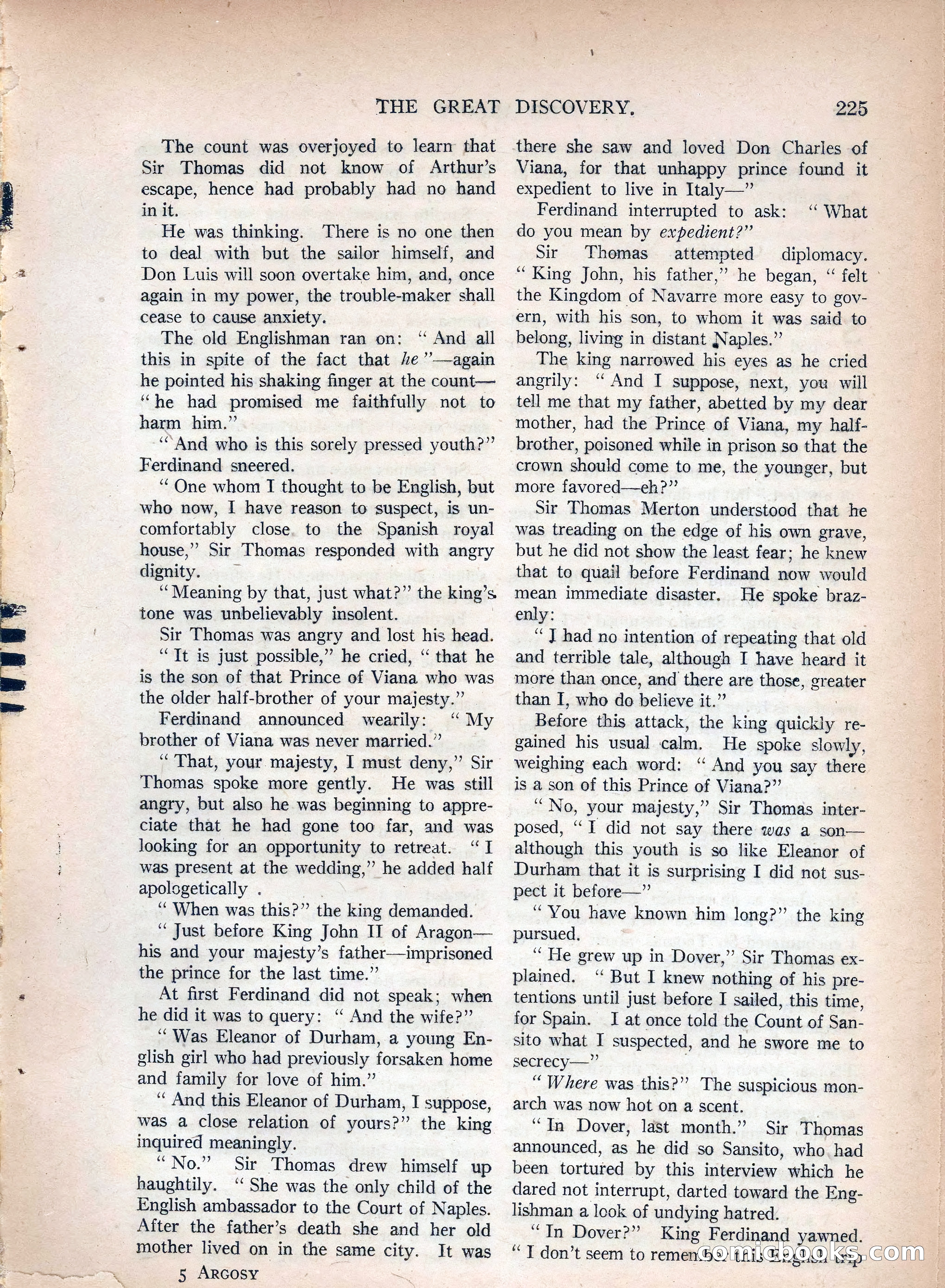
A restored page from Pulp Fiction, 1920. Page through the whole issue in the reader above.
📄 Transcribed text from this page (OCR, searchable)
Machine-transcribed from the original scan — historical spelling and the odd misread are preserved.
i J THE GREAT The count was overjoyed to learn that Sir Thomas did not know of Arthur’s escape, hence had probably had no hand in it. He was thinking. There is no one then to deal with but the sailor himself, and Don Luis will soon overtake him, and, once again in my power, the trouble-maker shall cease to cause anxiety. The old Englishman ran on: “ And all this in spite of the fact that /e ’’—again he pointed his shaking finger at the count— “he had promised me faithfully not to harm him.” -““And who is this sorely pressed youth?”’ Ferdinand sneered. “One whom I thought to be English, but who now, I have reason to suspect, is un- comfortably. close. to the Spanish royal house,” Sir Thomas responded with angry dignity. ‘“Meaning by that, just what?” the king's S tone was unbelievably insolent. Sir Thomas was angry and lost his head. ‘Tt is just possible,” he cried, “‘ that he is the son of that Prince of Viana who was the older half-brother of your majesty.” Ferdinand announced wearily: “ My brother of Viana was never married.” ‘That, your majesty, I must deny,” Sir Thomas spoke more gently. He was still angry, but also he was beginning to appre- ciate that he had gone too far, and was looking for an opportunity to retreat. “I was present at the wedding,” he added half apologetically . “ When was this?” the king demanded. ‘Just before King John IT of Aragon— his and your majesty’s father—imprisoned the prince for the last time.”’ At first Ferdinand did not speak; when he did it was to query: “ And the wife?” ‘“ Was Eleanor of Durham, a young En- glish girl who had previously forsaken home and family for love of him.” ‘ And this Eleanor of Durham, I suppose, was a close relation of yours?” the king inquired meaningly. “No.” Sir Thomas drew himself up haughtily. ‘She was the only child of the English ambassador to the Court of Naples. After the father’s death she and her old mother lived on in the same Rig It was 5 ARGOSY : DISCOVERY, 7 there she saw and loved Don Charles of © Viana, for that unhappy prince found it — expedient to live in Italy—” Ferdinand interrupted to ask: ‘‘ What do you mean by expedient?” Sir Thomas attempted diplomacy. “King John, his father,” he began, “ felt » the Kingdom of Navarre more easy to gov- ern, with his son, to whom it was said to belong, living in distant Naples.” The king narrowed his eyes as he cried angrily: “ And I suppose, next, you will tell me that my father, abetted by my dear mother, had the Prince of Viana, my half- brother, poisoned while in prison so that the crown should come to me, the younger, but more favored—eh?”’ Sir Thomas Merton understood that he was treading on the edge of his own grave, but he did not show the least fear; he knew that to quail before Ferdinand now would mean immediate disaster. He spoke braz- enly: | | ‘J had no intention of repeating that old and terrible tale, although I have heard it more than once, and there are those, greater than I, who do believe ag Before this attack, the king etl. re- gained his usual calm, He spoke slowly, weighing each word: is a son of this Prince of Viana?” ‘No, your majesty,” Sir Thomas inter- posed, “I did not say there was a son— although this youth is so like Eleanor of Durham that it is surprising I did not sus- pect it before—” “ You have known him long?” the king pursued, — ‘‘ He grew up in Dover,” Sir Thomas ex- plained. “ But I knew nothing of his pre- tentions until just before I sailed, this time, for Spain. J at once told the Count of San- sito what I suspected, and he swore me to secrecy—”’ ‘“ Where was this?” The suspicious mon- arch was now hot on a scent. “In Dover, last month.” Sir Thomas announced, as he did so Sansito, who. had been tortured by this interview which he dared not interrupt, darted toward the Eng- lishman a look of undying hatred. ‘“ And you say there “In Dover?” King Ferdi icbooks: ‘“T don’t seem to remen(6®) thikG eSaCO