
Pulp Fiction, 1920 · page 76 of 180
Argosy, Vol. 118, No. 2 — page 76: what you’re looking at
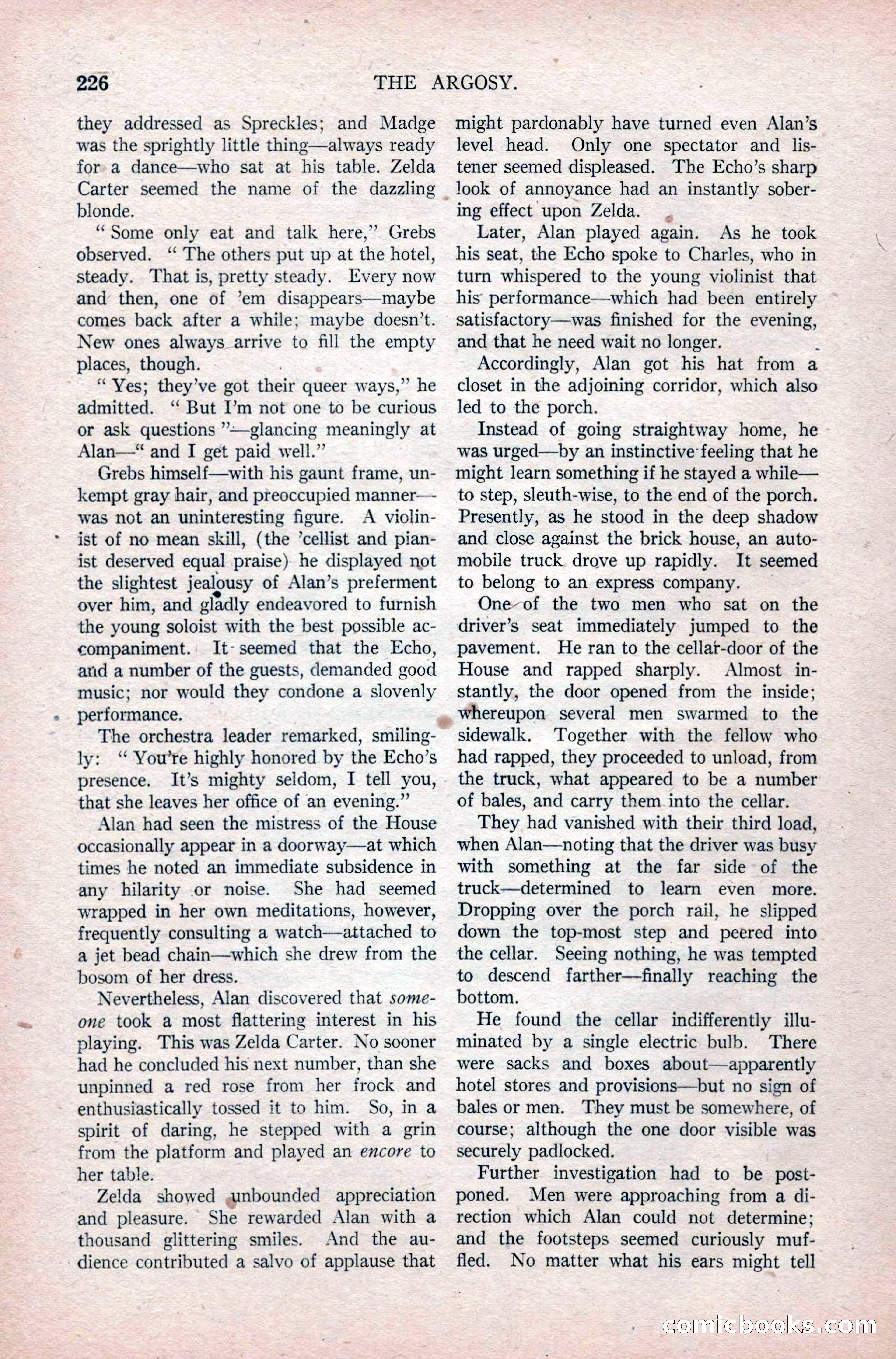
A restored page from Pulp Fiction, 1920. Page through the whole issue in the reader above.
📄 Transcribed text from this page (OCR, searchable)
Machine-transcribed from the original scan — historical spelling and the odd misread are preserved.
226 they addressed as Spreckles; and Madge was the sprightly little thing—always ready for a dance—who sat at his table. Zelda Carter seemed the name of the dazzling blonde. “Some only eat and talk here,” Grebs observed. ‘‘ The others put up at the hotel, steady. That is, pretty steady. Every now and then, one of ’em disappears—maybe comes back after a while; maybe doesn’t. New ones always arrive to fill the empty places, though. “Yes; they’ve got their queer ways,” he admitted. ‘But I’m not one to be curious or ask questions ’—-glancing meaningly at Alan—* and I get paid well.” Grebs himself—with his gaunt frame, un- kempt gray hair, and preoccupied manner— was not an uninteresting figure. A violin- ist of no mean skill, (the ’cellist and pian- ist deserved equal praise) he displayed not the slightest jealousy of Alan’s preferment over him, and gladly endeavored to furnish the young soloist with the best possible ac- companiment. It-seemed that the Echo, atid a number of the guests, demanded good music; nor would they condone a slovenly performance. % The orchestra leader remarked, smiling- ly: ‘“ You’re highly honored by the Echo’s presence. It’s mighty seldom, I tell you, that she leaves her office of an evening.” Alan had seen the mistress of the House occasionally appear in a doorway—at which times he noted an immediate subsidence in any hilarity or noise. She had seemed wrapped in her own meditations, however, frequently consulting a watch—attached to a jet bead chain—which she drew from the bosom of her dress. Nevertheless, Alan discovered that some- one took a most flattering interest in his playing. This was Zelda Carter. No sooner had he concluded his next number, than she unpinned a red rose from her frock and enthusiastically tossed it to him. So, ina spirit of daring, he stepped with a grin from the platform and played an encore to her table. Zelda showed qginbounded appreciation and pleasure. She rewarded Alan with a thousand glittering smiles. And the au- dience contributed a salvo of applause that THE ARGOSY. might pardonably have turned even Alan’s level head. Only one spectator and lis- tener seemed displeased. The Echo’s sharp _look of annoyance had an instantly sober- ing effect upon Zelda. Later, Alan played again. As he took his seat, the Echo spoke to Charles, who in turn whispered to the young violinist that his performance—which had been entirely satisfactory—was finished for the Hased and that he need wait no longer. Accordingly, Alan got his hat from a closet in the adjoining corridor, which also led to the porch. Instead of going straightway home, he was urged—by an instinctive feeling that he might learn something if he stayed a while— to step, sleuth-wise, to the end of the porch. Presently, as he stood in the deep shadow and close against the brick house, an auto- mobile truck. drove up rapidly. Tt seemed to belong to an express company. One-of the two men who sat on the driver’s seat immediately jumped to the pavement. He ran to the cellat-door of the House and rapped sharply. Almost in- stantly, the door opened from the inside; whereupon several men swarmed to the sidewalk. Together with the fellow who had rapped, they proceeded to unload, from the truck, what appeared to be a number of bales, and carry them into the cellar. They had vanished with their third load, when Alan—noting that the driver was busy with something at the far side of the truck—determined to learn even more. Dropping over the porch rail, he slipped down the top-most step and peered into the cellar. Seeing nothing, he was tempted to descend farther—finally reaching the bottom. He found the cellar indifferently illu- minated by a single electric bulb. There were sacks and boxes about—apparently hotel stores and provisions—but no sign of bales or men. They must be somewhere, of course; although the one door visible was securely padlocked. Further investigation had to be post- poned. Men were approaching from a di- rection which Alan could not determine; and the footsteps seemed curiously muf- fled. No matter what his ears might tell (E(0) .OO ANI S (E@)