
Pulp Fiction, 1920 · page 75 of 180
Argosy, Vol. 118, No. 2 — page 75: what you’re looking at
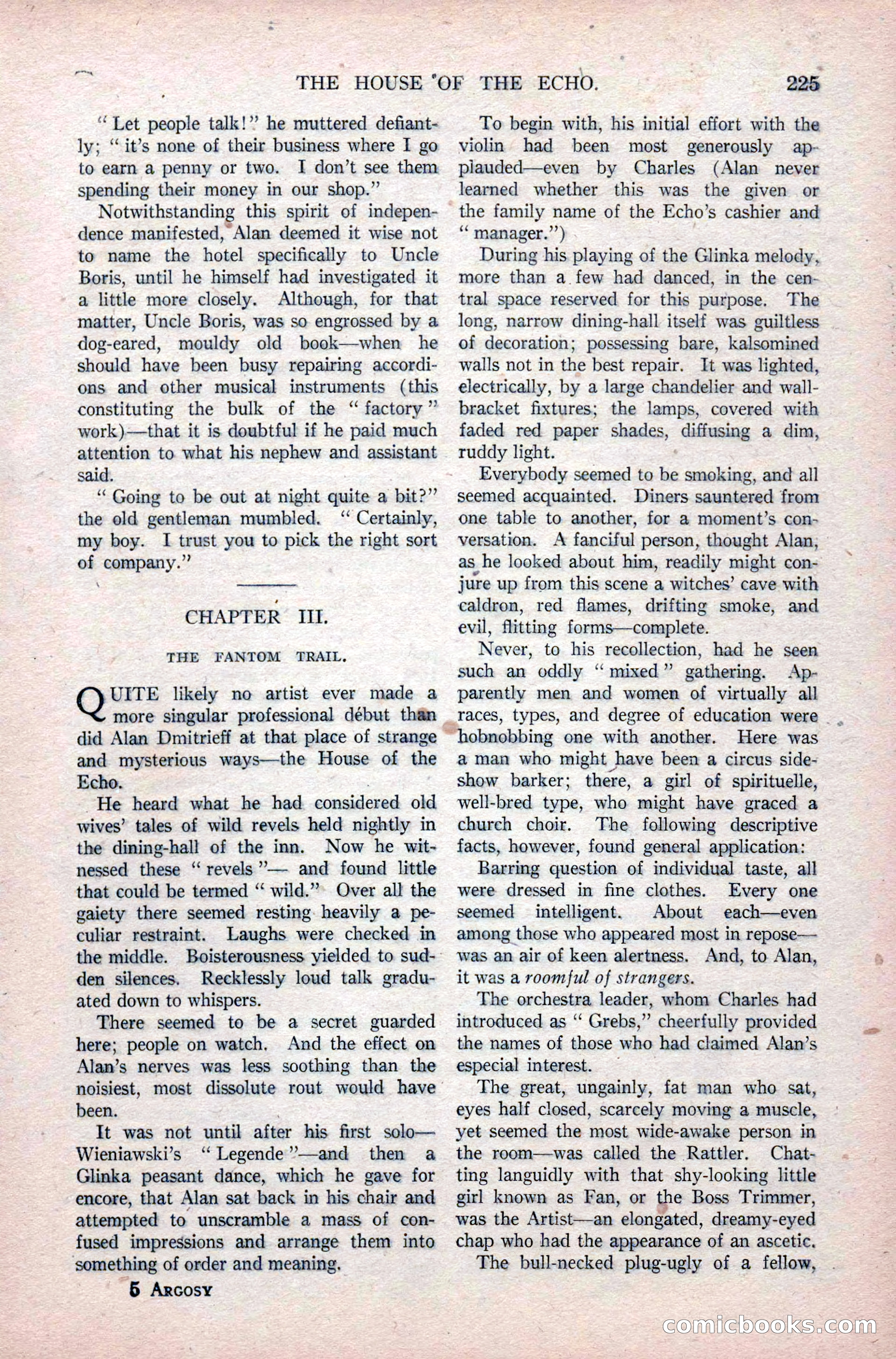
A restored page from Pulp Fiction, 1920. Page through the whole issue in the reader above.
📄 Transcribed text from this page (OCR, searchable)
Machine-transcribed from the original scan — historical spelling and the odd misread are preserved.
re, “ Let people talk!’ he muttered defiant- ly; ‘‘ it’s none of their business where I go to earn a penny or two. I don’t see them spending their money in our shop.” Notwithstanding this spirit of indepen- dence manifested, Alan deemed it wise not to name the hotel specifically to Uncle Boris, until he himself had investigated it a little more closely. Although, for that matter, Uncle Boris, was so engrossed by a dog-eared, mouldy old book—when he should have been busy repairing accordi- ons and other musical instruments (this constituting the bulk of the “ factory ” work)——that it is doubtful if he paid much attention to. what his nephew and assistant said. “Going to be out at night quite a bit?” the old gentleman mumbled. ‘“‘ Certainly, my boy. I trust you to pick the right sort of company.” CHAPTER IIL. THE FANTOM TRAIL. UITE likely no artist ever made a more singular professional début than did Alan Dmitrieff at that place of strange and mysterious ways—the House of the Echo. 3 He heard what he had considered old wives’ tales of wild revels held nightly in the dining-hall of the inn. Now he wit- nessed these ‘‘ revels ”»— and found little that could be termed “‘ wild.” Over all the gaiety there seemed resting heavily a pe- culiar restraint. Laughs were checked in the middle. Boisterousness yielded to sud-- den silences. Recklessly loud talk gradu- ated down to whispers. There seemed to be a secret guarded here; people on watch, And the effect on Alan’s nerves was less soothing than the noisiest, most dissolute rout would have been. , It was not until after his first solo— Wieniawski’s ‘‘ Legende”—and then a Glinka peasant dance, which he gave for encore, that Alan sat back in his chair and attempted to unscramble a mass of con- fused impressions and arrange them into something of order and meaning. 5 Arcosy THE HOUSE ‘OF THE ECHO. ~ hobnobbing one with another. To begin with, his initial effort with the violin had been most generously ap- piauded—even by Charles (Alan never learned whether this was the given or the family name of the Echo’s cashier and ‘* manager.’’) During his playing of the Glinka melody, more than a. few had danced, in the cen- tral space reserved for this purpose. The long, narrow dining-hall itself was guiltless of decoration; possessing bare, kalsomined walls not in the best repair. It was lighted, electrically, by a large chandelier and wall- bracket fixtures; the lamps, covered with faded red paper shades, diffusing a dim, ruddy light. Everybody seemed to be smoking, and all seemed acquainted. Diners sauntered from one table to another, for a moment’s con- versation. A fanciful person, thought Alan; as he looked about him, readily might con- jure up from this scene a witches’ cave with ealdron, red flames, drifting smoke, and evil, flitting forms—complete. Never, to his recollection, had he seen such an oddly ‘“‘ mixed” gathering. Ap- parently men and women of virtually all 225 _races, types, and degree of education were. Here was a man who might have been a circus side- show barker; there, a girl of spirituelle, well-bred type, who might have graced a church choir. The following descriptive facts, however, found general application: Barring question of individual taste, all were dressed in fine clothes. Every one seemed intelligent. About each—even among those who appeared most in repose— was an air of keen alertness. And, to Alan, it was a roomful of strangers. The orchestra leader, whom Charles had introduced as ‘‘ Grebs,” cheerfully provided the names of those who had claimed Alan’s especial interest. The great, ungainly, fat man who sat, eyes half closed, scarcely moving a muscle, yet seemed the most wide-awake person in the room—was called the Rattler. Chat- ting languidly with that shy-looking little girl known as Fan, or the Boss Trimmer, was the Artist—an elongated, dreamy-eyed chap who had the appearance of an ascetic. The bull-necked plug-ugly of a fellow, . COPMIE OOOKS (C (E@)