
Pulp Fiction, 1920 · page 71 of 180
Argosy, Vol. 118, No. 2 — page 71: what you’re looking at
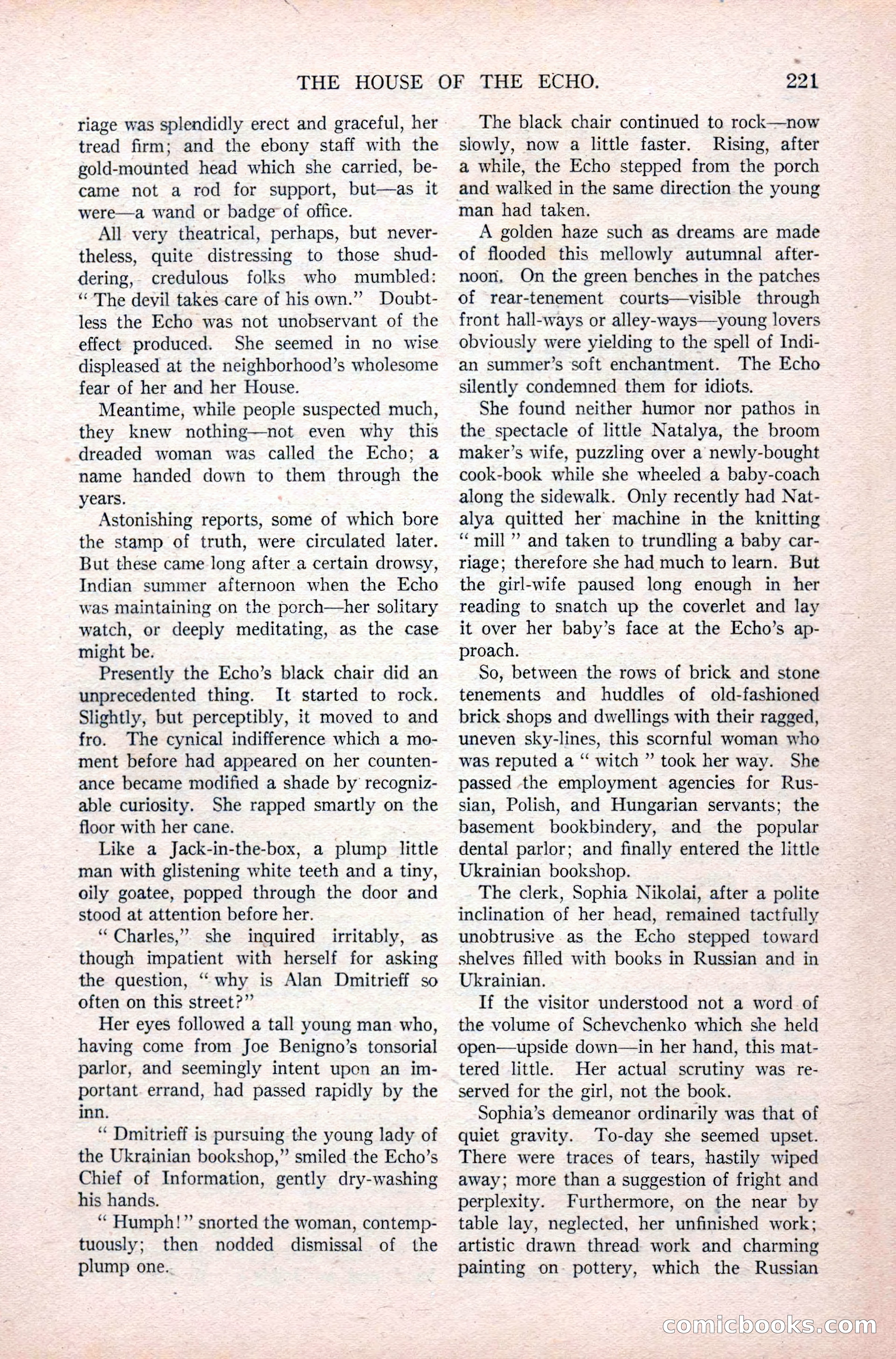
A restored page from Pulp Fiction, 1920. Page through the whole issue in the reader above.
📄 Transcribed text from this page (OCR, searchable)
Machine-transcribed from the original scan — historical spelling and the odd misread are preserved.
THE HOUSE OF THE ECHO. riage was splendidly erect and graceful, her tread firm; and the ebony staff with the gold-mounted head which she carried, be- came not a rod for support, but—as it were—a wand or badge of office. All very theatrical, perhaps, but never- theless, quite distressing to those shud- dering, credulous folks who mumbled: “ The devil takes care of his own.” Doubt- less the Echo was not unobservant of the effect produced. She seemed in no wise displeased at the neighborhood’s wholesome fear of her and her House. Meantime, while people suspected much, they knew nothing—not even why this dreaded woman was called the Echo; a name handed down to them through the years. 3 Astonishing reports, some of which bore the stamp of truth, were circulated later. But these came long after a certain drowsy, Indian summer afternoon when the Echo was maintaining on the porch—her solitary watch, or deeply meditating, as the case might be. Presently the Echo’s black chair did an unprecedented thing. It started to rock. Slightly, but perceptibly, it moved to and fro. The cynical indifference which a mo- ment before had appeared on her counten- ance became modified a shade by recogniz- able curiosity. She rapped smartly on the floor with her cane. : Like a Jack-in-the-box, a plump little man with glistening white teeth and a tiny, oily goatee, popped through the door and stood at attention before her. “Charles,” she inquired irritably, as though impatient with herself for asking the question, “why is Alan Dmitrieff so often on this street?” Her eyes followed a tall young man who, having come from Joe Benigno’s tonsorial parlor, and seemingly intent upen an im- portant errand, had passed rapidly by the inn. ‘“ Dmitrieff is pursuing the young lady of the Ukrainian bookshop,” smiled the Echo’s Chief of Information, gently dry-washing his hands. ‘““Humph!”’ snorted the woman, contemp- tuously; then nodded dismissal of the plump one. 221 The black chair continued to rock—now slowly, now a little faster. Rising, after a while, the Echo stepped from the porch and walked in the same direction the young man had taken. A golden haze such as dreams are made of flooded this mellowly autumnal after- noon, On the green benches in the patches of rear-tenement courts—visible through front hall-ways or alley-ways—young lovers obviously were yielding to the spell of Indi- an summer’s soft enchantment. The Echo silently condemned them for idiots. She found neither humor nor pathos in the spectacle of little Natalya, the broom maker’s wife, puzzling over a newly-bought cook-book while she wheeled a baby-coach along the sidewalk. Only recently had Nat- alya quitted her machine in the knitting ‘mill ” and taken to trundling a baby car- riage; therefore she had much to learn. But the girl-wife paused long enough in her reading to snatch up the coverlet and lay it over her baby’s face at the Echo’s ap- proach. So, between the rows of brick and stone tenements and huddles of old-fashioned brick shops and dwellings with their ragged, uneven sky-lines, this scornful woman who was reputed a “ witch ” took her way. She passed the employment agencies for Rus- sian, Polish, and Hungarian servants; the basement bookbindery, and the popular dental parlor; and finally entered the little Ukrainian bookshop. The clerk, Sophia Nikolai, after a polite inclination of her head, remained tactfully unobtrusive as the Echo stepped toward shelves filled with books in Russian and in Ukrainian. If the visitor understood not a word of the volume of Schevchenko which she held open—upside down— in her hand, this mat- tered little. Her actual scrutiny was re- served for the girl, not the book. Sophia’s demeanor ordinarily was that of quiet gravity. To-day she seemed upset. There were traces of tears, hastily wiped away; more than a suggestion of fright and perplexity. Furthermore, on the near by table lay, neglected, her unfinished work; artistic drawn thread work and charming painting on- pottery, which the Russian COL Ghbooks (E@)