
Pulp Fiction, 1920 · page 70 of 180
Argosy, Vol. 118, No. 2 — page 70: what you’re looking at
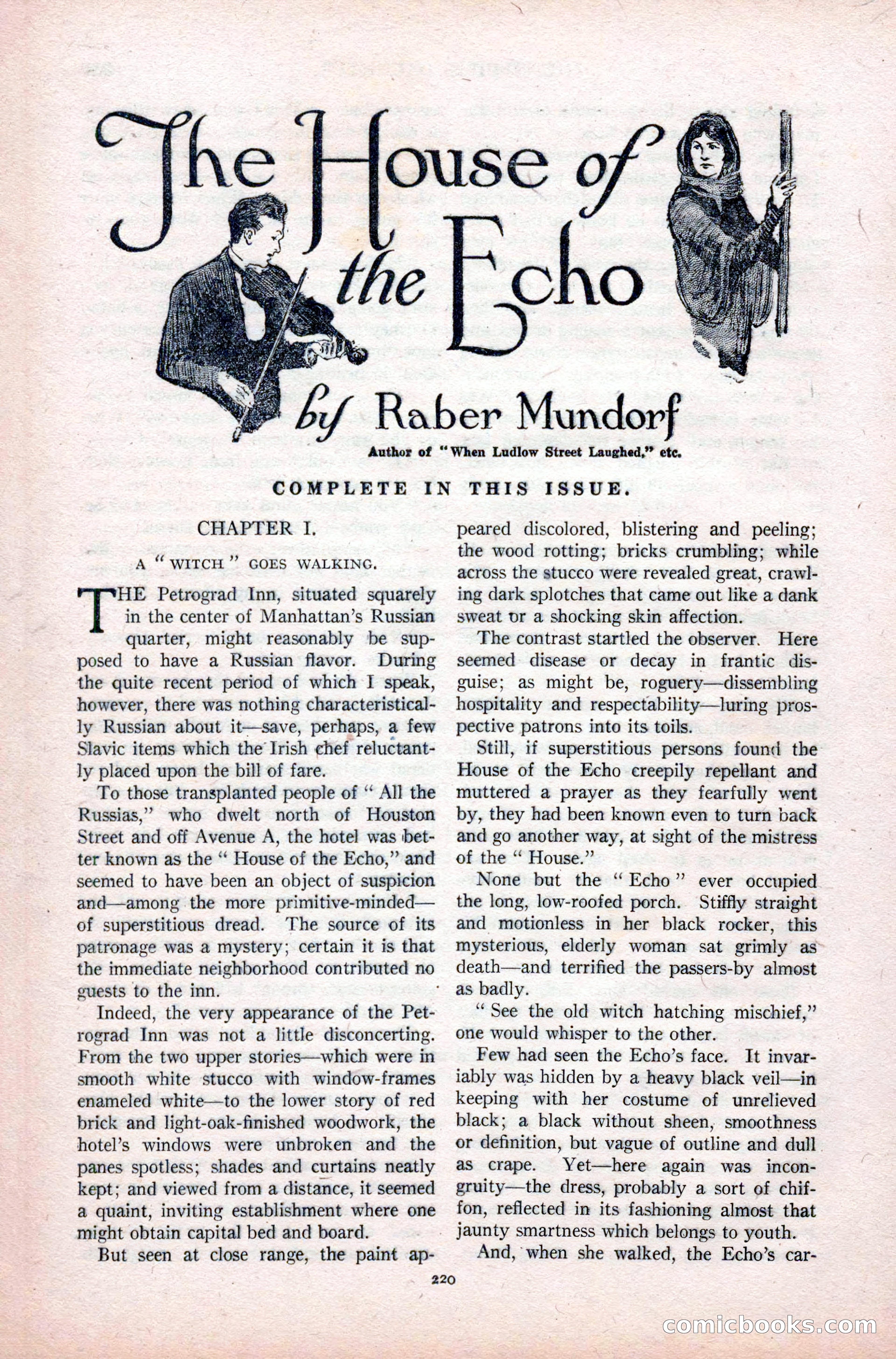
A restored page from Pulp Fiction, 1920. Page through the whole issue in the reader above.
📄 Transcribed text from this page (OCR, searchable)
Machine-transcribed from the original scan — historical spelling and the odd misread are preserved.
ff Raber Mundorf Author of “‘When Ludlow Street Laughed,’ etc. COMPLETE IN THIS ISSUE. CHAPTER I, A “ WITCH”? GOES WALKING. HE Petrograd Inn, situated squarely in the center of Manhattan’s Russian quarter, might reasonably be sup- posed to have a Russian flavor. During the quite recent period of which I speak, however, there was nothing characteristical- ly Russian about it—save, perhaps, a few Slavic items which the Irish chef reluctant- ly placed upon the bill of fare. To those transplanted people of ‘ All the Russias,” who dwelt north of Houston Street and off Avenue A, the hotel was bet- ter known as the “ House of the Echo,” and seemed to have been an object of suspicion and—among the more primitive-minded— of superstitious dread. The source of its patronage was a mystery; certain it is that the immediate neighborhood contributed no guests to the inn. Indeed, the very appearance of the Pet- rograd Inn was not a little disconcerting. From the two upper stories—which were in smooth white stucco with window-frames enameled white—to the lower story of red brick and light-oak-finished woodwork, the hotel’s windows were unbroken and the panes spotless; shades and curtains neatly kept; and viewed from a distance, it seemed a quaint, inviting establishment where one might obtain capital bed and board. But seen at close range, the paint ap- peared discolored, blistering and peeling; the wood rotting; bricks crumbling; while across the stucco were revealed great, crawl- ing dark splotches that came out like a dank sweat or a shocking skin affection. The contrast startled the observer. Here seemed disease or decay in frantic dis- guise; as might be, roguery—dissembling hospitality and respectability—luring pros- pective patrons into its toils. Still, if superstitious persons found the House of the Echo creepily repellant and muttered a prayer as they fearfully went by, they had been known even to turn back and go another way, at sight of the mistress of the “‘ House.” None but the “Echo” ever occupied the long, low-roofed porch. Stiffly straight and motionless in her black rocker, this mysterious, elderly woman sat grimly as death—and terrified the passers-by almost as badly. ‘See the old witch hatching mischief,” one would whisper to the other. Few had seen the Echo’s face. It invar- iably was hidden by a heavy black veil—in keeping with her costume of unrelieved black; a black without sheen, smoothness or definition, but vague of outline and dull. as crape. Yet—here again was incon- gruity—the dress, probably a sort of chif- fon, reflected in its fashioning almost that _ jaunty smartness which belongs to youth. And, when she walked, the Echo’s car- 220 CONMUC DOO (C@)