
Pulp Fiction, 1920 · page 159 of 180
Argosy, Vol. 118, No. 2 — page 159: what you’re looking at
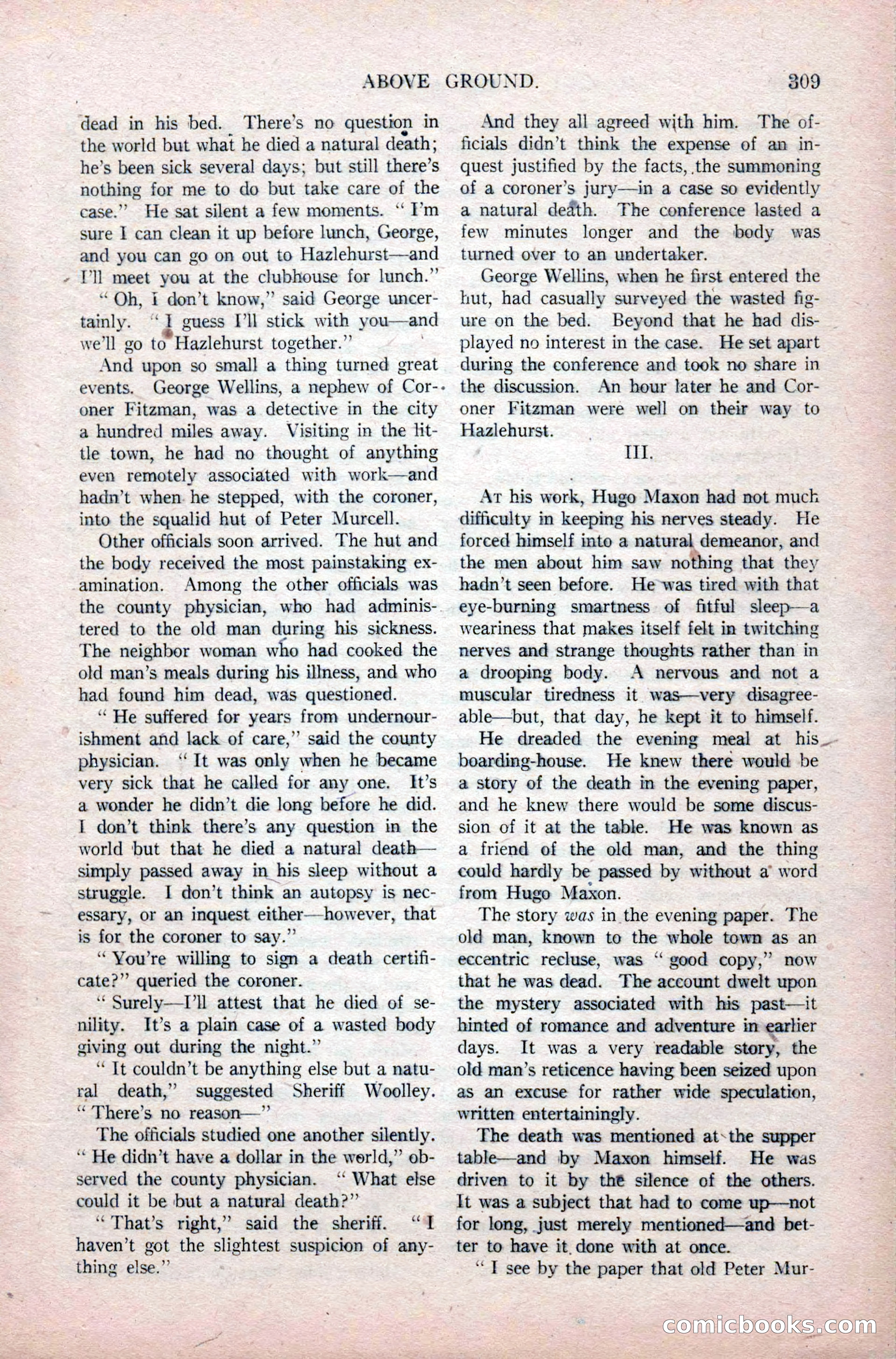
A restored page from Pulp Fiction, 1920. Page through the whole issue in the reader above.
📄 Transcribed text from this page (OCR, searchable)
Machine-transcribed from the original scan — historical spelling and the odd misread are preserved.
\ ABOVE GROUND. dead in his bed. There’s no question in the world but what he died a natural death; he’s been sick several days; but still there’s nothing for me to do but take care of the case.” He sat silent a few moments. “ I’m sure I can clean it up before lunch, George, and you can go on out to Hazlehurst—and I'll meet you at the clubhouse for lunch.”’ “ Oh, i don’t know,” said George uncer- tainly. “s guess I’ll stick with you—and we'll go to Hazlehurst together.”’ 3 And upon so small a thing turned great events, oner Fitzman, was a detective in the city a hundred miles away. Visiting in the lit- tle town, he had no thought of anything even remotely associated with work—and hadn’t when. he stepped, with the coroner, into the squalid hut of Peter Mureell. Other officials soon arrived. The hut and the body received the most painstaking ex- amination. Among the other officials was the county physician, who had adminis- tered to the old man during his sickness. The neighbor woman who had cooked the old man’s meals during his ilmess, and who had found him dead, was questioned. “He suffered for years from undernour- ishment and lack of care,” said the county physician. “It was only when he became very sick that he called for any one. It’s a wonder he didn’t die long before he did. I don’t think there’s any question in the world but that he died a natural death— simply passed away in his sleep without a struggle. I don’t think an autopsy is nec- essary, or an inquest either—however, that is for the coroner to say.” “ You’re willing to sign a death certifi- cate?’’ queried the coroner. ‘“ Surely—I’ll attest that he died of se- nility. It’s a plain case of a wasted body giving out during the night.” “ It couldn’t be anything else but a natu- ral death,’ suggested Sheriff Woolley. ‘“ There’s no reason—”’ The officials studied one another silently. ‘ He didn’t have a dollar in the world,” ob- served the county physician. ‘“ What else could it be but a natural death?” ‘That’s right,” said the sheriff. “TI haven’t got the slightest suspicion of any- thing else.”’ George Wellins, a nephew of Cor-- 309 And they all agreed with him. The of- ficials didn’t think the expense of an in- quest justified by the facts, the summoning of a coroner’s jury—in a case so evidently a natural dedth. The conference lasted a few minutes longer and the body was turned over to an undertaker. George Wellins, when he first entered the hut, had casually surveyed the wasted fig- ure on the bed. Beyond that he had dis- _ played no interest in the case. He set apart during the conference and took no share in the discussion. An hour later he and Cor- oner Fitzman were well on their way to Hazlehurst. III. At his work, Hugo Maxon had not muck difficulty in keeping his nerves steady. He forced himself into a natural demeanor, and the men about him saw nothing that they hadn’t seen before. eye-burning smartness of fitful sleep—a weariness that makes itself felt in twitching nerves and strange thoughts rather than in a drooping body. A nervous and not a muscular tiredness it was—very disagree- able—but, that day, he kept it to himself. He was tired with that — He dreaded the evening meal at his_- boarding-house. He knew there would be a story of the death in the evening paper, and he knew there would be some discus- sion of it at the table. He was known as a friend of the old man, and the thing could hardly be passed by without a’ word from Hugo Maxon. The story was in the evening paper. The old man, known to the whole town as an eccentric recluse, was “‘ good copy,” now that he was dead. The account dwelt upon the mystery associated with his past—it hinted of romance and adventure in earlier days. It was a very readable story, the old man’s reticence having been seized upon as an excuse for rather wide speculation, written entertainingly. The death was mentioned at-the supper table—and by Maxon himself. He was driven to it by thé silence of the others. It was a subject that had to come up—not for long, just merely mentioned—and bet- ter to have it. done with at once. ‘ F see by the paper that old Peter Mur- GEomichboo cS. a (E@)