
Pulp Fiction, 1920 · page 158 of 180
Argosy, Vol. 118, No. 2 — page 158: what you’re looking at
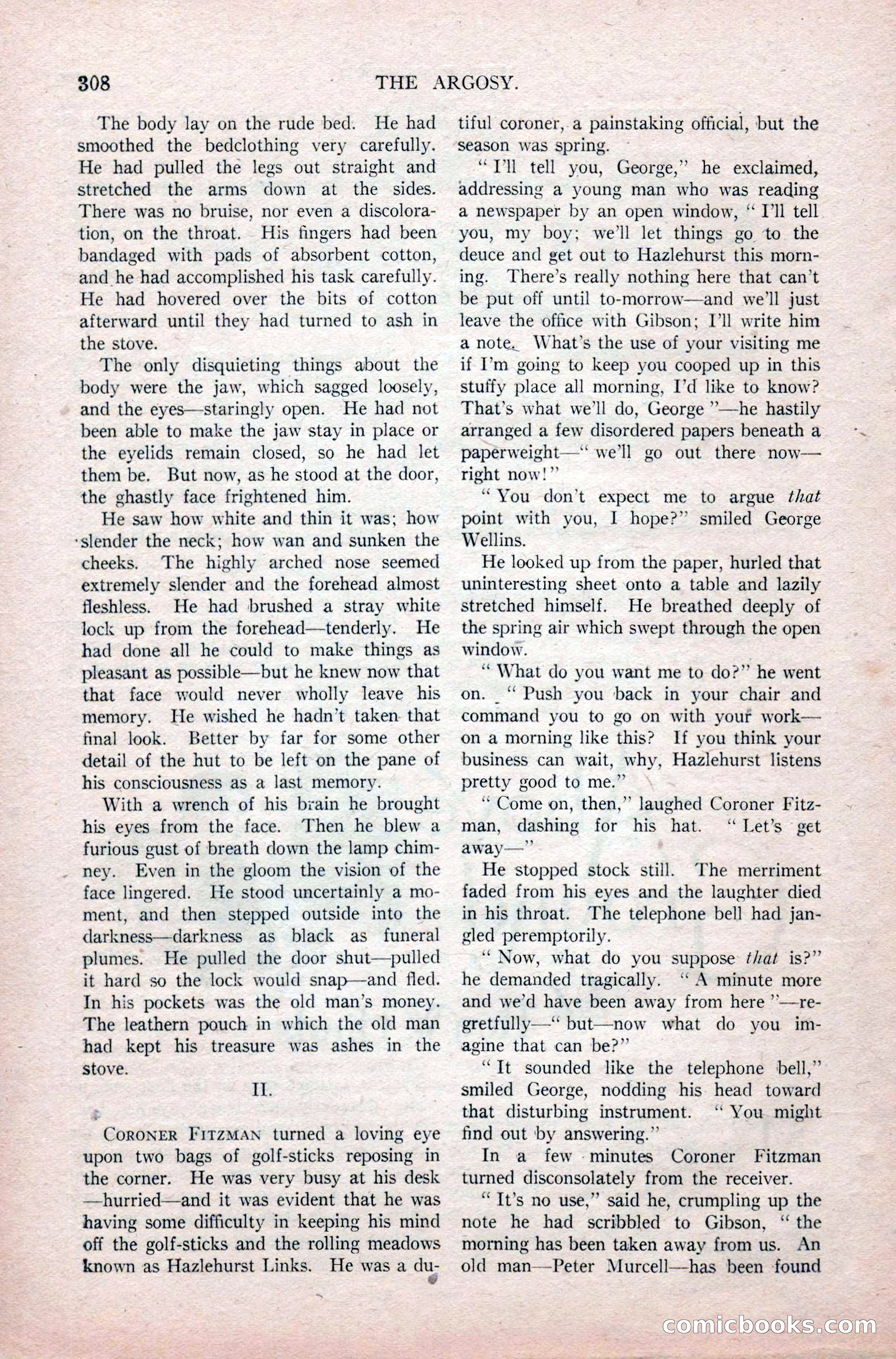
A restored page from Pulp Fiction, 1920. Page through the whole issue in the reader above.
📄 Transcribed text from this page (OCR, searchable)
Machine-transcribed from the original scan — historical spelling and the odd misread are preserved.
308 The body lay on the rude bed. He had smoothed the bedclothing very carefully. He had pulled the legs out straight and stretched the arms down at the sides. There was no bruise, nor even a discolora- tion, on the throat. His fingers had been bandaged with pads of absorbent cotton, and he had accomplished his task carefully. ' He had hovered over the bits of cotton afterward until they had turned to ash in the stove. The only disquieting things about the body were the jaw, which sagged loosely, and the eyes—staringly open. He had not been able to make the jaw stay in place or the eyelids remain closed, so he had let them be. But now, as he stood at the door, the ghastly face frightened him. He saw how white and thin it was; how ‘slender the neck; how wan and sunken the cheeks. The highly arched nose seemed extremely slender and the forehead almost fleshless. He had brushed a stray white lock up from the forehead—tenderly. He had done all he could to make things as pleasant as possible—but he knew now that that face would never wholly leave his memory. He wished he hadn’t taken: that final look. Better by far for some other detail of the hut to be left on the pane of his consciousness as a last memory. With a wrench of his brain he brought his eyes from the face. Then he blew a furious gust of breath down the lamp chim- ney. Even in the gloom the vision of the face lingered. He stood uncertainly a mo- ment, and then stepped outside into the darkness—darkness as black as funeral plumes. He pulled the door shut—pulled it hard so the lock would snap—and fled. In his pockets was the old man’s money. The leathern pouch in which the old man had kept his treasure was ashes in the stove. Il. CorRONER FITZMAN turned a loving eye upon two bags of golf-sticks reposing in the corner. He was very busy at his desk —hurried—and it was evident that he was having some difficulty in keeping his mind off the golf-sticks and the rolling meadows known as Hazlehurst Links. He was a du: THE ARGOSY. tiful coroner, a painstaking official, but the season was spring. “Tl tell you, George,” he exclaimed, addressing a young man who was reading a newspaper by an open window, “ I’ll tell you, my boy; we’ll let things go to the deuce and get out to Hazlehurst this morn- ing. There’s really nothing here that can’t be put off until to-morrow—and we'll just leave the office with Gibson; I'll write him a note. What’s the use of your visiting me if I’m going to keep you cooped up in this stuffy place all morning, I’d like to know? That’s what we’ll do, George ’—-he hastily arranged a few disordered papers beneath a paperweight—“‘ we'll go out there now— right now!”’ “You don’t expect me to argue that point with you, I hope?” smiled George Wellins. He looked up from the paper, hurled that uninteresting sheet onto a table and lazily stretched himself. He breathed deeply of the spring air which swept through the open window. ‘What do you want me to do?”’ he went on. ‘ Push you back in your chair and command you to go on with your work— on a morning like this? If you think your business can wait, why, Hazlehurst listens pretty good to me.” ‘“Come on, then,” laughed Coroner Fitz- man, dashing for his hat. ‘“ Let’s get away— He stopped stock still. The merriment faded from his eyes and the laughter died in his throat. The telephone bell had jan- gled peremptorily. ‘“Now, what do you suppose t/at is?” he demanded tragically. ‘“‘ A minute more and we’d have been away from here ’—re- gretfully—‘ but—now what do you im- agine that can be?” “It sounded like the telephone bell,” smiled George, nodding his head toward that disturbing instrument. ‘‘ You might find out ‘by answering.” In a few -minutes Coroner Fitzman turned disconsolately from the receiver. “It’s no use,” said he, crumpling up the note he had scribbled to Gibson, ‘ the morning has been taken away from us. An old man—Peter Murcell—has been found Eomicbooks (E(@)