
Pulp Fiction, 1920 · page 102 of 180
Argosy, Vol. 118, No. 2 — page 102: what you’re looking at
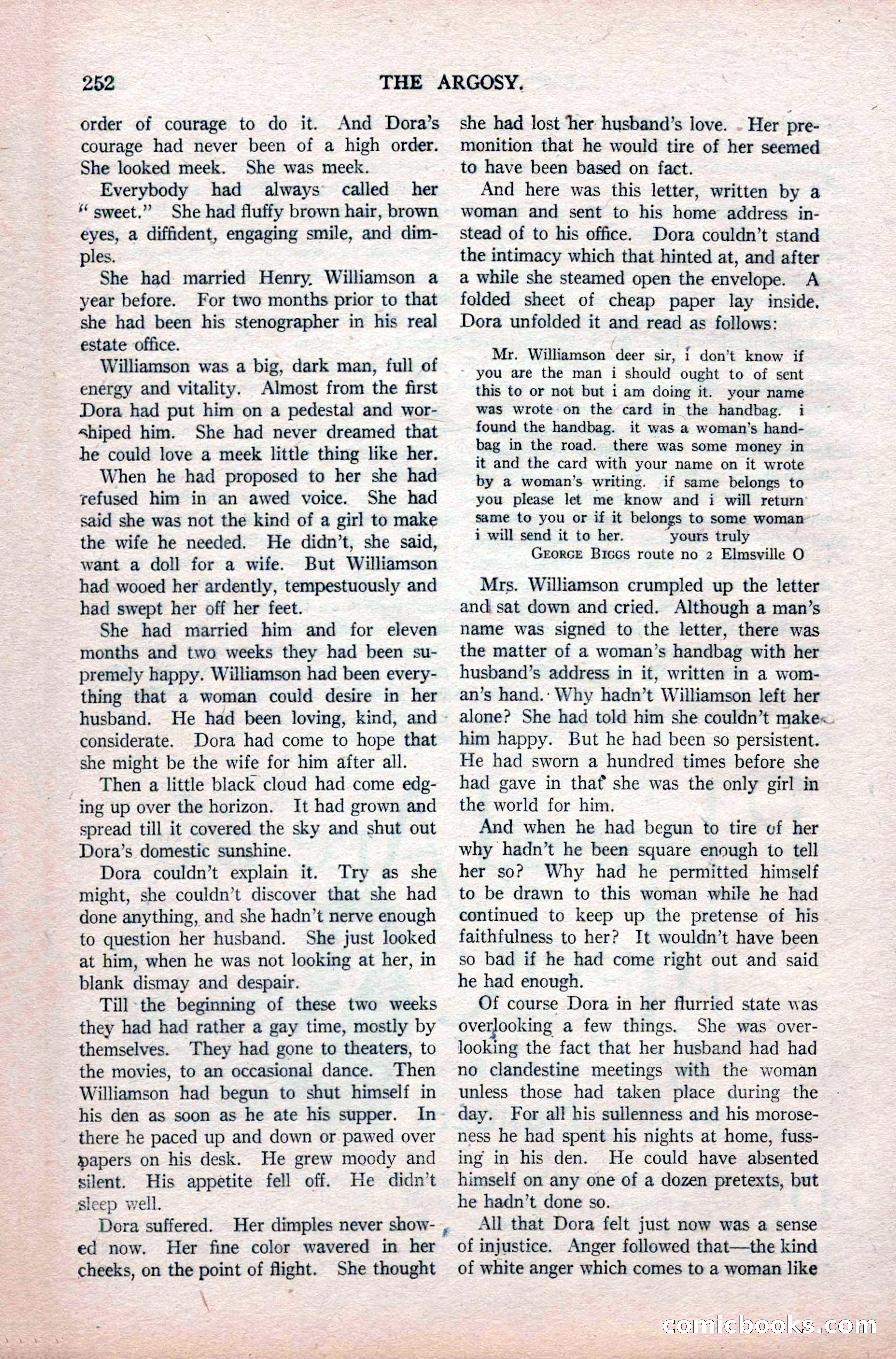
A restored page from Pulp Fiction, 1920. Page through the whole issue in the reader above.
📄 Transcribed text from this page (OCR, searchable)
Machine-transcribed from the original scan — historical spelling and the odd misread are preserved.
252 order of courage to do it. And Dora’s courage had never been of a high order. She looked meek. She was meek. Everybody had always called her * sweet.” She had fluffy brown hair, brown eyes, a diffident, engaging smile, and dim- ples. She had married Henry. Williamson a year before. For two months prior to that she had been his stenographer in his real estate office. Williamson was a big, dark man, full of energy and vitality. Almost from the first Dora had put him on a pedestal and wor- shiped him. She had never dreamed that he could love a meek little thing like her. When he had proposed to her she had refused him in an awed voice. She had said she was not the kind of a girl to make the wife he needed. He didn’t, she said, want a doll for a wife. But Williamson had wooed her ardently, tempestuously and had swept her off her feet. She had married him and for eleven months and two weeks they had been su- premely happy. Williamson had been every- thing that a woman could desire in her husband. He had been loving, kind, and considerate. Dora had come to hope that she might be the wife for him after all. Then a little black cloud had come edg- ing up over the horizon. It had grown and spread till it covered the sky and shut out Dora’s domestic sunshine. Dora couldn’t explain it. Try as she might, she couldn’t discover that she had done anything, and she hadn’t nerve enough to question her husband. She just looked at him, when he was not looking at her, in blank dismay and despair. Till the beginning of these two weeks they had had rather a gay time, mostly by themselves. They had gone to theaters, to the movies, to an occasional dance. Then Williamson had begun to shut himself in his den as soon as he ate his supper. there he paced up and down or pawed over papers on his desk. He grew moody and silent. His appetite fell off. He didn’t sleep well. Dora suffered. Her dimples never show- ed now. Her fine color wavered in her cheeks, on the point of flight. She thought \ In - f THE ARGOSY. she had lost ‘her husband’s love. . Her pre- monition that he would tire of her seemed to have been based on fact. And here was this letter, written by a woman and sent to his home address in- stead of to his office. Dora couldn’t stand the intimacy which that hinted at, and after a while she steamed open the envelope. A folded sheet of cheap paper lay inside. Dora unfolded it and read as follows: Mr. Williamson deer sir, i don’t know if * you are the man i should ought to of sent this to or not but 1 am doing it. your name was wrote on the card in the handbag. i found the handbag. it was a woman’s hand- bag in the road. there was some money in it and the card with your name on it wrote by a woman’s writing. if same belongs to you please let me know and i will return same to you or if it belongs to some woman i will send it to her. yours truly Grorce Bices route no 2 Elmsville O Mrs. Williamson crumpled up the letter and sat down and cried. Although a man’s name was signed to the letter, there was the matter of a woman’s handbag with her husband’s address in it, written in a wom- an’s hand.- Why hadn’t Williamson left her alone? She had told him she couldn’t make«. him happy. But he had been so persistent. He had sworn a hundred times before she had gave in that she was the only girl in the world for him. And when he had begun to tire of her why hadn’t he been square enough io tell her so? Why had he permitted himself to be drawn to this woman while he had continued to keep up the pretense of his faithfulness to her? It wouldn’t have been so bad if he had come right out and said he had enough. Of course Dora in her flurried state was overlooking a few things. She was over- looking the fact that her husband had had no clandestine meetings with the woman unless those had taken place during the day. For all his sullenness and his morose- ness he had spent his nights at home, fuss- ing in his den. He could have absented himself on any one of a dozen pretexts, but he hadn’t done so. All that Dora felt just now was a sense of injustice. Anger followed that—the kind of white anger which comes to a woman like ECOPMICOOOKS Gc (E©)