
Pulp Fiction, 1920 · page 101 of 180
Argosy, Vol. 118, No. 2 — page 101: what you’re looking at
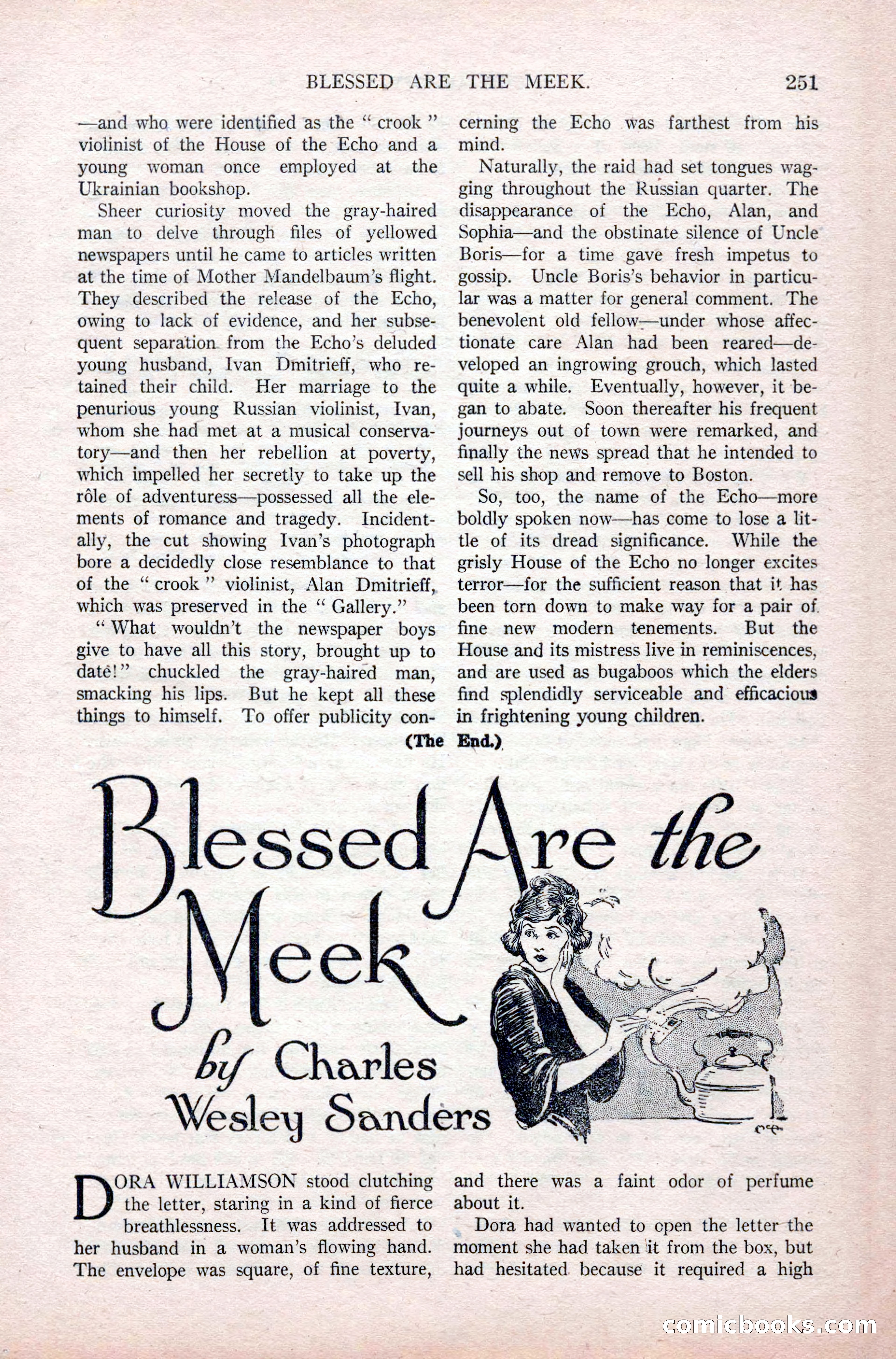
A restored page from Pulp Fiction, 1920. Page through the whole issue in the reader above.
📄 Transcribed text from this page (OCR, searchable)
Machine-transcribed from the original scan — historical spelling and the odd misread are preserved.
BLESSED ARE THE MEEK. —and who were identified as the “ crook ” violinist of the House of the Echo and a young woman once employed at the Ukrainian bookshop. Sheer curiosity moved the gray-haired man to delve through files of yellowed newspapers until he came to articles written at the time of Mother Mandelbaum’s flight. They described the release of the Echo, owing to lack of evidence, and her subse- quent separation. from the Echo’s deluded young husband, Ivan Dmitrieff, who re- tained their child. Her marriage to the penurious young Russian violinist, Ivan, whom she had met at a musical conserva- tory—and then her rebellion at poverty, which impelled her secretly to take up the role of adventuress—possessed all the ele- ments of romance and tragedy. Incident- ally, the cut showing Ivan’s photograph bore a decidedly close resemblance to that of the “crook” violinist, Alan Dmitrieff, which was preserved in the “ Gallery.” “What wouldn’t the newspaper boys give to have all this story, brought up to daté!” chuckled the gray-haired man, smacking his lips. But he kept all these things to himself. To offer publicity con- 251 cerning the Echo was farthest from his mind. Naturally, the raid had set tongues wag- ging throughout the Russian quarter. The disappearance of the Echo, Alan, and Sophia—and the obstinate silence of Uncle Boris—for a time gave fresh impetus to gossip. Uncle Boris’s behavior in particu- lar was a matter for general comment. The benevolent old fellow—under whose affec- tionate care Alan had been reared—de- veloped an ingrowing grouch, which lasted quite a while. Eventually, however, it be- gan to abate. Soon thereafter his frequent journeys out of town were remarked, and finally the news spread that he intended to sell his shop and remove to Boston. So, too, the name of the Echo—more boldly spoken now—has come to lose a lit- tle of its dread significance. While the grisly House of the Echo no longer excites terror—for the sufficient reason that it has been torn down to make way for a pair of. fine new modern tenements. But the House and its mistress live in reminiscences, and are used as bugaboos which the elders find splendidly serviceable and efficacious in frightening young children. (The End.) essed We sley Sanders ORA WILLIAMSON stood clutching the letter, staring in a kind of fierce breathlessness. It was addressed to her husband in a woman’s flowing hand. The envelope was square, of fine texture, A re the and there was a faint odor of perfume about it. _ Dora had wanted to open the letter the moment she had taken it from the box, but had hesitated. because it required a high COMIC .VOOKS (E@)