
Pulp Fiction, 1920 · page 98 of 188
Argosy, Vol. 117, No. 3 — page 98: what you’re looking at
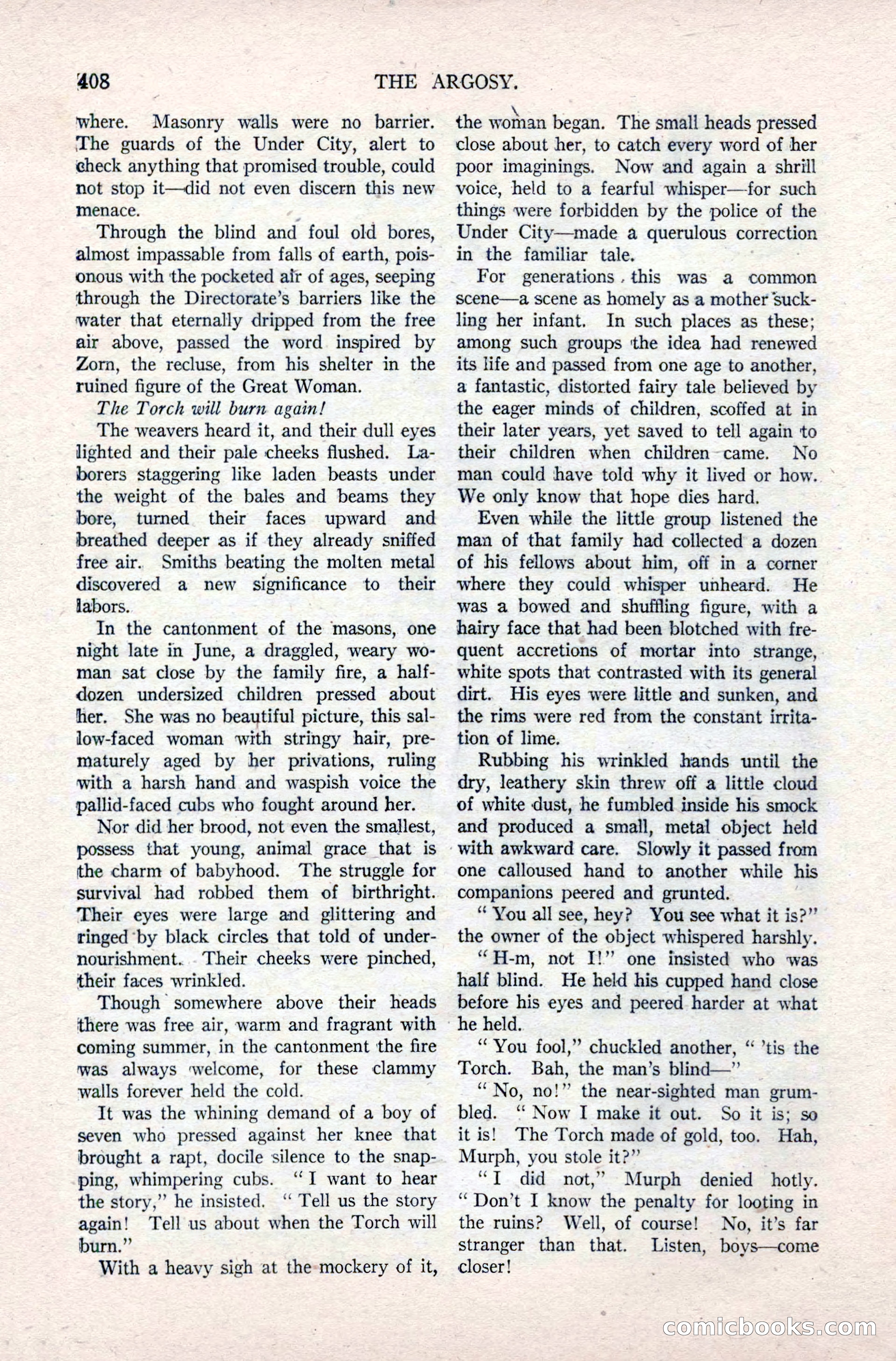
A restored page from Pulp Fiction, 1920. Page through the whole issue in the reader above.
📄 Transcribed text from this page (OCR, searchable)
Machine-transcribed from the original scan — historical spelling and the odd misread are preserved.
408 Where. Masonry walls were no barrier. The guards of the Under City, alert to check anything that promised trouble, could not stop it—did not even discern this new menace. Through the blind and foul old bores, almost impassable from falls of earth, pois- onous with the pocketed air of ages, seeping through the Directorate’s barriers like the water that eternally dripped from the free air above, passed the word inspired by Zorn, the recluse, from his shelter in the ruined figure of the Great Woman. The Torch will burn again! The weavers heard it, and their dull eyes lighted and their pale cheeks flushed. La- borers staggering like laden beasts under the weight of the bales and beams they bore, turned their faces upward and breathed deeper as if they already sniffed free air. Smiths beating the molten metal discovered a new significance to their labors. In the cantonment of the masons, one night late in June, a draggled, weary wo- man sat close by the family fire, a half- dozen undersized children pressed about her. She was no beautiful picture, this sal- low-faced woman with stringy hair, pre- maturely aged by her privations, ruling with a harsh hand and waspish voice the pallid-faced cubs who fought around her. Nor did her brood, not even the smallest, possess that young, animal grace that is the charm of babyhood. ‘The struggle for survival had robbed them of birthright. Their eyes were large and glittering and ringed ‘by black circles that told of under- nourishment. . Their cheeks were pinched, their faces wrinkled. Though somewhere above their heads there was free air, warm and fragrant with coming summer, in the cantonment the fire was always ‘welcome, for these clammy walls forever held the cold. It was the whining demand of a boy of seven who pressed against her knee that brought a rapt, docile silence to the snap- ping, whimpering cubs. “I want to hear the story,” he insisted. ‘ Tell us the story again! Tell us about when the Torch will burn.” With a heavy sigh at the-mockery of it, ‘with awkward care. THE ARGOSY. the woman began. The smali heads pressed close about her, to catch every word of her poor imaginings. Now and again a shrill voice, held to a fearful whisper—for such things were forbidden by the police of the Under City—made a querulous correction in the familiar tale. For generations. this was a common scene—a scene as homely as a mother Suck- ling her infant. In such places as these; among such groups ‘the idea had renewed its life and passed from one age to another, a fantastic, distorted fairy tale believed by the eager minds of children, scoffed at in their later years, yet saved to tell again to their children when children came. man could have told why it lived or how. We only know that hope dies hard. Even while the little group listened the man of that family had collected a dozen of his fellows about him, off in a corner where they could whisper unheard. He was a bowed and shuffling figure, with a hairy face that had been blotched with fre- quent accretions of mortar into strange, white spots that contrasted with its general dirt. His eyes were little and sunken, and the rims were red from the constant irrita- tion of lime. Rubbing his wrinkled hands until the dry, leathery skin threw off a little cloud of white dust, he fumbled inside his smock and produced a small, metal object held Slowly it passed from one calloused hand to another while his companions peered and grunted. “You all see, hey? You see what it is?” the owner of the object whispered harshly. “H-m, not I!”’ one insisted who was half blind. He held his cupped hand close before his eyes and peered harder at what he held. “You fool,” chuckled another, “ ’tis the Torch. Bah, the man’s blind—” ‘No, no!” the near-sighted man grum- bled. ‘ Now I make it out. So it is; so it is! The Torch made of gold, too. Hah, Murph, you stole it?” 2 ‘I did not,” Murph denied hotly. ‘Don’t I know the penalty for looting in the ruins? Well, of course! No, it’s far stranger than that. Listen, boys—come closer! Go .DOOK No (C@