
Pulp Fiction, 1920 · page 97 of 188
Argosy, Vol. 117, No. 3 — page 97: what you’re looking at
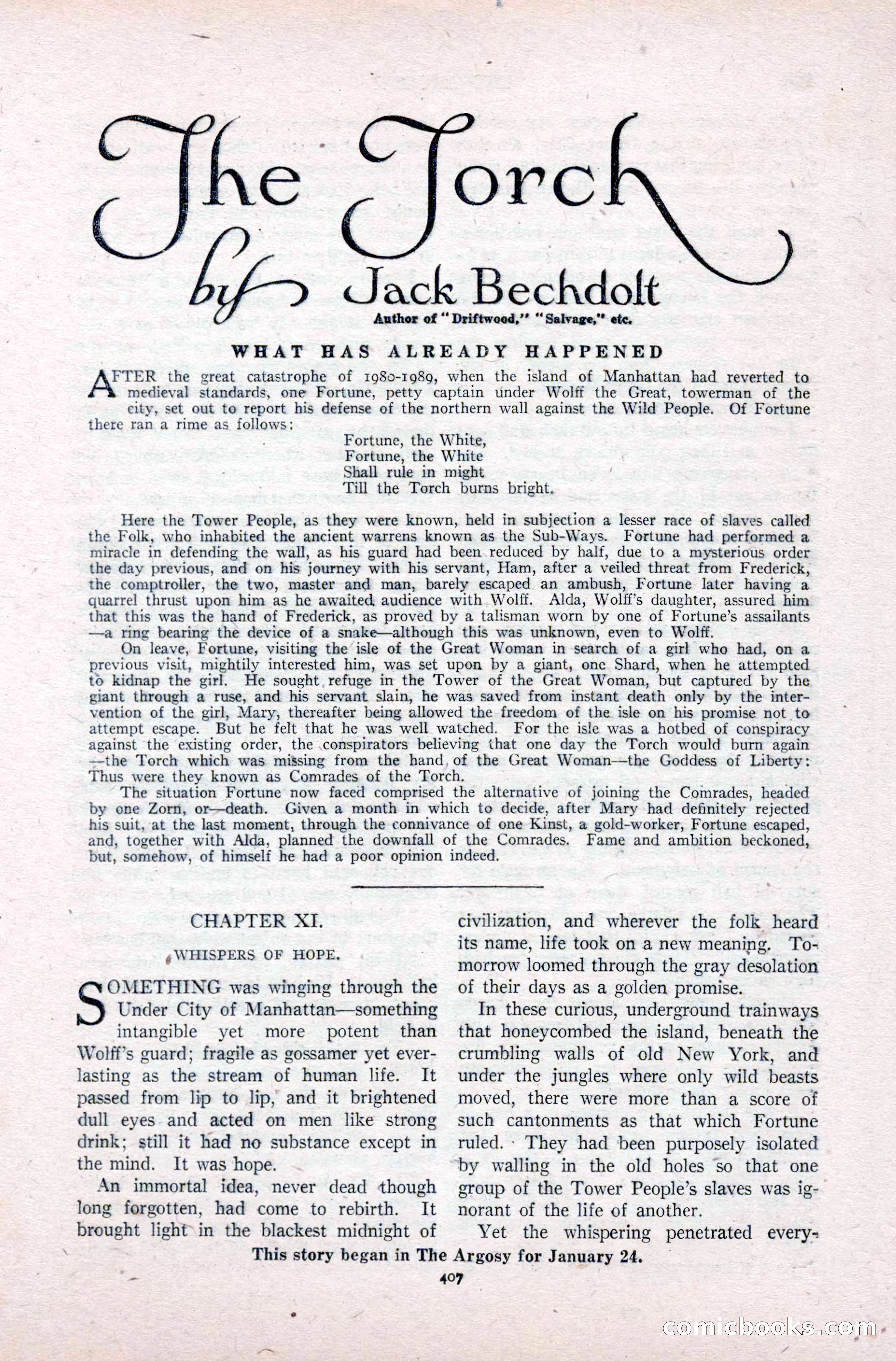
A restored page from Pulp Fiction, 1920. Page through the whole issue in the reader above.
📄 Transcribed text from this page (OCR, searchable)
Machine-transcribed from the original scan — historical spelling and the odd misread are preserved.
he Spe ¢ WHAT HAS ALREADY HAPPENED FTER the great catastrophe of 1980-1989, when the island of Manhattan had reverted to medieval standards, one Fortune, petty captain under Wolff the Great, towerman of the city, set out te report his defense of the northern wall against the Wild People. Of Fortune there ran a rime as follows: Jack B pedestals Author of “‘ Driftwood,’’ “Salvage,”’ etc. Fortune, the White, Fortune, the White Shall rule in might Till the Torch burns bright. Here the Tower People, as they were known, held in subjection a lesser race of slaves called the Folk, who inhabited the ancient warrens known as the Sub-Ways. Fortune had performed a miracle in defending the wall, as his guard had been. reduced by half, due to a mysterious order the day previous, and on his journey with his servant, Ham, after a veiled threat from Frederick, the comptroller, the two, master and man, barely escaped an ambush, Fortune later having a quarrel thrust upon him as he awaited audience with Wolff. Alda, Wolff’s daughter, assured him that this was the hand of Frederick, as proved by a talisman worn by one of Fortune’s assailants —a ring bearing the device of a snake—although this was unknown, even to Wolff. On leave, Fortune, visiting the isle of the Great Woman in search of a girl who had, on a previous visit, mightily interested him, was set upon by a giant, one Shard, when he attempted to kidnap the girl. He sought refuge in the Tower of the Great Woman, ‘but captured by the giant through a ruse, and his servant slain, he was saved from instant death only by the inter- vention of the girl, Mary, thereafter being allowed the freedom of the isle on his promise not to attempt escape. But he felt that he was well watched. For the isle was a hotbed of conspiracy against the existing order, the .conspirators believing that one day the Torch would burn again —the Torch which was missing from the hand, of the Great Woman-—the Goddess of Liberty: Thus were they known as Comrades of the Torch. The situation Fortune now faced comprised the alternative of joining the Comrades, headed by one Zorn, or—death. Given a month in which to decide, after Mary had definitely rejected his suit, at the last moment, through the connivance of one Kinst, a gold-worker, Fortune escaped, and, together with Alda, planned the downfall of the Comrades, Fame and ambition beckoned, but, somehow, of himself he had a poor opinion indeed. CHAPTER XI. ¢ WHISPERS OF HOPE, OMETHING was winging through the Under City of Manhattan—something intangible yet more potent than Wolff’s guard; fragile as gossamer yet ever- lasting as the stream of human life. It passed from lip to lip, and it brightened dull eyes and acted on men like strong drink; still it had no substance except in the mind. It was hope. An immortal idea, never dead though long forgotten, had come to rebirth. It brought light in the blackest midnight of civilization, and wherever the folk heard its name, life took on a new meaning. To- morrow loomed through the gray desolation of their days as a golden promise. In these curious, underground trainways that honeycombed the island, beneath the crumbling walls of old New York, and under the jungles where only wild beasts moved, there were more than a score of such cantonments as that which Fortune ruled. - They had been purposely isolated by walling in the old holes so that one group of the Tower People’s slaves was ig- norant of the life of another. Yet the whispering penetrated every- This story began in The Argosy for January 24. 407 (C@) NOOK (C©)