
Pulp Fiction, 1920 · page 84 of 188
Argosy, Vol. 117, No. 3 — page 84: what you’re looking at
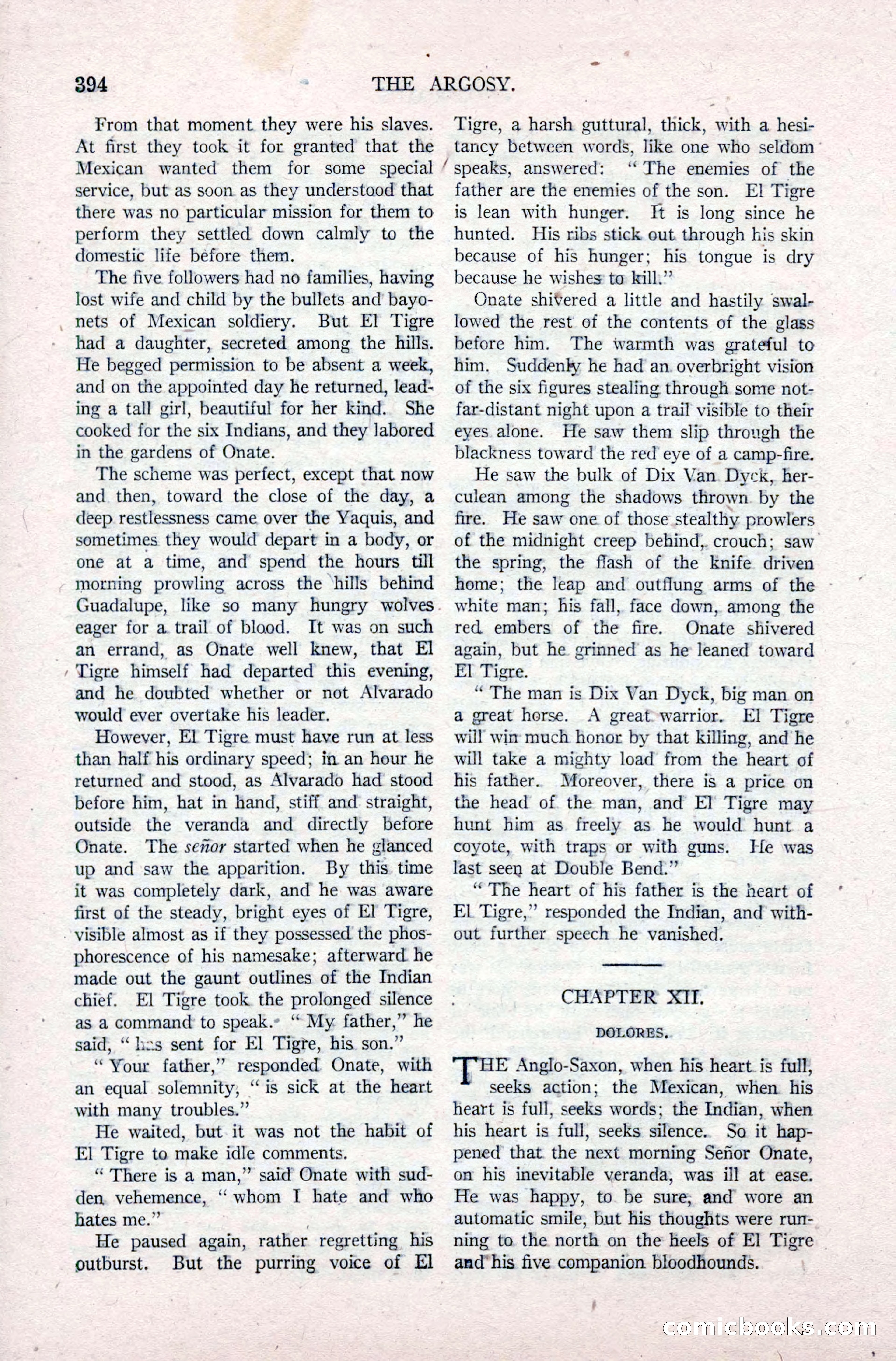
A restored page from Pulp Fiction, 1920. Page through the whole issue in the reader above.
📄 Transcribed text from this page (OCR, searchable)
Machine-transcribed from the original scan — historical spelling and the odd misread are preserved.
394 From that moment they were his slaves. At first they took it for granted that the Mexican wanted them for some special service, but as soon as they understood that there was no particular mission for them to perform they settled down calmly to the domestic life before them. The five followers had no families, having lost wife and child by the bullets and bayo- _ nets of Mexican soldiery. But El Tigre had a daughter, secreted among the hills. He begged permission to be absent a week, and on the appointed day he returned, lead- ing a tall girl, beautiful for her kind. She cooked for the six Indians, and they labored in the gardens of Onate. The scheme was perfect, except that now and then, toward the close of the day, a deep restlessness came over the Yaquis, and sometimes they would depart in a body, or one at a time, and spend the hours till morning prowling across the hills behind Guadalupe, like so many hungry wolves. eager for a trail of blood. It was on such an errand, as Onate well knew, that El - Tigre himself had departed this evening, and he doubted whether or not Alvarado would ever overtake his leader. However, El Tigre must have run at less than half his ordinary speed; in an hour he returned and stood, as Alvarado had stood before him, hat in hand, stiff and straight, outside the veranda and directly before Onate. The senor started when he glanced up and saw the apparition. By this time it was completely dark, and he was aware first of the steady, bright eyes of El Tigre, . visible almost as if they possessed the phos- phorescence of his namesake; afterward he made out the gaunt outlines of the Indian chief. El Tigre took the prolonged silence as a command to speak. “* My father,” he said, ‘hss sent for El Tigre, his. son.” ‘Your father,” responded Onate, with an equal solemnity, ‘‘is sick at the heart with many troubles.” He waited, but it was not the habit of El Tigre to make idle comments. “ There is a man,” said Onate with sud- den, vehemence, “ whom I hate and who hates me.” : He paused again, rather regretting his outburst. But the purring voice of El THE ARGOSY. Tigre, a harsh guttural, thick, with a hesi- tancy between words, like one who seldom speaks, answered: ‘‘ The enemies of the father are the enemies of the son. El Tigre is lean with hunger. ft is long since he hunted. His ribs stick out through his skin because of his hunger; his tongue is dry because he wishes to kill.” Onate shivered a little and hastily swal- lowed the rest of the contents of the glass before him. The warmth was grateful to him. Suddenky he had an. overbright vision of the six figures stealing through some not- far-distant night upon a trail visible to their eyes alone. He saw them slip through the blackness toward the red eye of a camp-fire. He saw the bulk of Dix Van. Dyck, her- culean among the shadows thrown. by the fire. He saw one of those stealthy prowlers of the midnight creep behind,. crouch; saw the spring, the flash of the knife driven home; the leap and outflung arms of the white man; his fall, face down, among the red embers of the fire. Onate shivered again, but he grinned as he Jeaned toward El] Tigre. ‘The man is Dix Van Dyck, big man on a great horse. A great warrior. El Tigre will win much honor by that killing, and he will take a mighty load from the heart of his father. Moreover, there is a price on the head of the man, and El Tigre may hunt him as freely as he would hunt a coyote, with traps or with guns. He was last seen at Double Bend.” “The heart of his father is the heart of El Tigre,” responded the Indian, and with- out further speech he vanished. CHAPTER XII. DOLORES, "BBE Anglo-Saxon, when his heart is full, seeks action; the Mexican, when his heart is full, seeks words; the Indian, when his heart is full, seeks silence. So it hap- pened that the next morning Senor Onate, on his inevitable veranda, was ill at ease. He was happy, to be sure; and wore an automatic smile, but his thoughts were run- ning to the north on the heels of El Tigre ~ and his five companion bloodhounds. ’ CORMICLOOLKK (C@)