
Pulp Fiction, 1920 · page 83 of 188
Argosy, Vol. 117, No. 3 — page 83: what you’re looking at
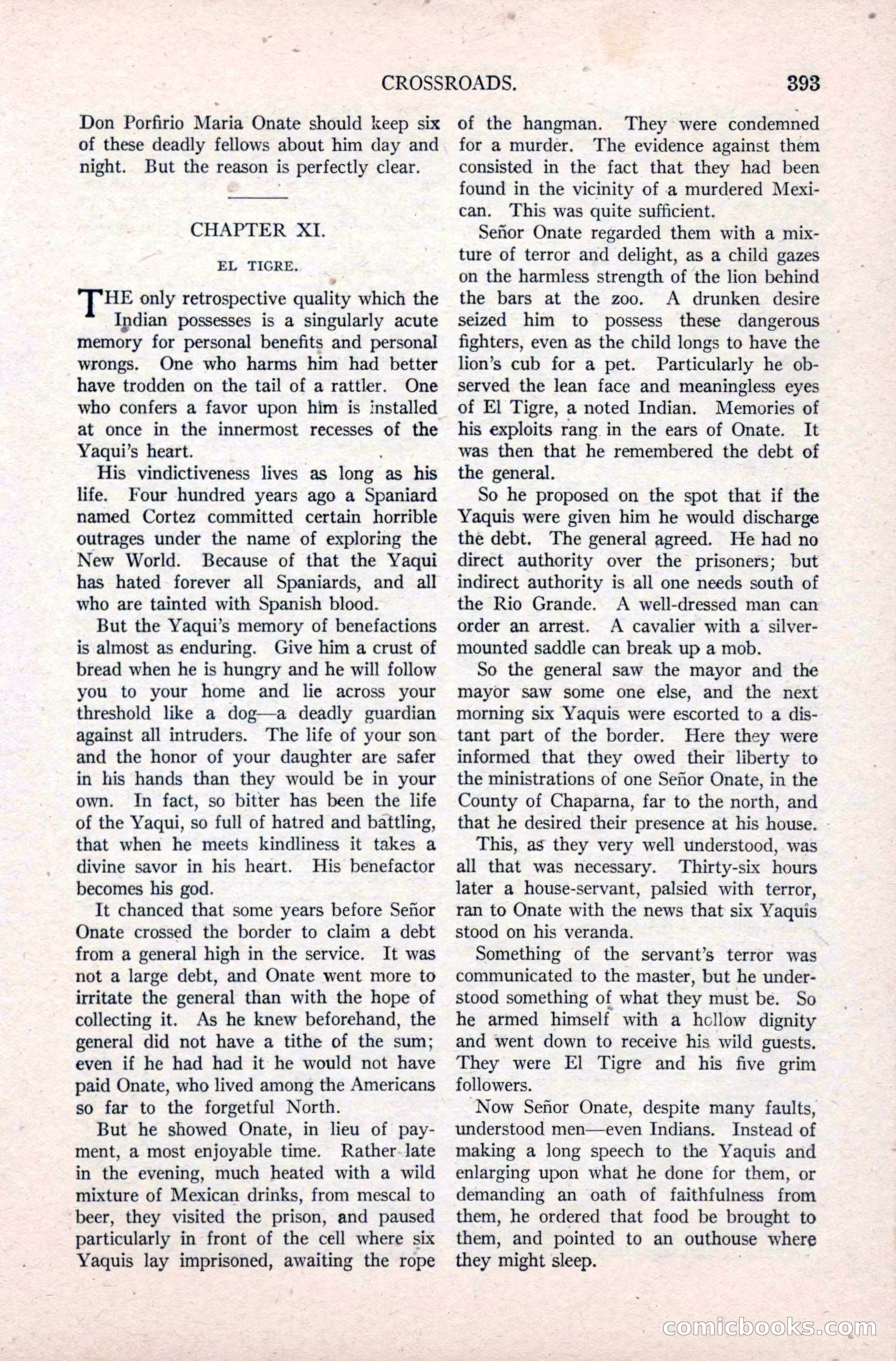
A restored page from Pulp Fiction, 1920. Page through the whole issue in the reader above.
📄 Transcribed text from this page (OCR, searchable)
Machine-transcribed from the original scan — historical spelling and the odd misread are preserved.
CROSSROADS. Don Porfirio Maria Onate should keep six of these deadly fellows about him day and night. But the reason is perfectly clear. CHAPTER XI. EL TIGRE. “THE only retrospective quality which the Indian possesses is a singularly acute memory for personal benefits and personal wrongs. One who harms him had better have trodden on the tail of a rattler. One who confers a favor upon him is installed at once in the innermost recesses of the Yaqui’s heart. His vindictiveness lives as long as his life. Four hundred years ago a Spaniard named Cortez committed certain horrible outrages under the name of exploring the New World. Because of that the Yaqui has hated forever all Spaniards, and all who are tainted with Spanish blood. But the Yaqui’s memory of benefactions is almost as enduring. Give him a crust of bread when he is hungry and he will follow you to your home and lie across your threshold like a dog—a deadly guardian against all intruders. The life of your son and the honor of your daughter are safer in his hands than they would be in your own. In fact, so bitter has been the life of the Yaqui, so full of hatred and battling, that when he meets kindliness it takes a divine savor in his heart. His benefactor becomes his god. It chanced that some years before Senor Onate crossed the border to claim a debt from a general high in the service. It was not a large debt, and Onate went more to irritate the general than with the hope of collecting it. As he knew beforehand, the general did not have a tithe of the sum; even if he had had it he would not have paid Onate, who lived among the Americans so far to the forgetful North. But he showed Onate, in lieu of pay- ment, a most enjoyable time. Rather-late in the evening, much heated with a wild mixture of Mexican drinks, from mescal to beer, they visited the prison, and paused particularly in front of the cell where six Yaquis lay imprisoned, awaiting the rope 393 of the hangman. They were condemned for a murder. The evidence against them consisted in the fact that they had been found in the vicinity of a murdered Mexi- can. This was quite sufficient. Senor Onate regarded them with a mix- ture of terror and delight, as a child gazes on the harmless strength of the lion behind the bars at the zoo. A drunken desire seized him to possess these dangerous fighters, even as the child longs to have the lion’s cub for a pet. Particularly he ob- served the lean face and meaningless eyes of El Tigre, a noted Indian. Memories of his exploits rang in the ears of Onate. It was then that he remembered the debt of the general. So he proposed on the spot that if the Yaquis were given him he would discharge the debt. The general agreed. He had no direct authority over the prisoners; but indirect authority is all one needs south of the Rio Grande. A well-dressed man can order an arrest. A cavalier with a silver- mounted saddle can break up a mob. So the general saw the mayor and the mayor saw some one else, and the next morning six Yaquis were escorted to a dis- tant part of the border. Here they were informed that they owed their liberty to the ministrations of one Senor Onate, in the County of Chaparna, far to the north, and that he desired their presence at his house. | This, as they very well understood, was all that was necessary. Thirty-six hours later a house-servant, palsied with terror, ran to Onate with the news that six Yaquis stood on his veranda. Something of the servant’s terror was communicated to the master, but he under- stood something of what they must be. So he armed himself with a hollow dignity and went down to receive his wild guests, They were El Tigre and his five grim followers. Now Senor Onate, despite many faults, understood men—even Indians. Instead of making a long speech to the Yaquis and enlarging upon what he done for them, or demanding an oath of faithfulness from them, he ordered that food be brought to them, and pointed to an outhouse where they might sleep. 3 GO NOOK C@