
Pulp Fiction, 1920 · page 58 of 188
Argosy, Vol. 117, No. 3 — page 58: what you’re looking at
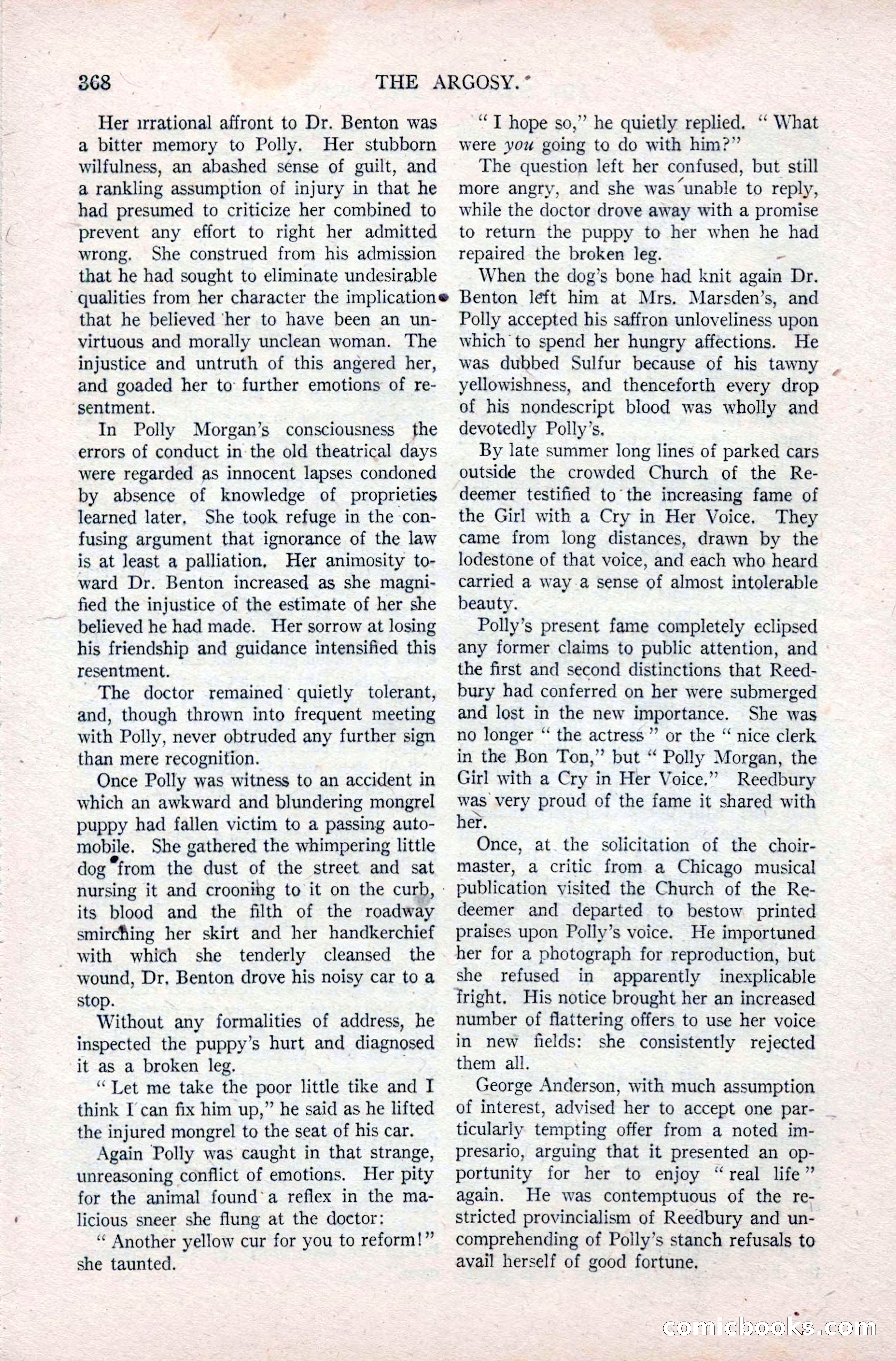
A restored page from Pulp Fiction, 1920. Page through the whole issue in the reader above.
📄 Transcribed text from this page (OCR, searchable)
Machine-transcribed from the original scan — historical spelling and the odd misread are preserved.
368 Her irrational affront to Dr. Benton was a bitter memory to Polly. Her stubborn wilfulness, an abashed sense of guilt, and a rankling assumption of injury in that he had presumed to criticize her combined to prevent any effort to right her admitted wrong. She construed from his admission that he had sought to eliminate undesirable ‘qualities from her character the implicatione that he believed ‘her to have been an un- virtuous and morally unclean woman. The injustice and untruth of this angered her, and goaded her to further emotions of re- sentment. In Polly Morgan’s consciousness the errors of conduct in the old theatrical days were regarded as innocent lapses condoned by absence of knowledge of proprieties learned later, She took refuge in the con- fusing argument that ignorance of the law is at least a palliation, Her animosity to- ward Dr. Benton increased as she magni- fied the injustice of the estimate of her she believed he had made. Her sorrow at losing his friendship and guidance intensified this resentment. The doctor remained’ quietly tolerant, and, though thrown into frequent meeting with Polly, never obtruded any further sign than mere recognition. Once Polly was witness to an accident in which an awkward and blundering mongrel puppy had fallen victim to a passing auto- mobile. She gathered the whimpering little dog "from the dust of the street and sat nursing it and crooning to it on the curb, - its blood and the filth of the roadway smirching her skirt and her handkerchief with which she tenderly cleansed the wound, Dr, Benton drove his noisy car to a stop. Without any formalities of address, he inspected the puppy’s hurt and diagnosed it as a broken leg. ‘Let me take the poor little tike and I think I can fix him up,” he said as he lifted the injured mongrel to the seat of his car. Again Polly was caught in that strange, unreasoning conflict of emotions. Her pity for the animal found’a reflex in the ma- licious sneer she flung at the doctor: ‘ Another yellow cur for you to reform she taunted. Si THE ARGOSY.* ‘“T hope so,” he quietly replied. “‘ What were you going to do with him?” The question left her confused, but still more angry, and she was unable to reply, while the doctor drove away with a promise to return the puppy to her when he had repaired the broken leg. When the dog’s bone had knit again Dr. Benton left him at Mrs. Marsden’s, and Polly accepted his saffron unloveliness upon which to spend her hungry affections. He was dubbed Sulfur because of his tawny yellowishness, and thenceforth every drop of his nondescript blood was wholly and devotedly Polly’s. By late summer long lines of parked cars outside the crowded Church of the Re- deemer testified to the increasing fame of the Girl with a Cry in Her Voice. They came from long distances, drawn by the lodestone of that voice, and each who heard carried a way a sense of almost intolerable beauty. Polly’s present fame completely eclipsed any former claims to public attention, and the first and second distinctions that Reed- bury had conferred on her were submerged and lost in the new importance. She was no longer “ the actress ” or the “ nice clerk in the Bon Ton,” but “ Polly Morgan, the Girl with a Cry in Her Voice,” Reedbury was very proud of the fame it shared with her. Once, at the solicitation of the choir- master, a critic from a Chicago musical publication visited the Church of the Re- deemer and departed to bestow printed praises upon Polly’s voice. He importuned her for a photograph for reproduction, but she refused in apparently inexplicable fright. His notice brought her an increased number of flattering offers to use her voice in new fields: she consistently rejected them all. George Anderson, with much assumption of interest, advised her to accept one par- ticularly tempting offer from a noted im- presario, arguing that it presented an op- portunity for her to enjoy “real life” again. He was contemptuous of the re- stricted provincialism of Reedbury and un- comprehending of Polly’s stanch refusals to avail herself of good fortune, 0) 6) COMMUC (C@)