
Pulp Fiction, 1920 · page 57 of 188
Argosy, Vol. 117, No. 3 — page 57: what you’re looking at
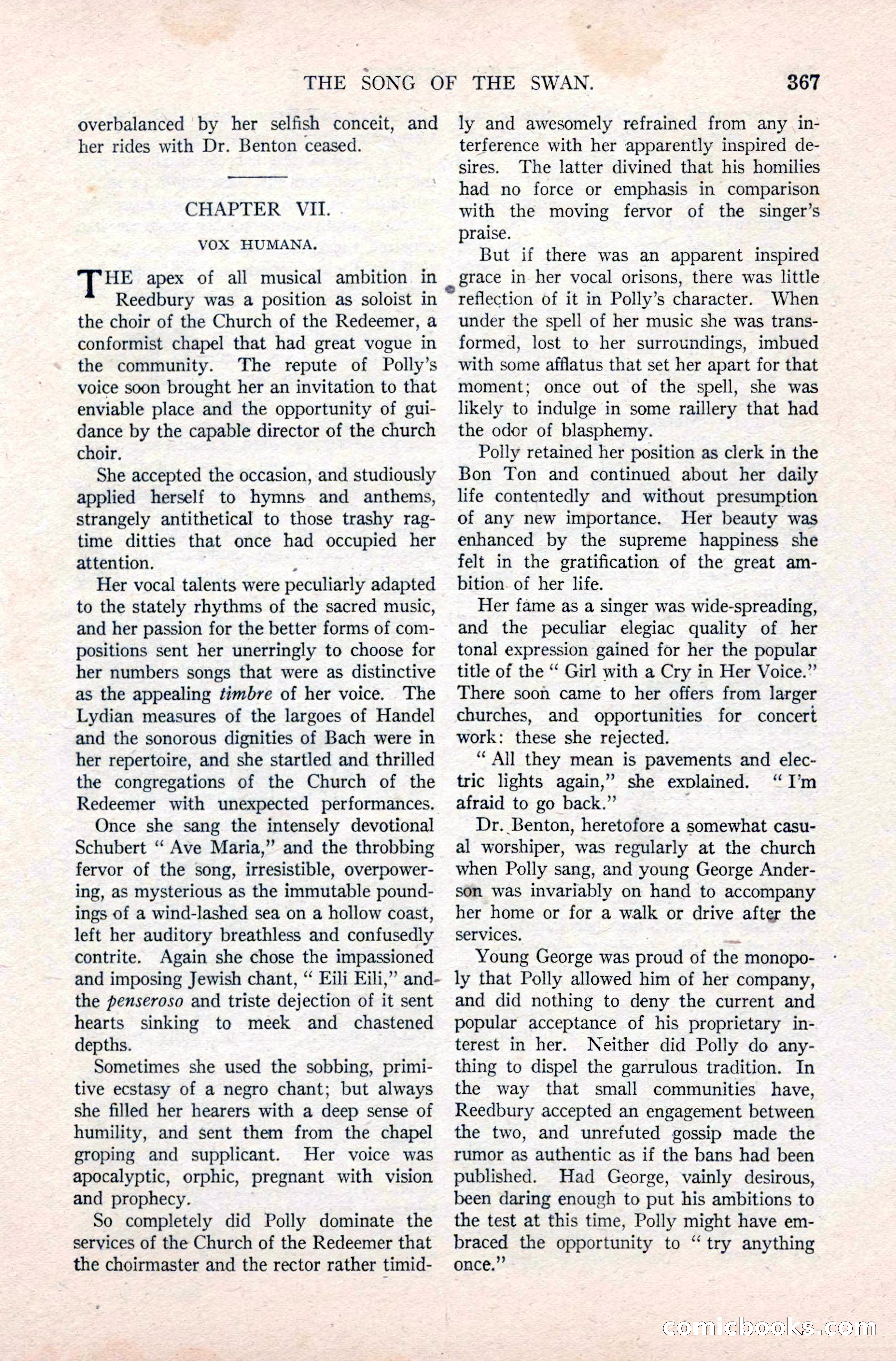
A restored page from Pulp Fiction, 1920. Page through the whole issue in the reader above.
📄 Transcribed text from this page (OCR, searchable)
Machine-transcribed from the original scan — historical spelling and the odd misread are preserved.
THE SONG OF THE SWAN. overbalanced by her selfish conceit, and her rides with Dr. Benton ceased. CHAPTER VII. VOX HUMANA. "THE apex of all musical ambition in Reedbury was a position as soloist in the choir of the Church of the Redeemer, a conformist chapel that had great vogue in the community. The repute of Polly’s voice soon brought her an invitation to that enviable place and the opportunity of gui- dance by the capable director of the church choir. She accepted the occasion, and studiously applied herself to hymns and anthems, strangely antithetical to those trashy rag- time ditties that once had occupied her attention. . Her vocal talents were peculiarly adapted to the stately rhythms of the sacred music, and her passion for the better forms of com- positions sent her unerringly to choose for her numbers songs that were as distinctive as the appealing timbre of her voice. The Lydian measures of the largoes of Handel and the sonorous dignities of Bach were in her repertoire, and she startled and thrilled the congregations of the Church of the Redeemer with unexpected performances. Once she sang the intensely devotional Schubert “ Ave Maria,” and the throbbing fervor of the song, irresistible, overpower- ing, as mysterious as the immutable pound- ings of a wind-lashed sea on a hollow coast, left her auditory breathless and confusedly contrite. Again she chose the impassioned 367 ly and awesomely refrained from any in- terference with her apparently inspired de- sires. The latter divined that his homilies had no force or emphasis in comparison with the moving fervor of the singer’s praise. But if there was an apparent inspired grace in her vocal orisons, there was little reflection of it in Polly’s character. When under the spell of her music she was trans- formed, lost to her surroundings, imbued with some afflatus that set her apart for that moment; once out of the spell, she was likely to indulge in some raillery that had the odor of blasphemy. Polly retained her position as clerk in the Bon Ton and continued about her daily life contentedly and without presumption of any new importance. Her beauty was enhanced by the supreme happiness she felt in the gratification of the great am- bition. of her life. Her fame as a singer was wide-spreading, and the peculiar elegiac quality of her tonal expression gained for her the popular title of the “ Girl with a Cry in Her Voice.” There soon came to her offers from larger churches, and opportunities for concert work: these she rejected. ‘All they mean is pavements and elec- tric lights again,” she explained. “I’m afraid to go back.” Dr. Benton, heretofore a somewhat casu- al worshiper, was regularly at the church when Polly sang, and young George Ander- son was invariably on hand to accompany her home or for a walk or drive after the services. . a Young George was proud of the monopo- and imposing Jewish chant, “ Eili Eili,” and- ly that Polly allowed him of her company, the penseroso and triste dejection of it sent hearts sinking to meek and chastened depths. Sometimes she used the sobbing, primi- tive ecstasy of a negro chant; but always she filled her hearers with a deep sense of humility, and sent them from the chapel groping and supplicant. Her voice was apocalyptic, orphic, pregnant with vision and prophecy. So completely did Polly dominate the services of the Church of the Redeemer that the choirmaster and the rector rather timid- and did nothing to deny the current and popular acceptance of his proprietary in- terest in her. Neither did Polly do any- thing to dispel the garrulous tradition. In the way that small communities have, Reedbury accepted an engagement between the two, and unrefuted gossip made the rumor as authentic as if the bans had been published. Had George, vainly desirous, been daring enough to put his ambitions to the test at this time, Polly might have em- braced the opportunity to “try anything once.”’ COmicloool< (C@