
Pulp Fiction, 1920 · page 46 of 188
Argosy, Vol. 117, No. 3 — page 46: what you’re looking at
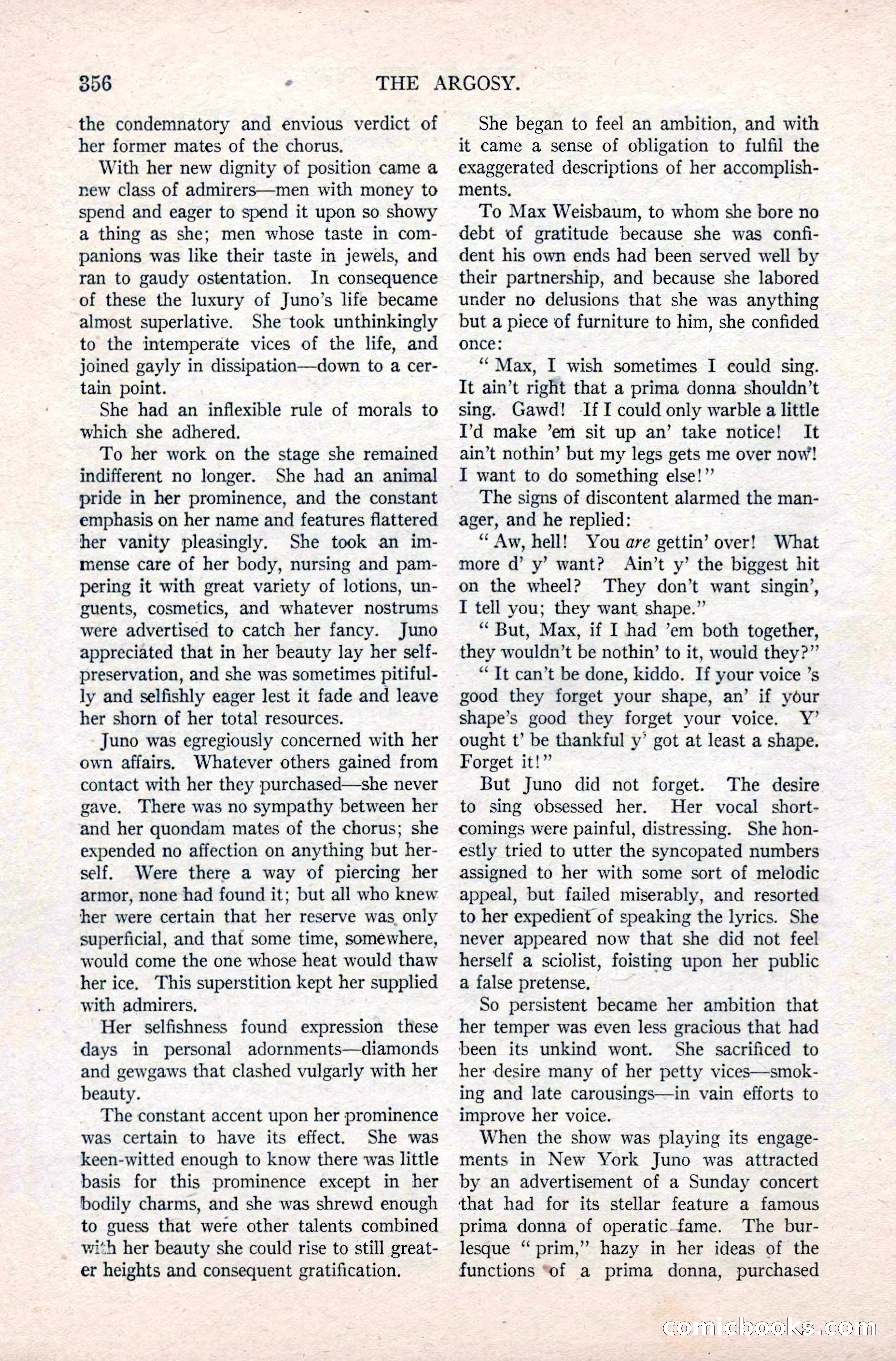
A restored page from Pulp Fiction, 1920. Page through the whole issue in the reader above.
📄 Transcribed text from this page (OCR, searchable)
Machine-transcribed from the original scan — historical spelling and the odd misread are preserved.
206 ? the condemnatory and envious verdict of her former mates of the chorus. With her new dignity of position came a new class of admirers—men with money to spend and eager to spend it upon so showy a thing as she; men whose taste in com- panions was like their taste in jewels, and ran to gaudy ostentation. In consequence of these the luxury of Juno’s life became almost superlative. She took unthinkingly to the intemperate vices of the life, and joined gayly in dissipation—down to a cer- tain point. She had an inflexible rule of morals to which she adhered. To her work on the stage she remained indifferent no longer. She had an animal pride in her prominence, and the constant emphasis on her name and features flattered her vanity pleasingly. She took an im- mense care of her body, nursing and pam- pering it with great variety of lotions, un- guents, cosmetics, and whatever nostrums were advertised to catch her fancy. Juno appreciated that in her beauty lay her self- preservation, and she was sometimes pitiful- ly and selfishly eager lest it fade and leave her shorn of her total resources. Juno was egregiously concerned with her own affairs. Whatever others gained from contact with her they purchased—she never gave. There was no sympathy between her and her quondam mates of the chorus; she expended no affection on anything but her- self. Were there a way of piercing her armor, none had found it; but all who knew her were certain that her reserve was only superficial, and that some time, somewhere, would come the one whose heat would thaw her ice. This superstition kept her supplied with admirers. Her selfishness found expression these days in personal adornments—diamonds and gewgaws that clashed vulgarly with her beauty. The constant accent upon her prominence was certain to have its effect. She was keen-witted enough to know there was little basis for this prominence except in her bodily charms, and she was shrewd enough to guess that were other talents combined with her beauty she could rise to still great- er heights and consequent gratification. THE ARGOSY. — She began to feel an ambition, and with it came a sense of obligation to fulfil the exaggerated descriptions of her accomplish- ments, | To Max Weisbaum, to whom she bore no debt of gratitude because she was confi- dent his own ends had been served well by their partnership, and because she labored under no delusions that she was anything but a piece of furniture to him, she confided once: “Max, I wish sometimes I could sing. It ain’t right that a prima donna shouldn’t sing. Gawd! -If I could only warble a little I’d make ’em sit up an’ take notice! It ain’t nothin’ but my legs gets me over now! I want to do something else!”’ The signs of discontent alarmed the man- ager, and he replied: ; ** Aw, hell! You are gettin’ over! What more d’ y’ want? Aijin’t y’ the biggest hit on the wheel? They don’t want singin’, I tell you; they want shape.”’ “But, Max, if I had ’em both together, they wouldn’t be nothin’ to it, would they?” “It can’t be done, kiddo. If your voice ’s good they forget your shape, an’ if your shape’s good they forget your voice. Y’ ought t’ be thankful y’ got at least a shape. Forget it!” But Juno did not forget. The desire to sing obsessed her. Her vocal short- comings were painful, distressing. She hon- estly tried to utter the syncopated numbers assigned to her with some sort of melodic appeal, but failed miserably, and resorted to her expedient of speaking the lyrics. She never appeared now that she did not feel herself a sciolist, foisting upon her public a false pretense, So persistent became her ambition that her temper was even less gracious that had been its unkind wont. She sacrificed to her desire many of her petty vices—smok- ing and late carousings—in vain efforts to improve her voice. When the show was playing its engage- ments in New York Juno was attracted by an advertisement of a Sunday concert that had for its stellar feature a famous prima donna of operatic-fame. The bur- lesque “ prim,” hazy in her ideas of the functions “of a prima donna, purchased (O) .OO AMG S (C@