
Pulp Fiction, 1920 · page 40 of 188
Argosy, Vol. 117, No. 3 — page 40: what you’re looking at
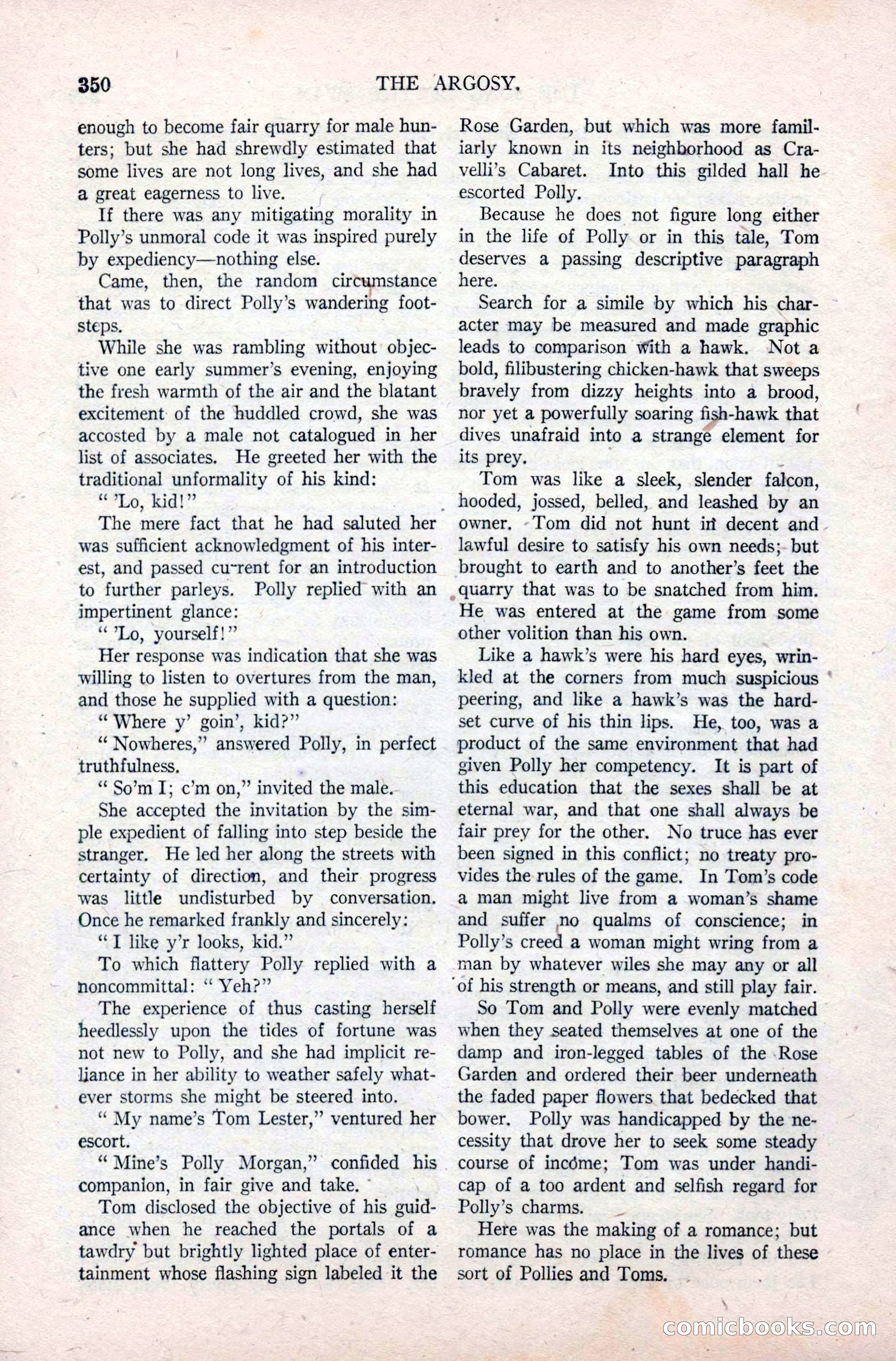
A restored page from Pulp Fiction, 1920. Page through the whole issue in the reader above.
📄 Transcribed text from this page (OCR, searchable)
Machine-transcribed from the original scan — historical spelling and the odd misread are preserved.
350 enough to become fair quarry for male hun- ters; but she had shrewdly estimated that some lives are not long lives, and she had a great eagerness to live. If there was any mitigating morality in Polly’s unmoral code it was inspired purely by expediency—nothing else. Came, then, the random circumstance that was to direct Polly’s wandering foot- steps. While she was rambling without objec- tive one early summer’s evening, enjoying the fresh warmth of the air and the blatant excitement of the huddled crowd, she was accosted by a male not catalogued in her list of associates. He greeted her with the traditional unformality of his kind: "LO, RI The mere fact that he had saluted her was sufficient acknowledgment of his inter- est, and passed cuvrent for an introduction to further parleys. Polly replied with an impertinent glance: "Lo, yourself!” Her response was indication that she was willing to listen to overtures from the man, and those he supplied with a question: “Where y’ goin’, kid?” “¢ Nowheres,” answered Polly, in perfect truthfulness, *¢ So’m I; c’m on,” invited the male. She accepted the invitation by the sim- ple expedient of falling into step beside the stranger. He led her along the streets with certainty of direction, and their progress was little undisturbed by conversation. Once he remarked frankly and sincerely: “J like y’r looks, kid.” To which flattery Polly replied with a noncommittal: ‘“‘ Yeh?” The experience of thus casting herself heedlessly upon the tides of fortune was not new to Polly, and she had implicit re- ljiance in her ability to weather safely what- ever storms she might be steered into. “ My name’s Tom Lester,” ventured her escort. “ Mine’s Polly Morgan,” confided his companion, in fair give and take. ~ Tom disclosed the objective of his guid- ance when he reached the portals of a tawdry but brightly lighted place of enter- tainment whose flashing sign labeled it the THE ARGOSY, Rose Garden, but which was more famil- larly known in its neighborhood as Cra- velli’s Cabaret. Into this gilded hall he escorted Polly. Because he does not figure long either in the life of Polly or in this tale, Tom deserves a passing descriptive paragraph here. Search for a simile by which his char- acter may be measured and made graphic leads to comparison With a hawk. Not a bold, filibustering chicken-hawk that sweeps bravely from dizzy heights into a brood, nor yet a powerfully soaring fish-hawk that dives unafraid into a strange element for its prey. ; Tom was like a sleek, slender falcon, hooded, jossed, belled, and leashed by an owner, -Tom did not hunt itt decent and lawful desire to satisfy his own needs;- but brought to earth and to another’s feet the ,quarry that was to be snatched from him. He was entered at the game from some other volition than his own. Like a hawk’s were his hard eyes, wrin- kled at the corners from much suspicious ‘ peering, and like a hawk’s was the hard- set curve of his thin lips. He, too, was a product of the same environment that had given Polly her competency. It is part of this education that the sexes shall be at eternal war, and that one shall always be fair prey for the other. No truce has ever been signed in this conflict; no treaty pro- vides the rules of the game. In Tom’s code a man might live from a woman’s shame and suffer no qualms of conscience; in Polly’s creed a woman might wring from a man by whatever wiles she may any or all ‘of his strength or means, and still play fair. 50 Tom and Polly were evenly matched when they seated themselves at one of the damp and iron-legged tables of the Rose Garden and ordered their beer underneath the faded paper flowers that bedecked that bower. Polly was handicapped by the ne- cessity that drove her to seek some steady course of incéme; Tom was under handi- cap of a too ardent and selfish regard for Polly’s charms. Here was the making of a romance; but romance has no place in the lives of these sort of Pollies and Toms. (E(0) _OOK €O