
Pulp Fiction, 1920 · page 39 of 188
Argosy, Vol. 117, No. 3 — page 39: what you’re looking at
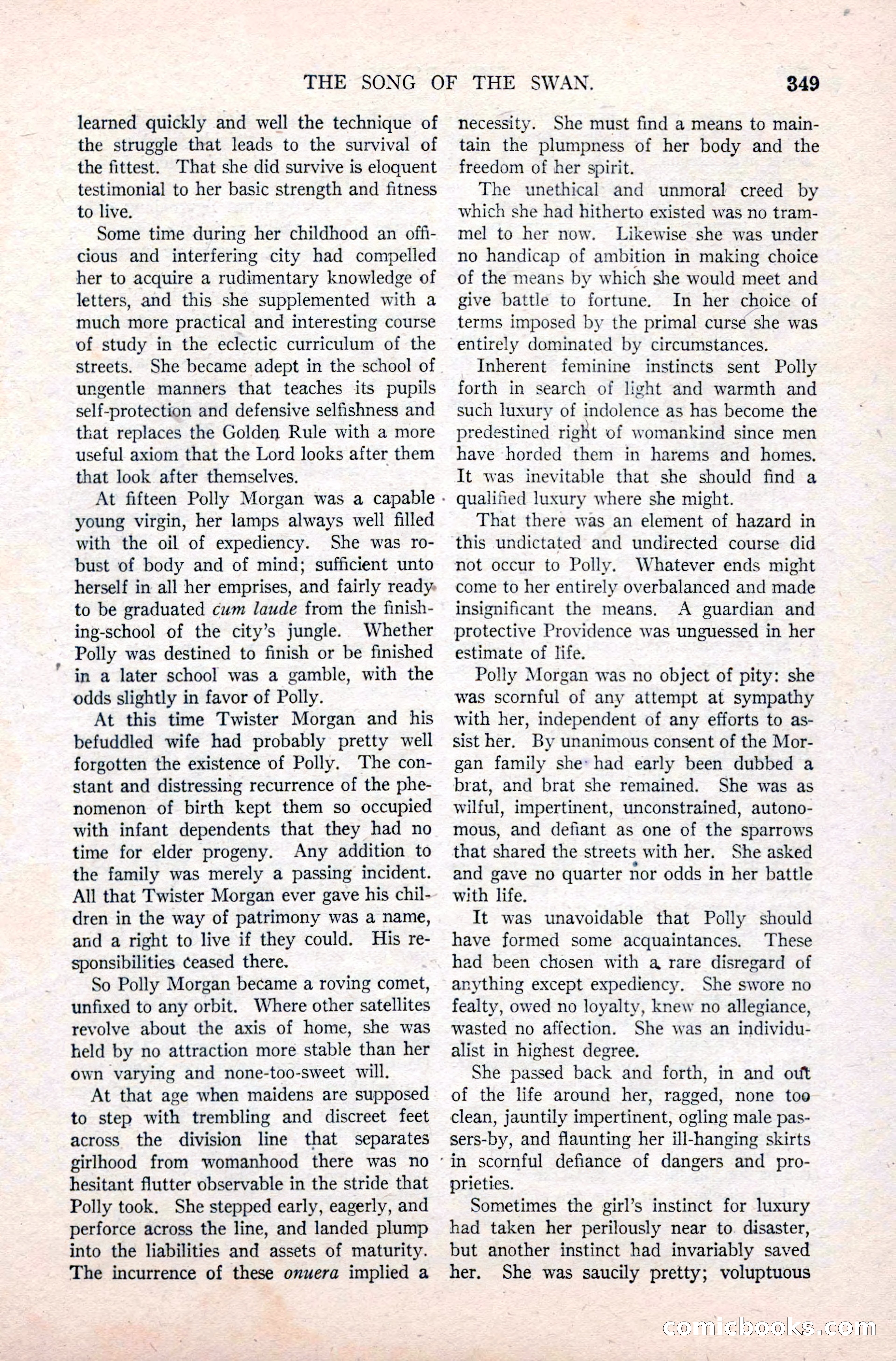
A restored page from Pulp Fiction, 1920. Page through the whole issue in the reader above.
📄 Transcribed text from this page (OCR, searchable)
Machine-transcribed from the original scan — historical spelling and the odd misread are preserved.
THE learned quickly and well the technique of the struggle that leads to the survival of the fittest. That she did survive is eloquent testimonial to her basic strength and fitness to live. Some time during her childhood an offi- cious and interfering city had compelled her to acquire a rudimentary knowledge of letters, and this she supplemented with a much more practical and interesting course of study in the eclectic curriculum of the streets. She became adept in the school of ungentle manners that teaches its pupils self-protection and defensive selfishness and that replaces the Golden Rule with a more useful axiom that the Lord looks after them that look after themselves. At fifteen Polly Morgan was a capable - young virgin, her lamps always well filled with the oil of expediency. She was ro- bust of body and of mind; sufficient unto herself in all her emprises, and fairly ready to be graduated cum laude from the finish- ing-school of the city’s jungle. Whether Polly was destined to finish or be finished in a later school was a gamble, with the odds slightly in favor of Polly. At this time Twister Morgan and his befuddled wife had probably pretty well forgotten the existence of Polly. ‘The con- stant and distressing recurrence of the phe- nomenon of birth kept them so occupied with infant dependents that they had no time for elder progeny. Any addition to the family was merely a passing incident. All that Twister Morgan ever gave his chil- dren in the way of patrimony was a name, and a right to live if they could. His re- sponsibilities ceased there. So Polly Morgan became a roving comet, unfixed to any orbit. Where other satellites revolve about the axis of home, she was held by no attraction more stable than her own varying and none-too-sweet will. At that age when maidens are supposed to step with trembling and discreet feet across the division line that separates girlhood from womanhood there was no hesitant flutter observable in the stride that Polly took. She stepped early, eagerly, and perforce across the line, and landed plump into the liabilities and assets of maturity. The incurrence of these onuera implied a SONG OF THE SWAN. 349 necessity. She must find a means to main- tain the plumpness of her body and the freedom of her spirit. The unethical and unmoral creed by which she had hitherto existed was no tram- mel to her now. Likewise she was under no handicap of ambition in making choice of the means by which she would meet and give battle to fortune. In her choice of terms imposed by the primal curse she was entirely dominated by circumstances. Inherent feminine instincts sent Polly forth in search of light and warmth and such luxury of indolence as has become the predestined right of womankind since men have horded them in harems and homes, It was inevitable that she should find a qualified luxury where she might. That there was an element of hazard in this undictated and undirected course did not occur to Polly. Whatever ends might come to her entirely overbalanced and made insignificant the means. A guardian and protective Providence was unguessed in her estimate of life. Polly Morgan was no object of pity: she was scornful of any attempt at sympathy with her, independent of any efforts to as- sist her. By unanimous consent of the Mor- gan family she’ had early been dubbed a brat, and brat she remained. She was as wilful, impertinent, unconstrained, autono- mous, and defiant as one of the sparrows that shared the streets with her. She asked and gave no quarter nor odds in her battle with life. It was unavoidable that Polly should have formed some acquaintances. These had been chosen with a rare disregard of anything except expediency. She swore no fealty, owed no loyalty, knew no allegiance, wasted no affection. She was an individu- alist in highest degree. She passed back and forth, in and out of the life around her, ragged, none toe clean, jauntily impertinent, ogling male pas- sers-by, and flaunting her ill-hanging skirts ‘in scornful defiance of dangers and pro- prieties. Sometimes the girl’s instinct for luxury had taken her perilously near to. disaster, but another instinct had invariably saved her. She was saucily pretty; voluptuous S CORICLOO© (C@