
Pulp Fiction, 1920 · page 84 of 176
Argosy, Vol. 117, No. 2 — page 84: what you’re looking at
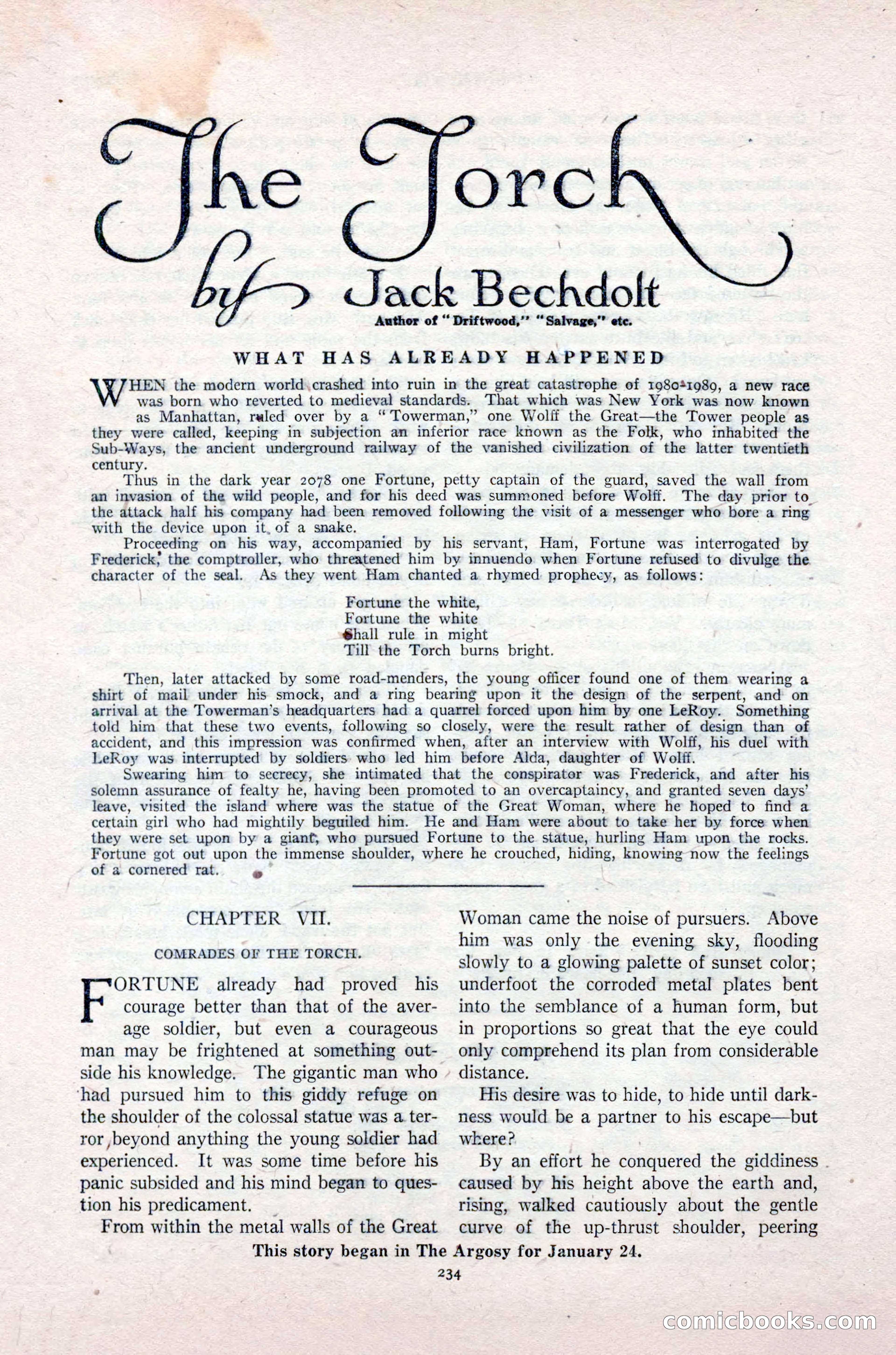
A restored page from Pulp Fiction, 1920. Page through the whole issue in the reader above.
📄 Transcribed text from this page (OCR, searchable)
Machine-transcribed from the original scan — historical spelling and the odd misread are preserved.
OVC Jack Bechdolt Author of “ Driftwood,’’ “Salvage,"’ etc. Cc os WHAT HAS ALREADY HAPPENED r7HEN the modern world.crashed into ruin in the great catastrophe of 19801980, a new race was born who reverted to medieval standards. That which was New York was now known as Manhattan, ruled over by a “Towerman,” one Wolff the Great—the Tower people as they were called, keeping in subjection an inferior race known as the Folk, who inhabited the Sub-Ways, the ancient underground railway of the vanished civilization of the latter twentieth century. Thus in the dark year 2078 one Fortune, petty captain of the guard, saved the wall from an invasion of the wild people, and for his deed was summoned before Wolff. The day prior to the attack half his company had been removed following the visit of a messenger who bore a ring with the device upon it, of a snake. Proceeding on his way, accompanied by his servant, Ham, Fortune was interrogated by Frederick; the comptroller, who threatened him by innuendo when Fortune refused to divulge the character of the seal. As they went Ham chanted a rhymed: prophecy, as follows: i Fortune the white, Fortune the white $hall rule in might Till the Torch burns bright. Then, later attacked by some road-menders, the young officer found one of them wearing a shirt of mail under his smock, and a ring bearing upon it the design of the serpent, and on arrival at the Towerman’s headquarters had a quarrel forced upon him by one LeRoy. Something told him that these two events, following so closely, were the result rather of design than of accident, and this impression was confirmed when, after an interview with Wolff, his duel with LeRoy was interrupted by soldiers. who led him before Alda, daughter of Wolff. Swearing him to seerecy, she intimated that the conspirater was Frederick, and after his solemn assurance of fealty he, having been promoted to an overcaptaincy, and granted seven days’ leave, visited the island where was the statue of the Great Woman, where he hoped to find a certain girl who had mightily beguiled him. He and Ham were about to take her by force when they were set upon by a giant, who pursued Fortune to the statue, hurling Ham upon the rocks. Fortune got out upon the immense shoulder, where he crouched, hiding, knowing now the feelings of a cornered rat. e CHAPTER VII. COMRADES OF THE TORCH. ORTUNE already had proved his courage better than that of the aver- age soldier, but even a courageous man may be frightened at something out- side his knowledge. The gigantic man who ‘had pursued him to this giddy refuge on the shoulder of the colossal statue was a. ter- ror beyond anything the young soldier had experienced. It was some time before his panic subsided and his mind began to ques- tion his predicament. _ From within the metal walls of the Great Woman came the noise of pursuers. Above him was only the evening sky, flooding slowly to a glowing palette of sunset color; underfoot the corroded metal plates bent into the semblance of a human form, but in proportions so great that the eye could only comprehend its plan from considerable distance. His desire was to hide, to hide until dark- ness would be a partner to his escape—but where? By an effort he conquered the giddiness . caused by his height above the earth and, rising, walked cautiously about the gentle curve of the up-thrust shoulder, peering This story began in The Argosy for January 24. 234 comichbook (C@