
Pulp Fiction, 1920 · page 83 of 176
Argosy, Vol. 117, No. 2 — page 83: what you’re looking at
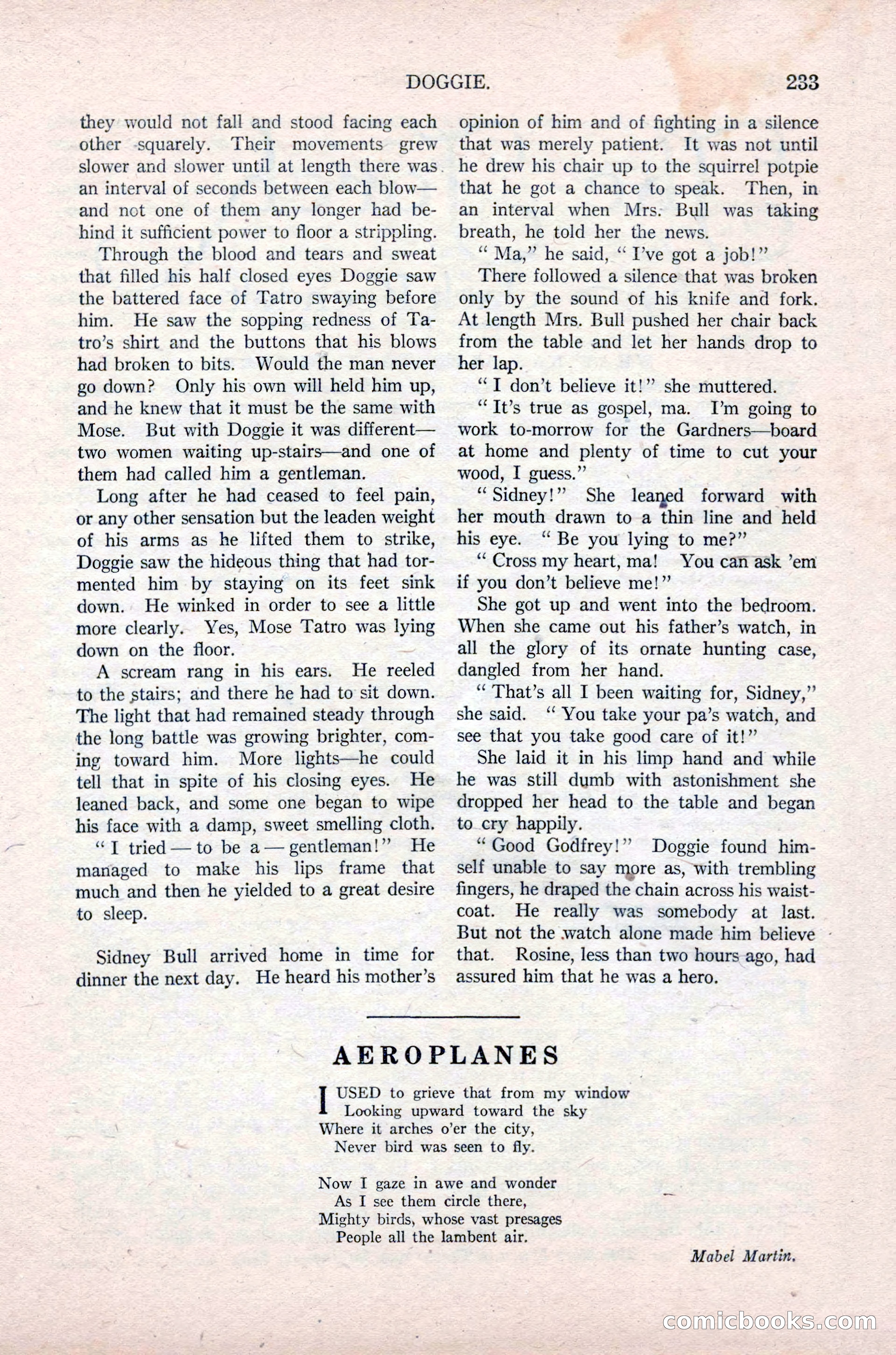
A restored page from Pulp Fiction, 1920. Page through the whole issue in the reader above.
📄 Transcribed text from this page (OCR, searchable)
Machine-transcribed from the original scan — historical spelling and the odd misread are preserved.
DOGGIE. they would not fall and stood facing each other -squarely. Their movements grew slower and slower until at length there was. an interval of seconds between each blow— and not one of them any longer had be- hind it sufficient power to floor a strippling. Through the blood and tears and sweat that filled his half closed eyes Doggie saw the battered face of Tatro swaying before him. He saw the sopping redness of Ta- tro’s shirt and the buttons that his blows had broken to bits. Would the man never go down? Only his own will held him up, and he knew that it must be the same with Mose. But with Doggie it was different— two women waiting up-stairs—and one of them had called him a gentleman. Long after he had ceased to feel pain, or any other sensation but the leaden weight of his arms as he lifted them to strike, Doggie saw the hideous thing that had tor- mented him by staying on its feet sink down. He winked in order to see a little more clearly. Yes, Mose Tatro was lying down on the floor. A scream rang in his ears. He reeled to the stairs; and there he had to sit down. The light that had remained steady through the long battle was growing brighter, com- ing toward him. More lights—he could tell that in spite of his closing eyes. He leaned back, and some one began to wipe his face with a damp, sweet smelling cloth. ‘““T tried — to be a— gentleman!” He managed to make his lips frame that much and then he yielded to a great desire to sleep. . Sidney Bull arrived home in time for dinner the next day. He heard his mother’s 2933 opinion of him and of fighting in a silence that was merely patient. It was not until he drew his chair up to the squirrel potpie that he got a chance to speak. Then, in an interval when Mrs. Bull was taking breath, he told her the news. “Ma,” he said, “ I’ve got a job!” There followed a silence that was broken only by the sound of his knife and fork. At length Mrs. Bull pushed her chair back from the table and let her hands drop to her lap. “IT don’t believe it!” she muttered. ‘It’s true as gospel, ma. I’m going to work to-morrow for the Gardners—board at home and plenty of time to cut your wood, I guess.”’ “Sidney!” She leaned forward with her mouth drawn to a thin line and held his eye. “ Be you lying to me?” ‘““ Cross my heart, ma! You can ask ’em if you don’t believe me!”’ She got up and went into the bedroom. When she came out his father’s watch, in all the glory of its ornate hunting case, dangled from her hand. ‘“That’s all I been waiting for, Sidney,” she said. ‘‘ You take your pa’s watch, and see that you take good care of it!” She laid it in his limp hand and while he was still dumb with astonishment she dropped her head to the table and began to cry happily. “Good Godfrey!” Doggie found him- self unable to say more as, with trembling fingers, he draped the chain across his waist- coat. He really was somebody at last. But not the watch alone made him believe - that. Rosine, less than two hours ago, had assured him that he was a hero. AEROPLANES USED to grieve that from my window Looking upward toward the sky Where it arches o’er the city, Never bird was seen to fly. Now I gaze in awe and wonder As I see them circle there, Mighty birds, whose vast presages People all the lambent air. Mabel Martin. GEomichbook (C@