
Pulp Fiction, 1920 · page 32 of 176
Argosy, Vol. 117, No. 2 — page 32: what you’re looking at
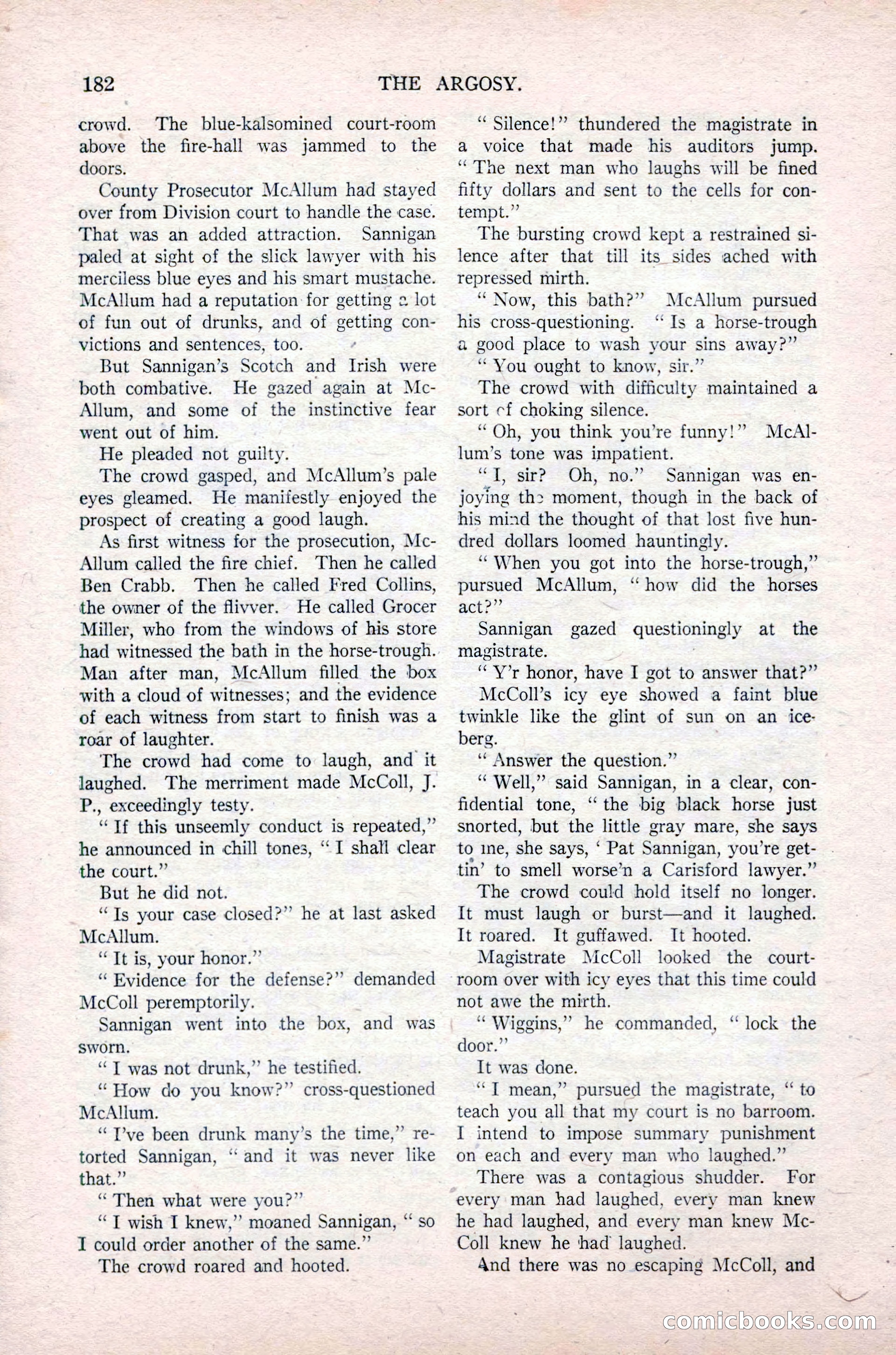
A restored page from Pulp Fiction, 1920. Page through the whole issue in the reader above.
📄 Transcribed text from this page (OCR, searchable)
Machine-transcribed from the original scan — historical spelling and the odd misread are preserved.
182 crowd. The blue-kalsomined court-room above the fire-hall was jammed to the doors. County Prosecutor McAllum had stayed over from Division court to handle the case. That was an added attraction. Sannigan paled at sight of the slick lawyer with his merciless blue eyes and his smart mustache. McAllum had a reputation for getting 2 lot of fun out of drunks, and of getting con- victions and sentences, too. But Sannigan’s Scotch and Irish were both combative. He gazed again at Mc- Allum, and some of the instinctive fear went out of him. He pleaded not guilty. The crowd gasped, and McAllum’s pale eyes gleamed. He manifestly enjoyed the prospect of creating a good laugh. As first witness for the prosecution, Mc- Allum called the fire chief. Then he called Ben Crabb. Then he called Fred Collins, the owner of the flivver. He called Grocer Miller, who from the windows of his store had witnessed the bath in the horse-trough. Man after man, McAllum filled the box with a cloud of witnesses; and the evidence of each witness from start to finish was a roar of laughter. The crowd had come to laugh, and it laughed. The merriment made McColl, J. P., exceedingly testy. “Tf this unseemly conduct is repeated,” he announced in chill tones, ‘‘ I shall clear the court.” But he did not. “Is your case closed?” he at last asked McAllum. “Tt is, your honor.” “ Evidence for the defense?’’ demanded McColl peremptorily. Sannigan went into the box, and was sworn. “ T was not drunk,” he testified. “How do you know?” cross-questioned McAllum. “ T’ve been drunk many’s the time,” re- torted Sannigan, ‘‘ and it was never like that.” “Then what were you?”’ “TI wish I knew,” moaned Sannigan, “ so I could order another of the same.” The crowd roared and hooted. THE ARGOSY. ‘“ Silence!” thundered the magistrate in a voice that made his auditors jump. ‘“The next man who laughs will be fined fifty dollars and sent to the cells for con- tempt.” The bursting crowd kept a restrained si- lence after that till its sides ached with repressed mirth. ‘Now, this bath?” McAllum pursued his cross-questioning. “Is a horse-trough a good place to wash your sins away?” * You ought to know, sir.” The crowd with difficulty maintained a sort cf choking silence. “Oh, you think you’re funny!” lum’s tone was impatient. “I, sir? Oh, no.” Sannigan was en- joying ths moment, though in the back of his mind the thought of that lost five hun- dred dollars loomed hauntingly. ‘“When you got into the horse-trough,” pursued McAllum, ‘“ how did the horses act?” Sannigan magistrate. “'Y’r honor, have I got to answer that?” McColl’s icy eye showed a faint blue twinkle like the glint of sun on an ice- berg. ‘“ Answer the question.” ‘ Well,” said Sannigan, in a clear, con- fidential tone, “the big black horse just snorted, but the little gray mare, she says to ine, she says, ‘ Pat Sannigan, you’re get- tin’ to smell worse’n a Carisford lawyer.” The crowd could hold itself no longer. [It must laugh or burst—and it laughed. It roared. It guffawed. It hooted. Magistrate McColl looked the court- room over with icy eyes that this time could not awe the mirth. ‘‘ Wiggins,” he commanded, “ lock the door.”’ It was done. ‘“T mean,” pursued the magistrate, “ to teach you all that my court is no barroom. I intend to impose summary punishment on each and every man who laughed.” There was a contagious shudder. For every man had laughed, every man knew he had laughed, and every man knew Mc- Coll knew he had laughed. And there was no escaping McColl, and McAl- gazed questioningly at the VOOKS COLAMUGE (E@)