
Pulp Fiction, 1920 · page 31 of 176
Argosy, Vol. 117, No. 2 — page 31: what you’re looking at
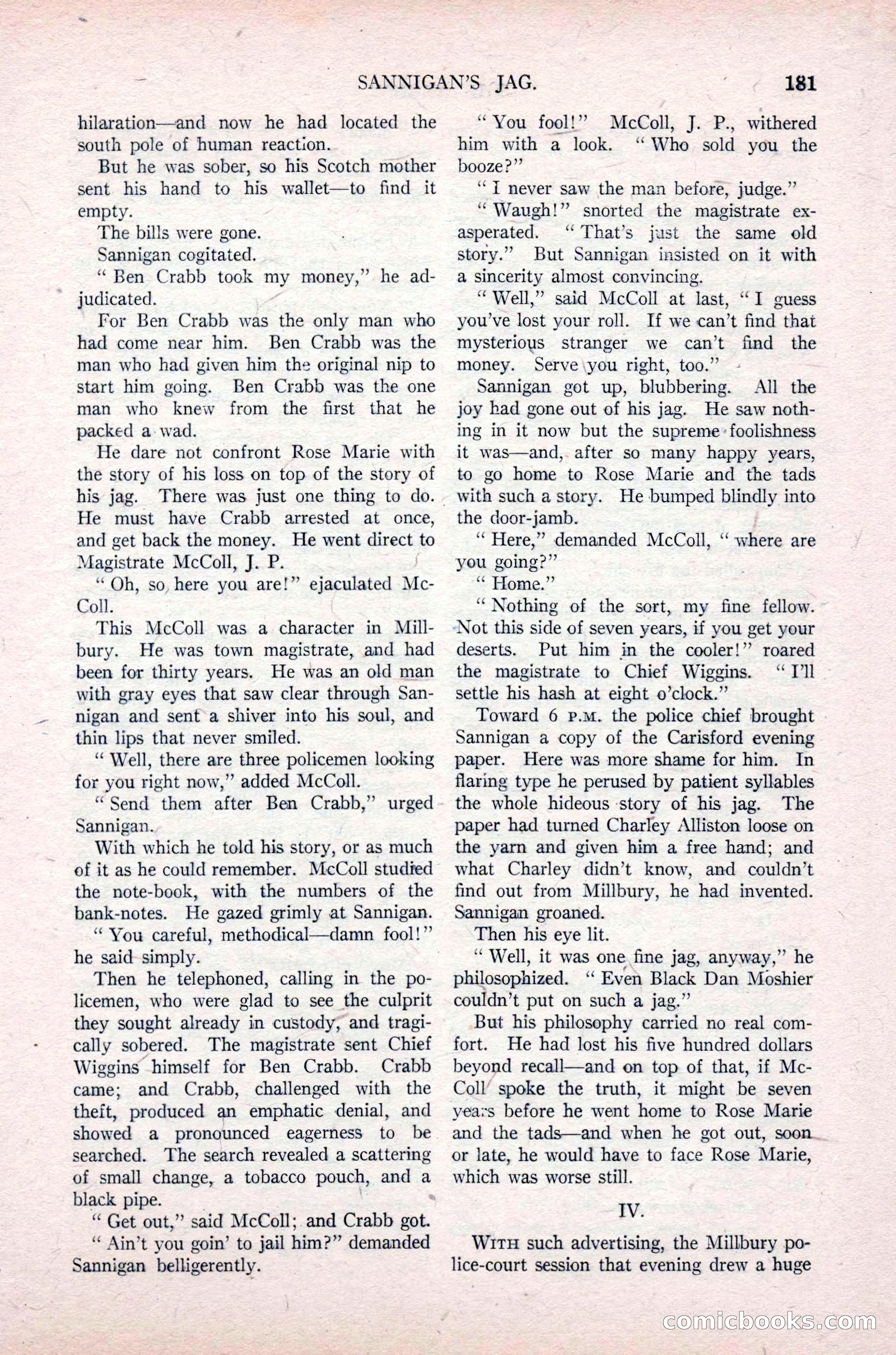
A restored page from Pulp Fiction, 1920. Page through the whole issue in the reader above.
📄 Transcribed text from this page (OCR, searchable)
Machine-transcribed from the original scan — historical spelling and the odd misread are preserved.
> - SANNIGAN’S. JAG. hilaration—and now he had located the south pole of human reaction. But he was sober, so his Scotch mother sent his hand to his wallet—to find it empty. The bills were gone. Sannigan cogitated. “Ben Crabb took my money,” he ad- judicated. For Ben Crabb was the only man who had come near him. Ben Crabb was the man who had given him the original nip to start him going. Ben Crabb was the one man who knew from the first that he packed a- wad. He dare not confront Rose Marie with the story of his loss on top of the story of his jag. He must have Crabb arrested at once, and get back the money. He went direct to Magistrate McColl, J. P. “Oh, so, here you are!” ejaculated Mc- Coll. This McColl was a character in Mill- bury. He was town magistrate, and had been for thirty years. He was an old man with gray eyes that saw clear through San- nigan and sent a shiver into his soul, and thin lips that never smiled. ‘Well, there are three policemen looking for you right now,” added McColl. “Send them after Ben Crabb,” urged Sannigan. With which he told his story, or as much of it as he could remember. McColl studied the note-book, with the numbers of the bank-notes. He gazed grimly at Sannigan. “You careful, methodical—damn fool!” he said simply. Then he telephoned, calling in the po- licemen, who were glad to see the culprit they sought already in custody, and tragi- cally sobered. The magistrate sent Chief Wiggins himself for Ben Crabb. Crabb came; and Crabb, challenged with the theft, produced an emphatic denial, and showed a pronounced eagerness to be searched. The search revealed a scattering of small change, a tobacco pouch, and a black pipe. | “ Get out,” said McColl; and Crabb got. ‘ Ain’t you goin’ to jail him?” demanded Sannigan belligerently. There was just one thing to do. . 181 “You fool!’ McColl, J. P., withered him with a look. ‘“ Whe sold you the booze?” ‘“T never saw the man before, judge.” “Waugh!” snorted the magistrate ex- asperated. ‘“ That’s just the same old story.” But Sannigan insisted on it with a sincerity almost convincing. “Well,” said McColl at last, “I guess you’ve lost your roll. If we can’t find that mysterious stranger we can’t find the money. Serve \you right, too.” Sannigan got up, blubbering. All the joy bad gone out of his jag. He saw noth- ing in it now but the supreme: foolishness it was—and, after so many happy years, to go home to Rose Marie and the tads with such a story. He bumped blindly into the door-jamb. ‘“ Here,” demanded McColl, ‘“ where are you going?” ‘* Home.” ‘Nothing of the sort, my fine fellow. ‘Not this side of seven years, if you get your deserts. Put him in the cooler!” roared the magistrate to Chief Wiggins. ‘I'll settle his hash at eight o’clock.” Toward 6 p.m. the police chief brought Sannigan a copy of the Carisford evening paper. Here was more shame for him. In flaring type he perused by patient syllables the whole hideous ‘story of his jag. The paper had turned Charley Alliston loose on the yarn and given him a free hand; and what Charley didn’t know, and couldn’t find out from Millbury, he had invented. Sannigan groaned. Then his eye lit. “ Well, it was one fine jag, anyway,” he philosophized. ‘‘ Even Black Dan Moshier couldn’t put on such a jag.” But his philosophy carried no real com- fort. He had lost his five hundred dollars beyond recall—and on top of that, if Mc- Coll’ spoke the truth, it might be seven yeas before he went home to Rose Marie and the tads—and when he got out, soon. or late, he would have to face Rose Marie, which was worse still. IV. WitH such advertising, the Millbury po- lice-court session that evening drew a huge Gomichbooks (C@