
Pulp Fiction, 1920 · page 142 of 176
Argosy, Vol. 117, No. 2 — page 142: what you’re looking at
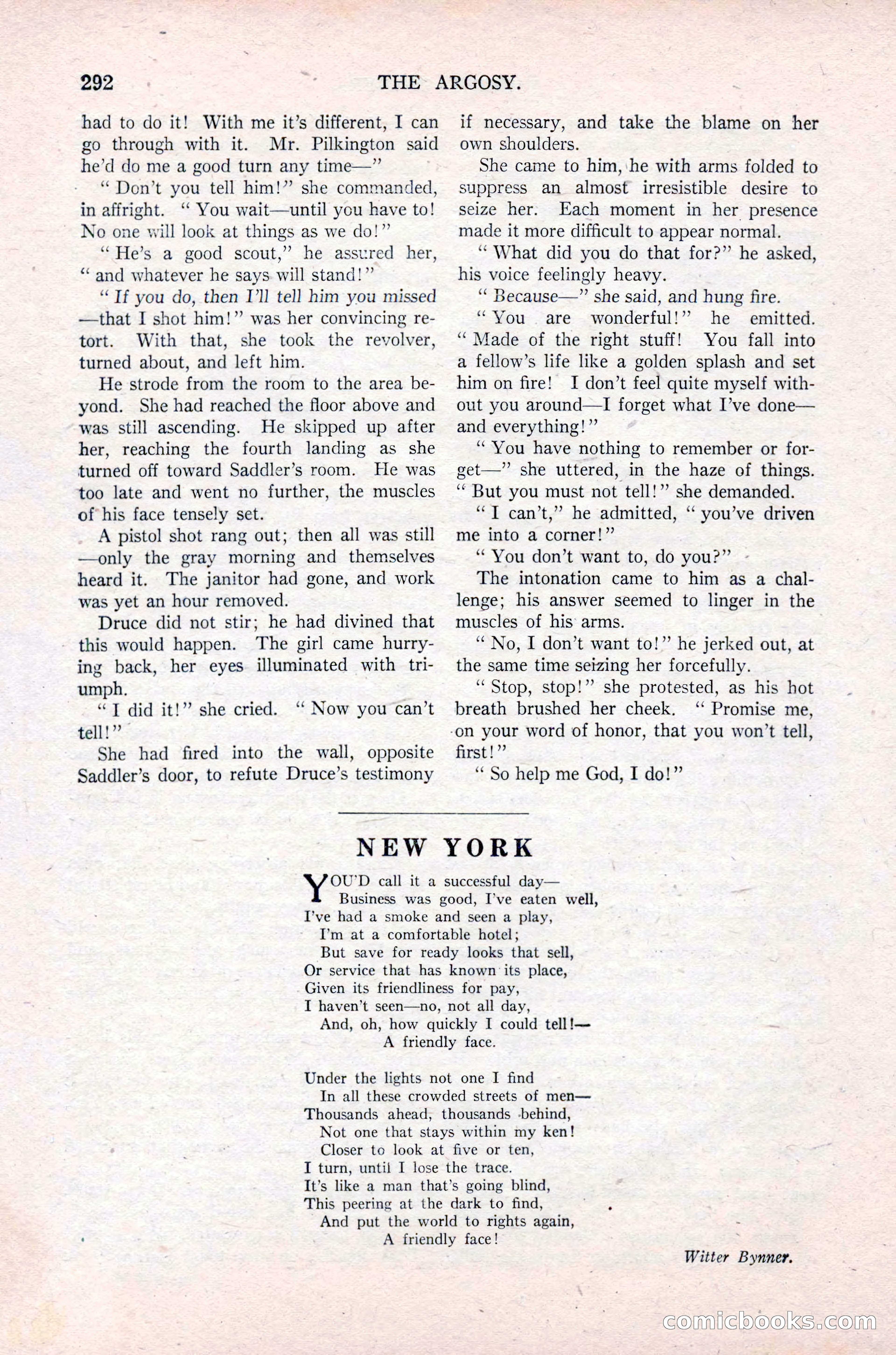
A restored page from Pulp Fiction, 1920. Page through the whole issue in the reader above.
📄 Transcribed text from this page (OCR, searchable)
Machine-transcribed from the original scan — historical spelling and the odd misread are preserved.
292 THE had to do it! With me it’s different, I can go through with it. Mr. Pilkington said he’d do me a good turn any time—”’ “Don’t you tell him!” she commanded, in affright. “ You wait—until you have to! No one will look at things as we do!” “He’s a good scout,” he assured her, “and whatever he says will stand!” “Tf you do, then I’ll tell him you missed —that I shot him!” was her convincing re- tort. With that, she took the revolver, turned about, and left him. He strode from the room to the area be- yond. She had reached the floor above and was still ascending. He skipped up after her, reaching the fourth landing as she turned off toward Saddler’s room. He was too late and went no further, the muscles of his face tensely set. A pistol shot rang out; then all was still —only the gray morning and themselves heard it. The janitor had gone, and work was yet an hour removed. Druce did not stir; he had divined that this would happen. The girl came hurry- ing back, her eyes illuminated with tri- umph, “T did it!” she cried. tell!” She had fired into the wall, opposite Saddler’s door, to refute Druce’s testimony ‘““ Now you can’t ARGOSY. if necessary, and take the blame on her own shoulders. She came to him, he with arms folded to suppress an almost irresistible desire to seize her. Each moment in her presence made it more difficult to appear normal. ‘What did you do that for?” he asked, his voice feelingly heavy. ‘“ Because—”’ she said, and hung fire. “You are wonderful!” he _ emitted. ‘““ Made of the right stuff! You fall into a fellow’s life like a golden splash and set him on fire! I don’t feel quite myself with- out you around—lI forget what I’ve done— and everything!” ‘You have nothing to remember or for- get—” she uttered, in the haze of things. ‘But you must not tell!” she demanded. ‘“T can’t,” he admitted, “ you’ve driven me into a corner!” “ You don’t want to, do you?” The intonation came to him as a chal- lenge; his answer seemed to linger in the muscles of his arms. “No, I don’t want to!” he jerked out, at the same time seizing her forcefully. ‘Stop, stop!” she protested, as his hot breath brushed her cheek. ‘‘ Promise me, -on your word of honor, that you won’t tell, first!” ‘“ So help me God, I do!” NEW YORK OU’D call it a successful day— Business was good, I’ve eaten well, I’ve had a smoke and seen a play, I’m at a comfortable hotel; But save for ready looks that sell, Or service that has known ‘its place, Given its friendliness for pay, I haven’t seen—no, not all day, And, oh, how quickly I could tell!— A friendly face. Under the lights not one I find In all these crowded streets of men— Thousands ahead, thousands -behind, Not one that stays within my ken! Closer to look at five or ten, I turn, until I lose the trace. It’s like a man that’s going blind, This peering at the dark to find, And put the world to rights again, A friendly face! Witter Bynner. Gomichbooks (C@