
Pulp Fiction, 1920 · page 141 of 176
Argosy, Vol. 117, No. 2 — page 141: what you’re looking at
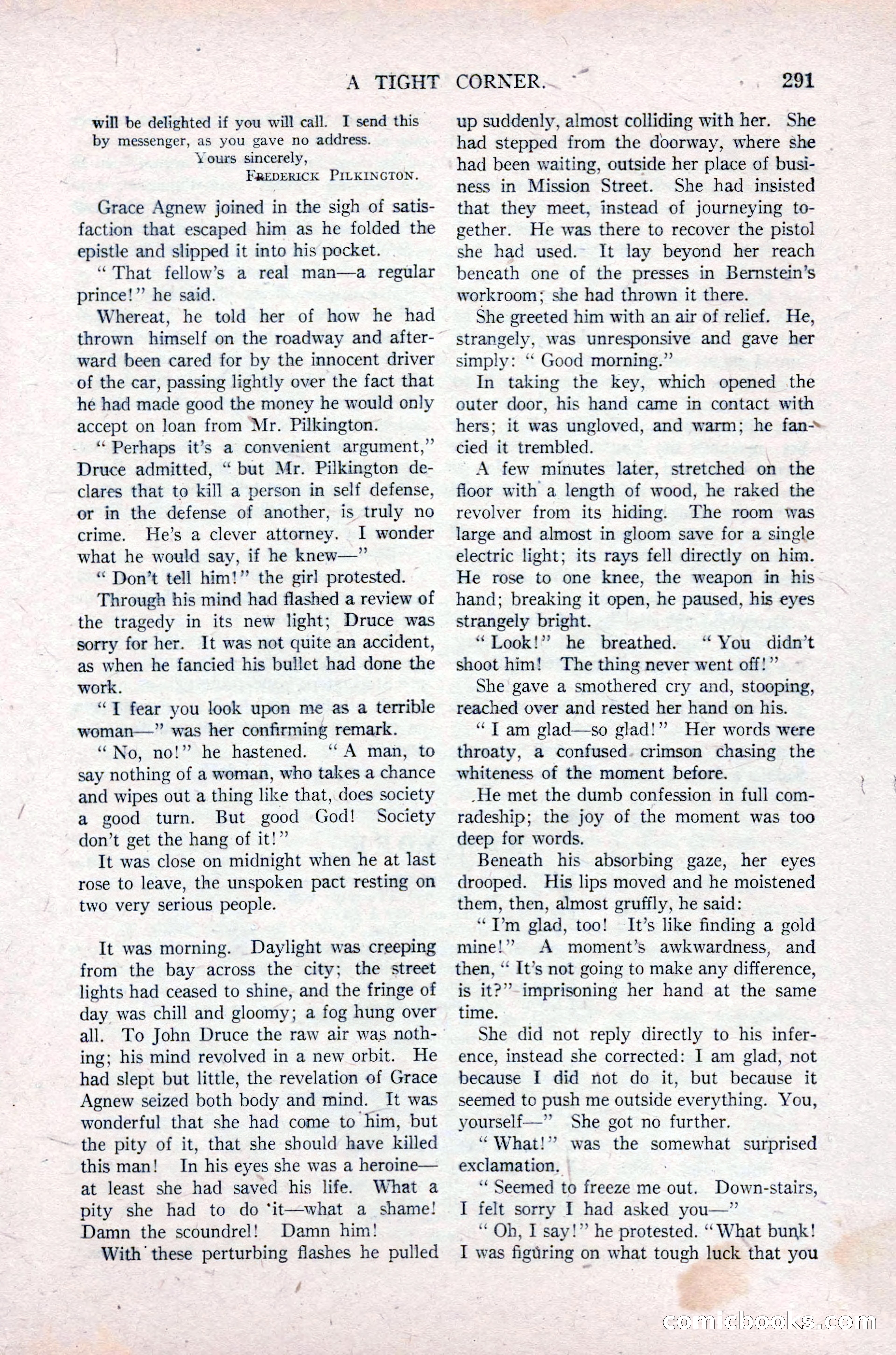
A restored page from Pulp Fiction, 1920. Page through the whole issue in the reader above.
📄 Transcribed text from this page (OCR, searchable)
Machine-transcribed from the original scan — historical spelling and the odd misread are preserved.
A TIGHT will be delighted if you will call. I send this by messenger, as you gave no address. Yours sincerely, FREDERICK PILKINGTON. Grace Agnew joined in the sigh of satis- faction that escaped him as he folded the epistle and slipped it into his pocket. “That fellow’s a real man—a regular prince!” he said. Whereat, he told her of how he had thrown himself on the roadway and after-— ward been cared for by the innocent driver of the car, passing lightly over the fact that he had made good the money he would only accept on loan from Mr. Pilkington. ‘‘ Perhaps it’s a convenient argument,” Druce admitted, “ but Mr. Pilkington de- clares that to kill a person in self defense, or in the defense of another, is truly no crime. He’s a clever attorney. I wonder what he would say, if he knew—” “ Don’t tell him!” the girl protested. Through his mind had flashed a review of the tragedy in its new light; Druce was sorry for her. It was not quite an accident, as when he fancied his bullet had done the work. “T fear you look upon me as a terrible woman—” was her confirming remark. ‘No, no!” he hastened. ‘‘A man, to say nothing of a woman, who takes a chance and wipes out a thing like that, does society a good turn. But good God! Society don’t get the hang of it!” It was close on midnight when he at last rose to leave, the unspoken pact resting on two very serious people. It was morning. Daylight was creeping from the bay across the city; the street lights had ceased to shine, and the fringe of day was chill and gloomy; a fog hung over all. To John Druce the raw air was noth- ing; his mind revolved in a new orbit. He had slept but little, the revelation of Grace Agnew seized both body and mind. It was wonderful that she had come to him, but the pity of it, that she should have killed this man! In his eyes she was a heroine— at least she had saved his life. What a pity she had to do ‘it—what a shame! Damn the scoundrel! Damn him! With these perturbing flashes he pulled é CORNER. 291 up suddenly, almost colliding with her. She had stepped from the doorway, where she had been waiting, outside her place of busi- ness in Mission Street. She had insisted that they meet, instead of journeying to- gether. He was there to recover the pistol she had used. It lay beyond her reach beneath one of the presses in Bernstein’s workroom; she had thrown it there. She greeted him with an air of relief. He, strangely, was unresponsive and gave her simply: ‘“‘ Good morning.” In taking the key, which opened the outer door, his hand came in contact with hers; it was ungloved, and warm; he fan- cied it trembled. A few minutes later, stretched on the floor with a length of wood, he raked the revolver from its hiding. The room was large and almost in gloom save for a single electric light; its rays fell directly on him. He rose to one knee, the weapon in his hand; breaking it open, he paused, his eyes strangely bright. “Look!”’ he breathed. ‘“ You didn’t shoot him! The thing never went off!”’ She gave a smothered cry and, stooping, reached over and rested her hand on his. ‘““T am glad—so glad!” Her words were throaty, a confused. crimson chasing the whiteness of the moment before. _He met the dumb confession in full com- radeship; the joy of the moment was too deep for words. Beneath his absorbing gaze, her eyes drooped. His lips moved and he moistened them, then, almost gruffly, he said: “T’m glad, too! It’s like finding a gold mine!”? A moment’s awkwardness, and then, “‘ It’s not going to make any difference, is it?’’-imprisoning her hand at the same time. She did not reply directly to his infer- | ence, instead she corrected: I am glad, not because I did not do it, but because it seemed to push me outside everything. You, yourself—”’ She got no further. “What!” was the somewhat surprised exclamation. ‘“ Seemed to freeze me out. Down-stairs, I felt sorry I had asked you—”’ ‘“ Oh, I say!” he protested. ‘What bunk! I was figtring on what tough luck that you GCoOmichdoo C S (©