
Pulp Fiction, 1920 · page 138 of 176
Argosy, Vol. 117, No. 2 — page 138: what you’re looking at
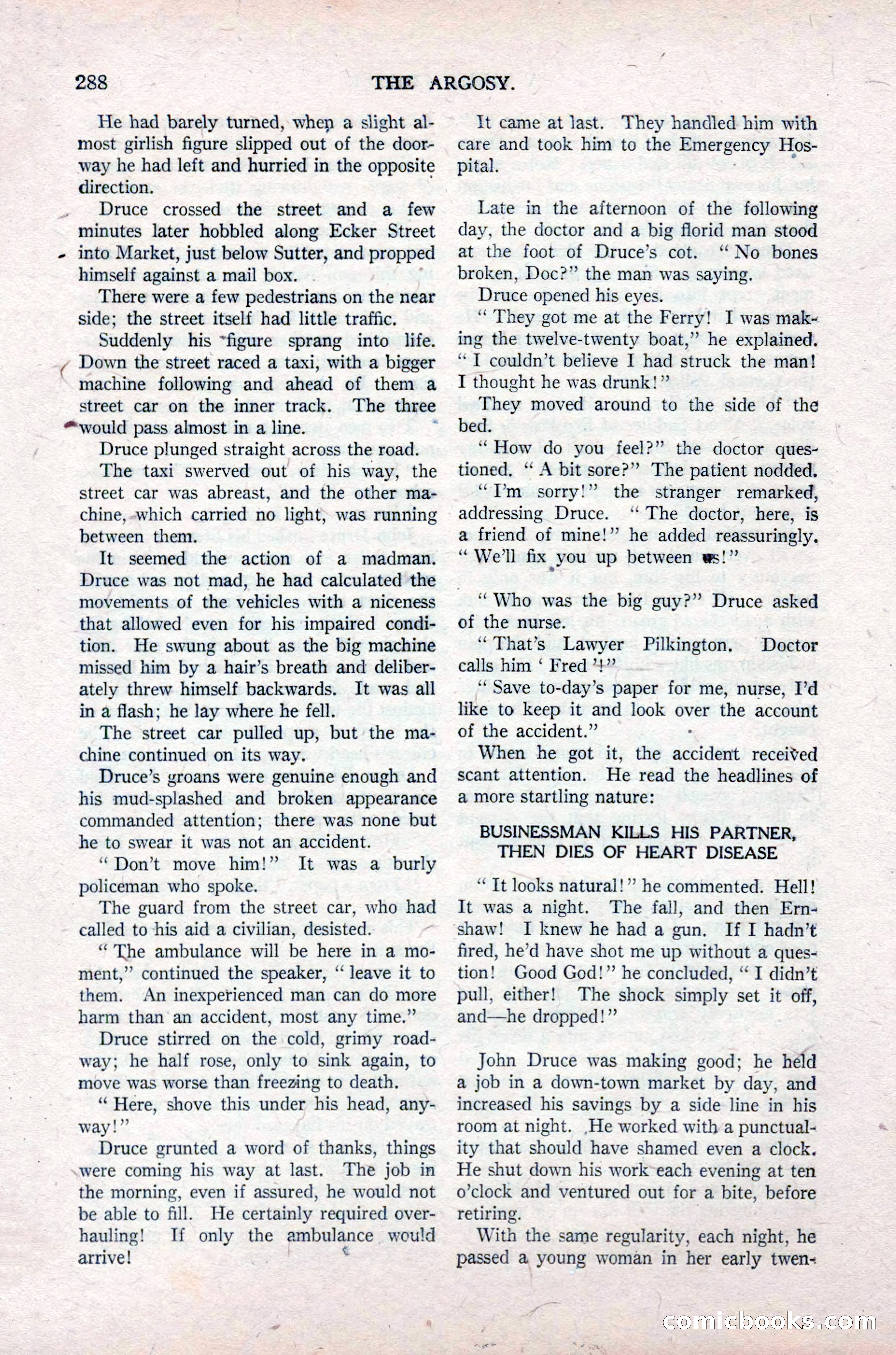
A restored page from Pulp Fiction, 1920. Page through the whole issue in the reader above.
📄 Transcribed text from this page (OCR, searchable)
Machine-transcribed from the original scan — historical spelling and the odd misread are preserved.
288 He had barely turned, when a slight al- most girlish figure slipped out of the door- way he had left and hurried in the opposite direction. Druce crossed the street and a few minutes later hobbled along Ecker Street - into Market, just below Sutter, and propped himself against a mail box. There were a few pedestrians on the near side; the street itself had little traffic. Suddenly his “figure sprang into life. Down the street raced a taxi, with a bigger machine following and ahead of them a street car on the inner track. The three “would pass almost in a line. Druce plunged straight across the road. The taxi swerved out of his way, the street car was abreast, and the other ma- chine, -which carried no light; was running between them. It seemed the action of a madman. Druce was not mad, he had calculated the movements of the vehicles with a niceness that allowed even for his impaired condi- tion. He swung about as the big machine missed him by a hair’s breath and deliber- ately threw himself backwards. It was all in a flash; he lay where he fell. The street car pulled up, but the ma- chine continued on its way. Druce’s groans were genuine enough and his mud-splashed and broken appearance commanded attention; there was none but he to swear it was not an accident. “Don’t move him!” It was a burly policeman who spoke. The guard from the street car, who had called to his aid a civilian, desisted. “The ambulance will be here in a mo- ment,’’ continued the speaker, “‘ leave it to them. An inexperienced man can do more harm than an accident, most any time.” Druce stirred on the cold, grimy road- way; he half rose, only to sink again, to move was worse than freezing to death. “ Here, shove this under his head, any- way!” Druce grunted a word of thanks, things were coming his way at last. The job in the morning, even if assured, he would not be able to fill. He certainly required over- hauling! If only the ambulance would arrive! . THE ARGOSY. It came at last. They handled him with care and took him to the Renergercy Hos- pital. Late in the afternoon of the following day, the doctor and a big florid man stood at the foot of Druce’s cot. “No bones broken, Doc?” the man was saying. Druce opened his eyes. ‘“ They got me at the Ferry! I was mak- ing the twelve-twenty boat,” he explained. ‘TI couldn’t believe I had struck the man! I thought he was drunk!” They moved around to the side of the bed. ‘How do you feel?” the doctor ques- tioned. “ A bit sore?” The patient nodded. ‘““T’m sorry!” the stranger remarked, addressing Druce. ‘‘ The doctor, here, is a friend of mine!” he added reassuringly. “ We'll fix you up between ws!” ‘“Who was the big guy?” Druce asked of the nurse. ‘“ That’s Lawyer Pilkington, calls him ‘ Fred *}” ‘“ Save to-day’s paper for me, nurse, I’d like to keep it and look over the account of the accident.” When he got it, the secidun received scant attention. He read the headlines of a more startling nature: BUSINESSMAN KILLS HIS PARTNER, THEN DIES OF HEART DISEASE Doctor “Tt looks natural!” he commented. Hell! It was a night. The fall, and then Ern- shaw! I knew he had a gun. If I hadn’t fired, he’d have shot me up without a ques- tion! Good God!” he concluded, “ I didn’t pull, either! The shock simply set it off, and—he dropped!” John Druce was making good; he held a job in a down-town market by day, and increased his savings by a side line in his room at night. He worked with a punctual- ity that should have shamed even a clock. He shut down his work-each evening at ten o’clock and ventured out for a bite, before retiring. With the same regularity, each night, he passed a young woman in her early twen- ECOPMICLOOOKS Col