
Pulp Fiction, 1920 · page 137 of 176
Argosy, Vol. 117, No. 2 — page 137: what you’re looking at
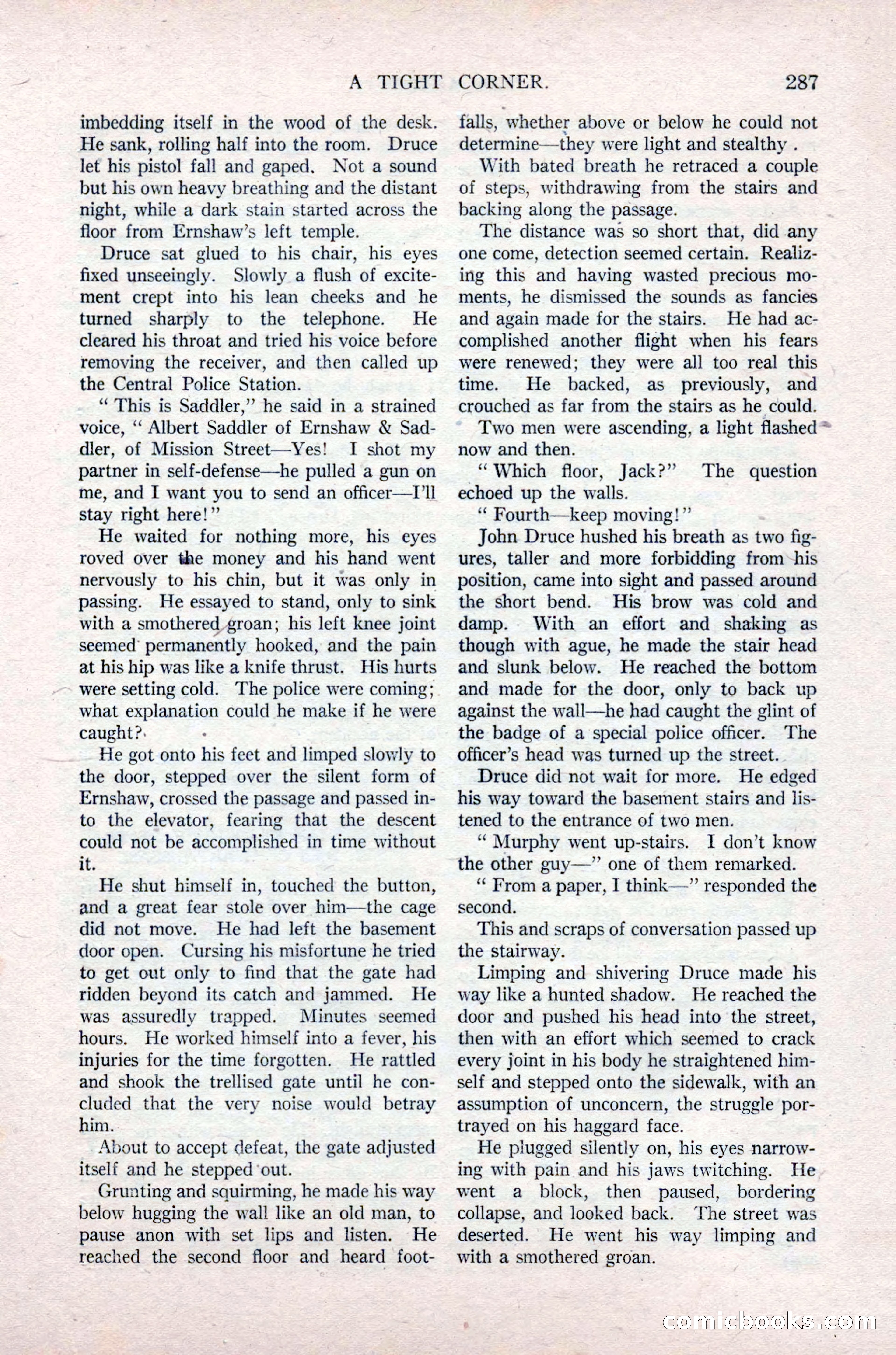
A restored page from Pulp Fiction, 1920. Page through the whole issue in the reader above.
📄 Transcribed text from this page (OCR, searchable)
Machine-transcribed from the original scan — historical spelling and the odd misread are preserved.
A= TIGHT imbedding itself in the wood of the desk. He sank, rolling half into the room. Druce let his pistol fall and gaped. Not a sound but his own heavy breathing and the distant night, while a dark stain started across the floor from Ernshaw’s left temple. Druce sat glued to his chair, his eyes fixed unseeingly. Slowly a flush of excite- ment crept into his lean cheeks and he turned sharply to the telephone. He cleared his throat and tried his voice before removing the receiver, and then called up the Central Police Station. “This is Saddler,” he said in a strained voice, “‘ Albert Saddler of Ernshaw & Sad- dler, of Mission Street—Yes! I shot my partner in self-defense—he pulled a gun on me, and I want you to send an officer—I'll stay right here!”’ He waited for nothing more, his eyes roved over the money and his hand went nervously to his chin, but it was only in passing. He essayed to stand, only to sink with a smothered groan; his left knee joint seemed’ permanently hooked, and the pain at his hip was like a knife thrust. His hurts were setting cold. The police were coming; what explanation could he make if he were caught? He got onto his feet and limped slowly to the door, stepped over the silent form of Ernshaw, crossed the passage and passed in- to the elevator, fearing that the descent could not be accomplished in time without it. He shut himself in, touched the button, and a great fear stole over him—the cage did not move. He had left the basement door open. Cursing his misfortune he tried to get out only to find that the gate had ridden beyond its catch and jammed. He was assuredly trapped. Minutes seemed hours. He worked himself into a fever, his injuries for the time forgotten. He rattled and shook the trellised gate until he con- cluded that the very noise would betray him. About to accept defeat, the gate adjusted itself and he stepped ‘out. Grunting and squirming, he made his way below hugging the wall like an old man, to pause anon with set lips and listen. He reached the second floor and heard foot- CORNER. 287 falls, whether above or below he could not determine—they were light and stealthy . With bated breath he retraced a couple of steps, withdrawing from the stairs and backing along the passage. The distance was so short that, did any one come, detection seemed certain. Realiz- ing this and having wasted precious mo- ments, he dismissed the sounds as fancies and again made for the stairs. He had ac- complished another flight when his fears were renewed; they were all too real this time. He backed, as previously, and crouched as far from the stairs as he could. Two men were ascending, a light flashed now and then. “Which floor, Jack?” echoed up the walls. ‘“* Fourth—keep moving!” John Druce hushed his breath as two fig- ures, taller and more forbidding from his position, came into sight and passed around the short bend. His brow was cold and damp. With an effort and shaking as though with ague, he made the stair head and slunk below. He reached the bottom and made for the door, only to back up against the wall—he had caught the glint of the badge of a special police officer. The officer’s head was turned up the street. Druce did not wait for more. He edged his way toward the basement stairs and lis- tened to the entrance of two men. “Murphy went up-stairs. I don’t know the other guy—” one of them remarked. “From a paper, I think—” responded the second. This and scraps of conversation passed up the stairway. Limping and shivering Druce made his way like a hunted shadow. He reached the door and pushed his head into the street, then with an effort which seemed to crack every joint in his body he straightened him- self and stepped onto the sidewalk, with an assumption of unconcern, the struggle por- trayed on his haggard face. He plugged silently on, his eyes narrow- ing with pain and his jaws twitching. He went a block, then paused, bordering collapse, and looked back. The street was deserted. He went his way limping and with a smothered groan. The question (E(0) OOOLK a‘ Co