
Pulp Fiction, 1920 · page 134 of 176
Argosy, Vol. 117, No. 2 — page 134: what you’re looking at
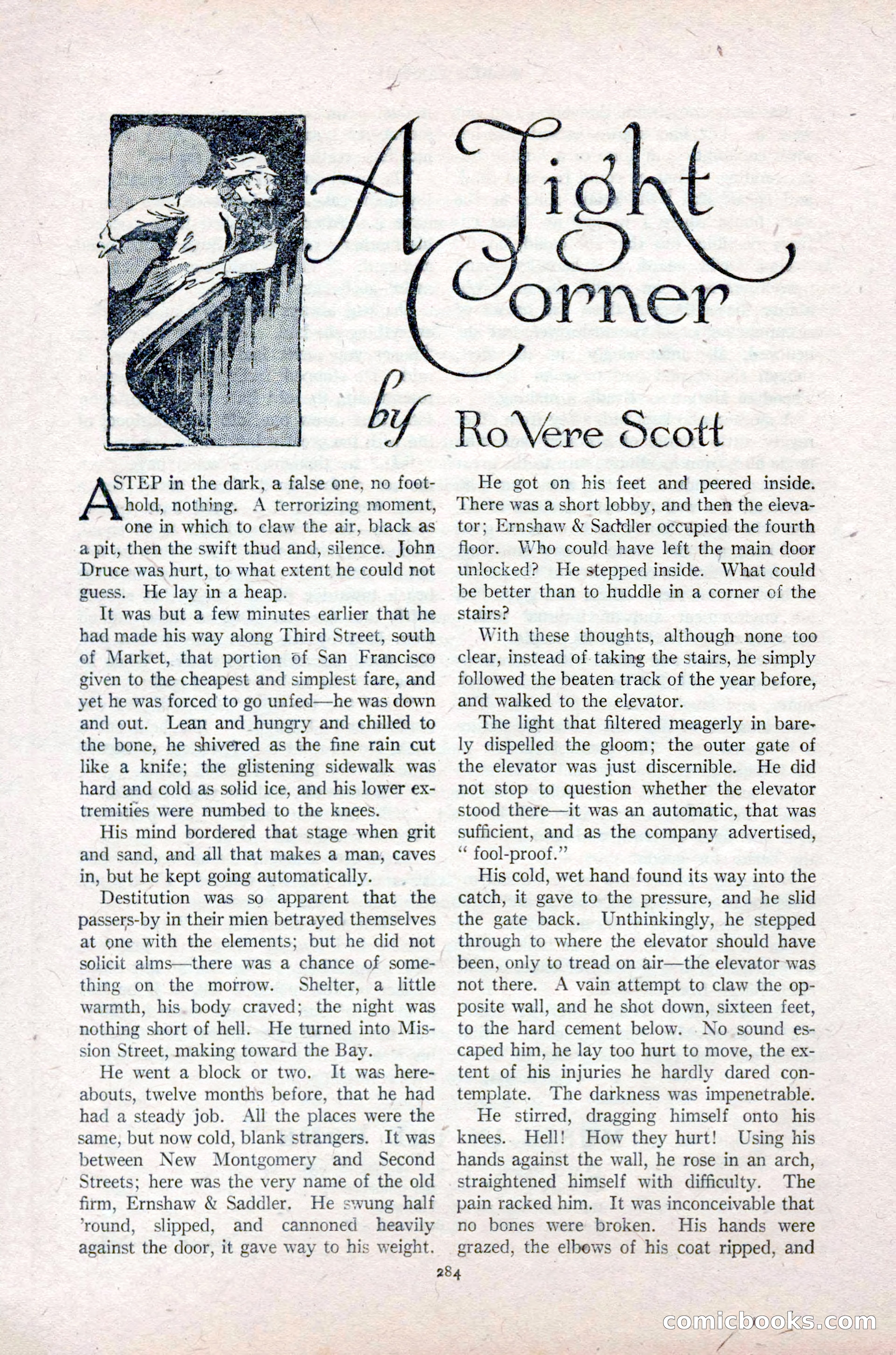
A restored page from Pulp Fiction, 1920. Page through the whole issue in the reader above.
📄 Transcribed text from this page (OCR, searchable)
Machine-transcribed from the original scan — historical spelling and the odd misread are preserved.
a ¥ STEP in the dark, a false one, no foot- -—& hold, nothing. A terrorizing moment, one in which to claw the air, black as a pit, then the swift thud and, silence. John Druce was hurt, to what extent he could not guess. He lay in a heap. It was but a few minutes earlier that he had made his way along Third Street, south of Market, that portion of San Francisco given to the cheapest and simplest fare, and yet he was forced to go unfed—he was down and eut. Lean and hungry and chilled to the bone, he shivered as the fine rain cut like a knife; the glistening sidewalk was hard and cold as solid ice, and his lower ex- tremities were numbed to the knees. His mind bordered that stage when grit and sand, and all that makes a man, caves in, but he kept going automatically. Destitution was so apparent that the passers-by in their mien betrayed themselves at one with the elements; but he did not solicit alms—there was a chance of some- thing on the morrow. Shelter, a little warmth, his. body craved; the night was nothing short of hell. He turned into Mis- sion Street, making toward the Bay. He went a block or two. It was here- abouts, twelve months before, that he had had a steady job. All the places were the same, but now cold, blank strangers. It was between New Montgomery and Second Streets; here was the very name of the old firm, Ernshaw & Saddler. He swung half ‘round, slipped, and cannoned heavily against the door, it gave way to his weight. by Rebs Ocott He got on his feet and peered inside. There was a short lobby, and then the eleva- tor; Ernshaw & Saddler occupied the fourth floor. Who could have left the main door unlocked? He stepped inside. What could be better than to huddle in a corner of the stairs? With these thoughts, although none too clear, instead of taking the stairs, he simply followed the beaten track of the year before, and walked to the elevator. The light that filtered meagerly in bare- ly dispelled the gloom; the outer gate of the elevator was just discernible. He did not stop to question whether the elevator stood there—it was an automatic, that was sufficient, and as the company advertised, ‘* fool-proof.”’ His cold, wet hand found its way into the catch, it gave to the pressure, and he slid the gate back. Unthinkingly, he stepped through to where the elevator should have been, only to tread on air—the elevator was not there. A vain attempt to claw the op- posite wall, and he shot down, sixteen feet, to the hard cement below. . No sound es- caped him, he lay too hurt to move, the ex- tent of his injuries he hardly dared con- template. The darkness was impenetrable. He stirred, dragging himself onto his knees.. Hell! How they hurt! Using his hands against the wall, he rose in an arch, straightened himself with difficulty. The pain racked him. It was inconceivable that no bones were broken. His hands were grazed, the elbews of his coat ripped, and 284 COMIC NOOKS (C@