
Pulp Fiction, 1920 · page 133 of 176
Argosy, Vol. 117, No. 2 — page 133: what you’re looking at
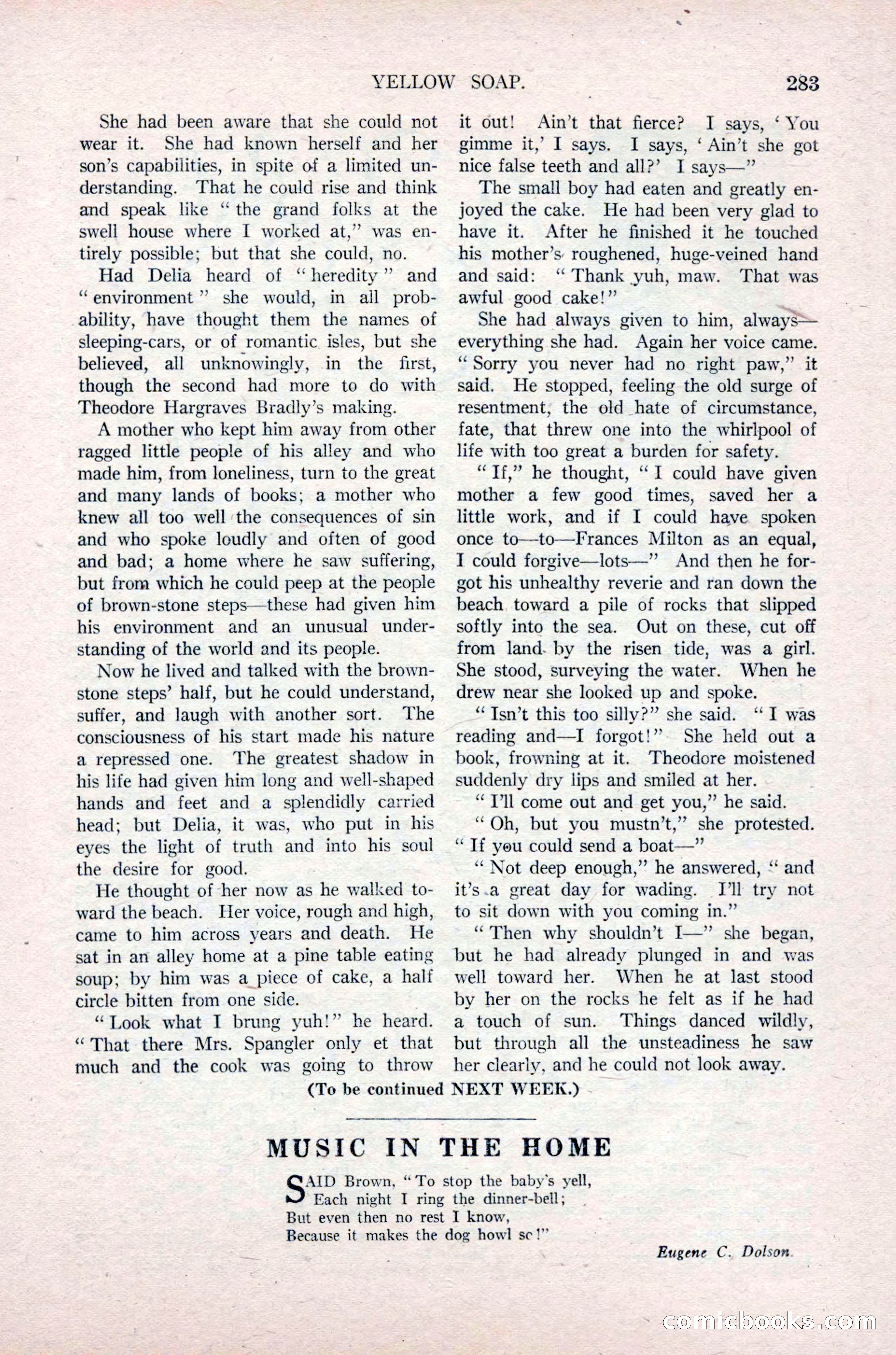
A restored page from Pulp Fiction, 1920. Page through the whole issue in the reader above.
📄 Transcribed text from this page (OCR, searchable)
Machine-transcribed from the original scan — historical spelling and the odd misread are preserved.
YELLOW She had been aware that she could not wear it. She had known herself and her son’s capabilities, in spite of a limited un- derstanding. That he could rise and think and speak like “the grand folks at the swell house where I worked at,” was en- tirely possible; but that she could, no. Had Delia heard of “ heredity” and “environment ” she would, in all prob- ability, have thought them the names of sleeping-cars, or of romantic isles, but she believed, all unknowingly, in the first, though the second had more to do with Theodore Hargraves Bradly’s making. A mother who kept him away from other ragged little people of his alley and who made him, from loneliness, turn to the great and many lands of books; a mother who knew all too well the consequences of sin and who spoke loudly and often of good and bad; a home where he saw suffering, but from which he could peep at the people of brown-stone steps—these had given him his environment and an unusual under- standing of the world and its people. Now he lived and talked with the brown- stone steps’ half, but he could understand, suffer, and laugh with another sort. The consciousness of his start made his nature a repressed one. The greatest shadow in his life had given him long and well-shaped hands and feet and a splendidly carried head; but Delia, it was, who put in his eyes the light of truth and into his soul the desire for good. He thought of her now as he walked to- ward the beach. Her voice, rough and high, came to him across years and death. He sat in an alley home at a pine table eating soup; by him was a piece of cake, a half circle bitten from one side. “Took what I brung yuh!” he heard. “That there Mrs. Spangler only et that much and the cook was going to throw SOAP. 283 it out! Ain’t that fierce? I says, ‘ You gimme it,’ I says. I says, ‘ Ain’t she got nice false teeth and all?’ I says—” The small boy had eaten and greatly en- joyed the cake. He had been very glad to have it. After he finished it he touched his mother’s: roughened, huge-veined hand and said: “ Thank yuh, maw. That was awful good cake!” She had always given to him, always everything she had. Again her voice came. “Sorry you never had no right paw,’ it said. He stopped, feeling the old surge of resentment, the old hate of circumstance, fate, that threw one into the whirlpool of life with too great a burden for safety. “Tf,” he thought, “I could have given mother a few good times, saved her a little work, and if I could have spoken once to—to—Frances Milton as an equal, I could forgive—lots—” And then he for- got his unhealthy reverie and ran down the beach. toward a pile of rocks that slipped softly into the sea. Out on these, cut off from land. by the risen tide, was a girl. She stood, surveying the water. When he drew near she looked up and spoke. ““Isn’t this too silly?” she said. ‘“‘ I was reading and—TI forgot!” She held out a book, frowning at it. ‘Theodore moistened suddenly dry lips and smiled at her. ‘Tl come out and get you,” he said. “Oh, but you mustn’t,” she protested. “Tf yeu could send a boat—” ‘““Not deep enough,” he answered, “‘ and it’s.a great dav for wading. J’ll try not to sit down with you coming in.”’ “Then why shouldn’t I—” she began, but he had already plunged in and was well toward her. When he at last stood by her on the rocks he felt as if he had a touch of sun. Things danced wildly, but through all the unsteadiness he saw her clearly, and he could not look away. (To be continued NEXT WEEK.) MUSIC IN THE HOME AID Brown, “To stop the baby’s yell, Each night I ring the dinner-bell; But even then no rest I know, Because it makes the dog howl sc!” Eugene C. Dolson. COMMICLOOOLK (C@