
Pulp Fiction, 1920 · page 129 of 176
Argosy, Vol. 117, No. 2 — page 129: what you’re looking at
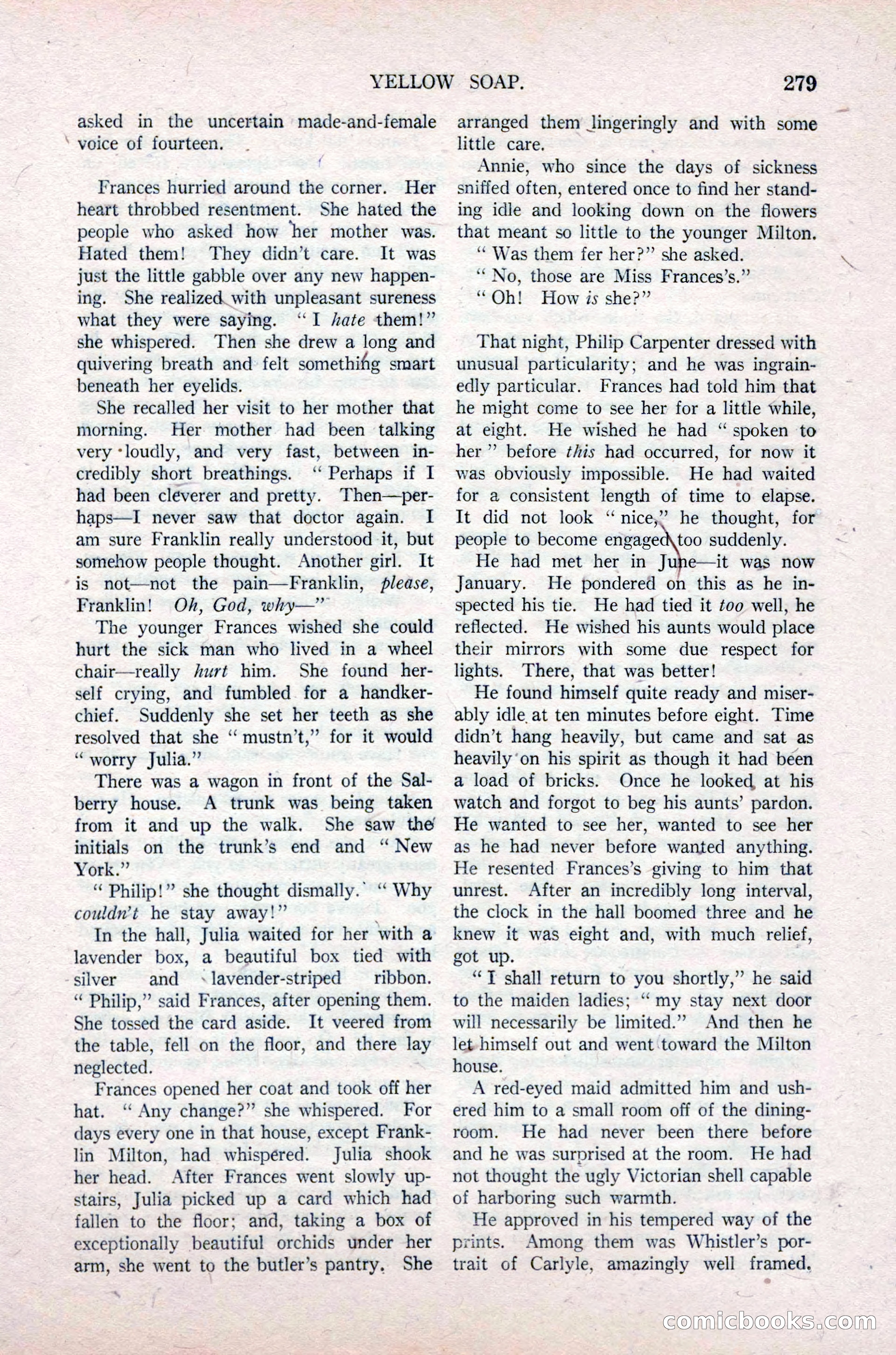
A restored page from Pulp Fiction, 1920. Page through the whole issue in the reader above.
📄 Transcribed text from this page (OCR, searchable)
Machine-transcribed from the original scan — historical spelling and the odd misread are preserved.
YELLOW SOAP. asked in the uncertain made-and-female ‘ voice of fourteen. Frances hurried around the corner. Her heart throbbed resentment. She hated the people who asked how her mother was. Hated them! They didn’t care. It was just the little gabble over any new happen- ing. She realized_with unpleasant sureness what they were saying. ‘I sate them!” she whispered. Then she drew a long and quivering breath and felt somethifg smart beneath her eyelids. She recalled her visit to her mother that morning. Her mother had been talking very ‘loudly, and very fast, between in- credibly short breathings. ‘ Perhaps if I had been cléverer and pretty. ‘Then—per- haps—I never saw that doctor again. I am sure Franklin really understood it, but somehow people thought. Another girl. It is not—not the pain—Franklin, please, Franklin! Of, God, why—” The younger Frances wished she could hurt the sick man who lived in a wheel chair—really hurt him. She found her- self crying, and fumbled for a handker- chief. Suddenly she set her teeth as she resolved that she ‘‘ mustn’t,” for it would “worry Julia.” There was a wagon in front of the Sal- berry house. A trunk was being taken from it and up the walk. She saw the initials on the trunk’s end and “ New York.” “ Philip!” she thought dismally. ‘“‘ Why couldn’t he stay away!” ' In the hall, Julia waited for her with a lavender box, a beautiful box tied with silver and ~-lavender-striped ribbon. “ Philip,” said Frances, after opening them. She tossed the card aside. It veered from the table, fell on the floor, and there lay neglected. Frances opened her coat and took off her hat. ‘‘ Any change?” she whispered. For days every one in that house, except Frank- lin Milton, had whispéred. Julia shook her head. After Frances went slowly up- stairs, Julia picked up a card which had fallen to the floor; and, taking a box of exceptionally beautiful orchids under her arm, she went to the butler’s pantry. She 279 arranged them lingeringly and with some little care. Annie, who since the days of sickness sniffed often, entered once to find her stand- ing idle and looking down on the flowers that meant so little to the younger Milton. ‘Was them fer her?” she asked. ‘“ No, those are Miss Frances’s.” “Oh! How is she?” That night, Philip Carpenter dressed with unusual particularity; and he was ingrain- edly particular. Frances had told him that he might come to see her for a little while, at eight. He wished he had “ spoken to her” before ¢/is had occurred, for now it was obviously impossible. He had waited for a consistent length of time to elapse. It did not look ‘ nice,” he thought, for people to become engagec\too suddenly. He had met her in Juhe—it was now January. He pondered on this as he in- spected his tie. He had tied it too well, he reflected. He wished his aunts would place their mirrors with some due respect for lights. There, that was better! He found himself quite ready and miser- ably idle at ten minutes before eight. Time didn’t hang heavily, but came and sat as heavily ‘on his spirit as though it had been a load of bricks. Once he looked at his watch and forgot to beg his aunts’ pardon. He wanted to see her, wanted to see her as he had never before wanted anything. He resented Frances’s giving to him that unrest. After an incredibly long interval, the clock in the hall boomed three and he knew it was eight and, with much relief, got up. : “T shall return to you shortly,” he said to the maiden ladies; “ my stay next door will necessarily be limited.’”’ And then he let himself out and went toward the Milton house. A red-eyed maid admitted him and ush- ered him to a small room off of the dining- room. He had never been there before and he was surprised at the room. He had not thought the ugly Victorian shell capable of harboring such warmth. He approved in his tempered way of the prints. Among them was Whistler’s por- trait of Carlyle, amazingly well framed. Gomichbooks (C@