
Pulp Fiction, 1920 · page 128 of 176
Argosy, Vol. 117, No. 2 — page 128: what you’re looking at
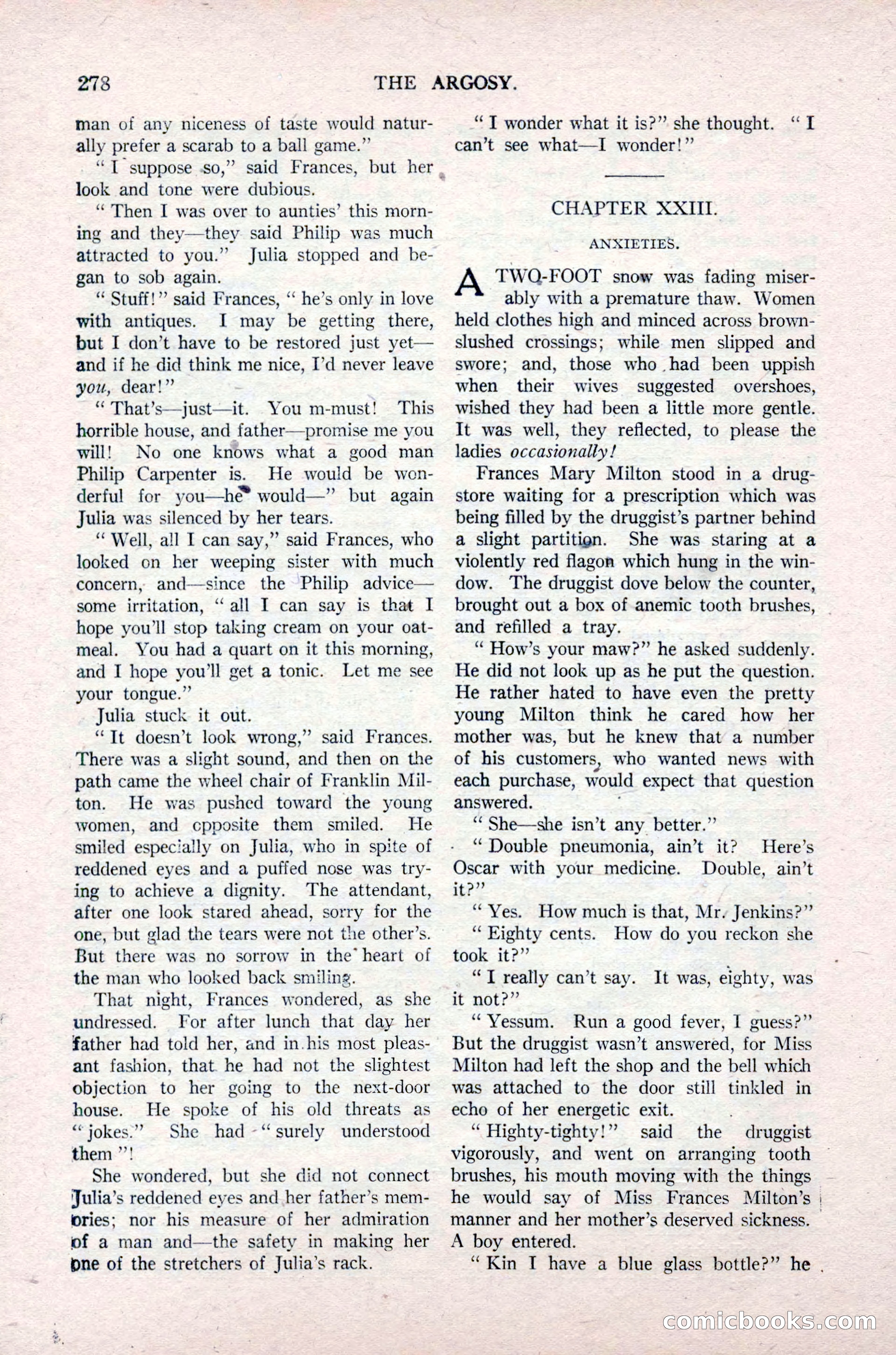
A restored page from Pulp Fiction, 1920. Page through the whole issue in the reader above.
📄 Transcribed text from this page (OCR, searchable)
Machine-transcribed from the original scan — historical spelling and the odd misread are preserved.
278 man of any niceness of taste would natur- ally prefer a scarab to a ball game.” ‘I suppose so,” said Frances, but her . look and tone were dubious. ‘Then I was over to aunties’ this morn- ing and they—they said Philip was much aitracted to you.” Julia stopped and be- gan to sob again. “ Stuff!’ said Frances, ‘‘ he’s only in love with antiques. I may be getting there, but I don’t have to be restored just yet— and if he did think me nice, I’d never leave you, dear!” “ That’s—just—it. You m-must! This horrible house, and father—promise me you will! No one knows what a good man Philip Carpenter is. He would be wen- derful for you—he* would—” but again Julia was silenced by her tears. ‘Well, all I can say,” said Frances, who looked on her weeping sister with much concern, and—since the Philip advice— some irritation, ‘all I can say is that I hope you'll stop taking cream on your oat- meal. You had a quart on it this morning, and I hope you'll get a tonic. Let me see your tongue.” Julia stuck it out. “Tt doesn’t look wrong,” said Frances. There was a slight sound, and then on the path came the wheel chair of Franklin Mil- ton. He was pushed toward the young women, and cpposite them smiled. He smiled especially on Julia, who in spite of reddened eyes and a puffed nose was try- ing to achieve a dignity. The attendant, after one look stared ahead, sorry for the one, but glad the tears were not the other’s. But there was no sorrow in the heart of the man who looked back smiling. That night, Frances wondered, as she undressed. For after lunch that day her father had told her, and in. his most pleas- ant fashion, that. he had not the slightest objection to her going to the next-door house. He spoke of his old threats as “jokes.” She had ~-“ surely understood them ”! She wondered, but she did not connect 'Julia’s reddened eyes and her father’s mem- ries; nor his measure of her admiration of a man and—the safety in making her bne of the stretchers of Julia’s rack. THE ARGOSY. “T wonder what it is?” she thought. “I can’t see what—I wonder!”’ CHAPTER XXIII. ANXIETIES. A TWQ-FOOT snow was fading miser- ably with a premature thaw. Women held clothes high and minced across brown- slushed crossings; while men slipped and swore; and, those who had been uppish when their wives suggested overshoes, wished they had been a little more gentle. It was well, they reflected, to please the ladies occasionally! Frances Mary Milton stood in a drug- store waiting for a prescription which was being filled by the druggist’s partner behind a slight partitign. She was staring at a violently red flagon which hung in the win- dow. The druggist dove below the counter, brought out a box of anemic tooth brushes, ~ and refilled a tray. ‘“How’s your maw?” he asked suddenly. He did not look up as he put the question. He rather hated to have even the pretty young Milton think he cared how her mother was, but he knew that a number of his customers, who wanted news with each purchase, would expect that question answered. ‘‘ She—she isn’t any better.”’ “Double pneumonia, ain’t it? Here’s Oscar with your medicine. Double, ain’t it?” ‘Yes. How much is that, Mr. Jenkins?” “Eighty cents. How do you reckon she took it?” “T really can’t say. It was, eighty, was it not?” “Yessum. Run a good fever, I guess?”’ But the druggist wasn’t answered, for Miss Milton had left the shop and the bell which was attached to the door still tinkled in echo of her energetic exit. ; “ Highty-tighty!” said the druggist vigorously, and went on arranging tooth brushes, his mouth moving with the things he would say of Miss Frances Milton’s manner and her mother’s deserved sickness. A boy entered. “Kin I have a blue glass bottle?” he . CORNICLOOOKS (C@)