
Pulp Fiction, 1920 · page 117 of 176
Argosy, Vol. 117, No. 2 — page 117: what you’re looking at
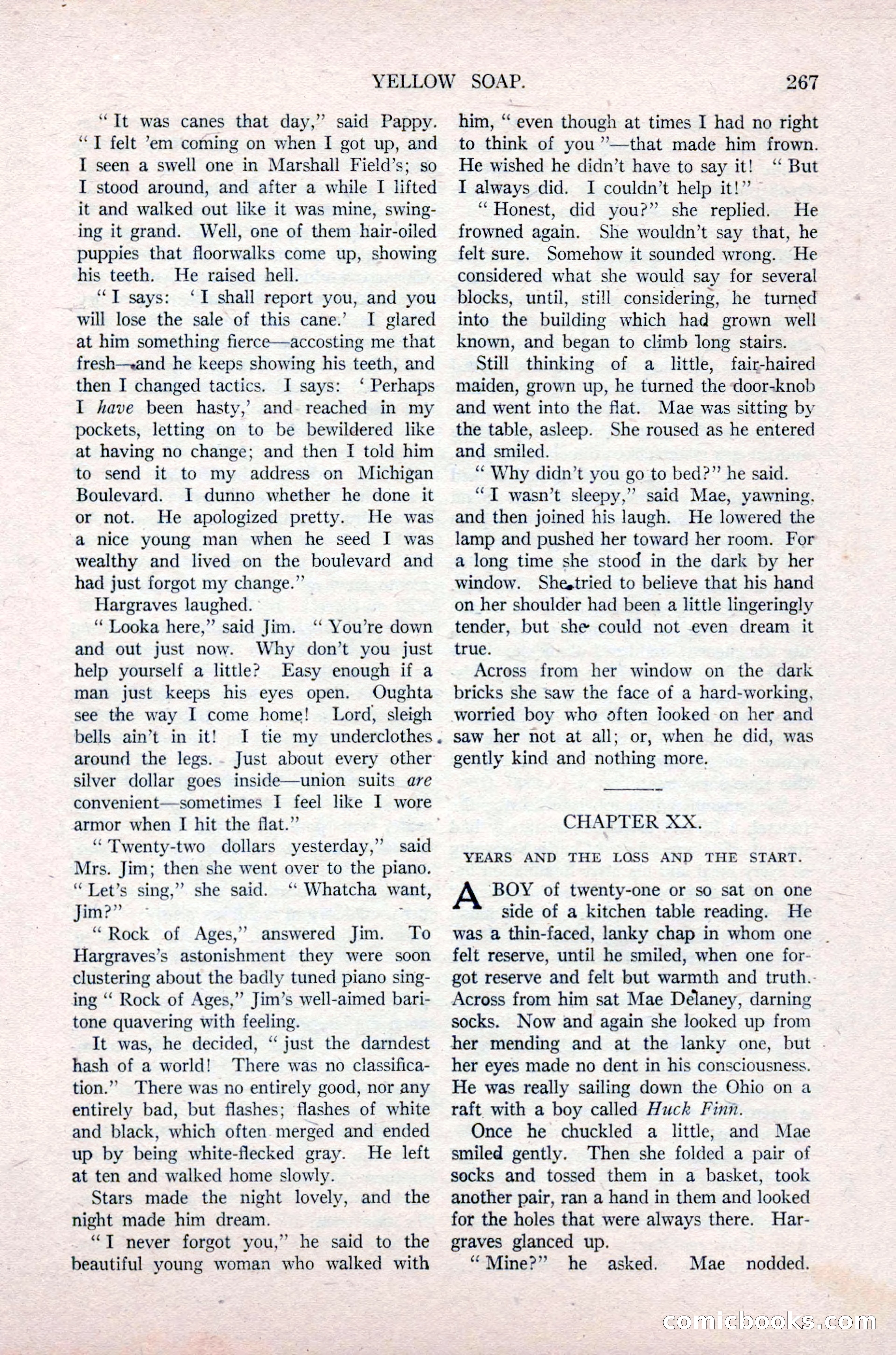
A restored page from Pulp Fiction, 1920. Page through the whole issue in the reader above.
📄 Transcribed text from this page (OCR, searchable)
Machine-transcribed from the original scan — historical spelling and the odd misread are preserved.
YELLOW “Tt was canes that day,” said Pappy. ‘““T felt em coming on when I got up, and I seen a swell one in Marshall Field’s; so I stood around, and after a while I lifted it and walked out like it was mine, swing- ing it grand. Well, one of them hair-oiled puppies that floorwalks come up, showing his teeth. He raised hell. “T says: ‘I shall report you, and you will lose the sale of this cane.’ I glared at him something fierce—accosting me that fresh—eand he keeps showing his teeth, and then I changed tactics. I says: ‘ Perhaps I have been hasty,’ and- reached in my pockets, letting on to be bewildered like at having no change; and then I told him to send it to my address on Michigan Boulevard. JI dunno whether he done it or not. He apologized pretty. He was a nice young man when he seed I was wealthy and lived on the boulevard and had just forgot my change.”’ Hargraves laughed. ‘“ Looka here,” said Jim. ‘“ You’re down and out just now. Why don’t you just help yourself a little? Easy enough if a man just keeps his eyes open. Oughta see the way I come home! Lord, sleigh bells ain’t in it! I tie my underclothes around the legs. - Just about every other silver dollar goes inside—union suits are convenient—sometimes I feel like I wore armor when I hit the flat.” “Twenty-two dollars yesterday,” said Mrs. Jim; then she went over to the piano. ‘“Let’s sing,” she said. ‘ Whatcha want, Jim?” - “Rock of Ages,’ answered Jim. To Hargraves’s astonishment they were soon clustering about the badly tuned piano sing- ing “‘ Rock of Ages,” Jim’s well-aimed bari- tone quavering with feeling. It was, he decided, “ just the darndest hash of a world! There was no classifica- tion.”” There was no entirely good, nor any entirely bad, but flashes; flashes of white and black, which often merged and ended up by being white-flecked gray. He left at ten and walked home slowly. Stars made the night lovely, and the night made him dream. “T never forgot you,” he said to the beautiful young woman who walked with SOAP. 267 him, “ even though at times I had no right to think of you’’—that made him frown. He wished he didn’t have to say it! ‘ But I always did. I couldn’t help it!” ‘Honest, did you?” she replied. He frowned again. She wouldn’t say that, he felt sure. Somehow it sounded wrong. He considered what she would say for several blocks, until, still considering, he turned into the building which had grown well known, and began to climb long stairs. Still thinking of a little, fair-haired maiden, grown up, he turned the door-knob and went into the flat. Mae was sitting by the table, asleep. She roused as he entered and smiled. “Why didn’t you go to bed?” he said. ‘““T wasn’t sleepy,” said Mae, yawning. and then joined his laugh. He lowered the lamp and pushed her toward her room. For a long time she stood in the dark by her window. She.tried to believe that his hand on her shoulder had been a little lingeringly tender, but she could not even dream it true. Across from her window on the dark bricks she saw the face of a hard-working, worried boy who aften looked on her and saw her not at all; or, when he did, was gently kind and nothing more. CHAPTER XX. YEARS AND THE LOSS AND THE START. A BOY of twenty-one or so sat on one side of a kitchen table reading. He was a thin-faced, lanky chap in whom one . felt reserve, until he smiled, when one for- got reserve and felt but warmth and truth.. Across from him sat Mae Delaney, darning socks. Now and again she looked up from her mending and at the lanky one, but . her eyes made no dent in his consciousness. He was really sailing down the Ohio on a raft with a boy called Huck Finn. Once he chuckled a little, and Mae smiled gently. Then she folded a pair of socks and tossed them in a basket, took another pair, ran a hand in them and looked for the holes that were always there. Har- graves glanced up. “Mine?” he asked. Mae nodded. CORMICLOOOKS (C@