
Pulp Fiction, 1920 · page 116 of 176
Argosy, Vol. 117, No. 2 — page 116: what you’re looking at
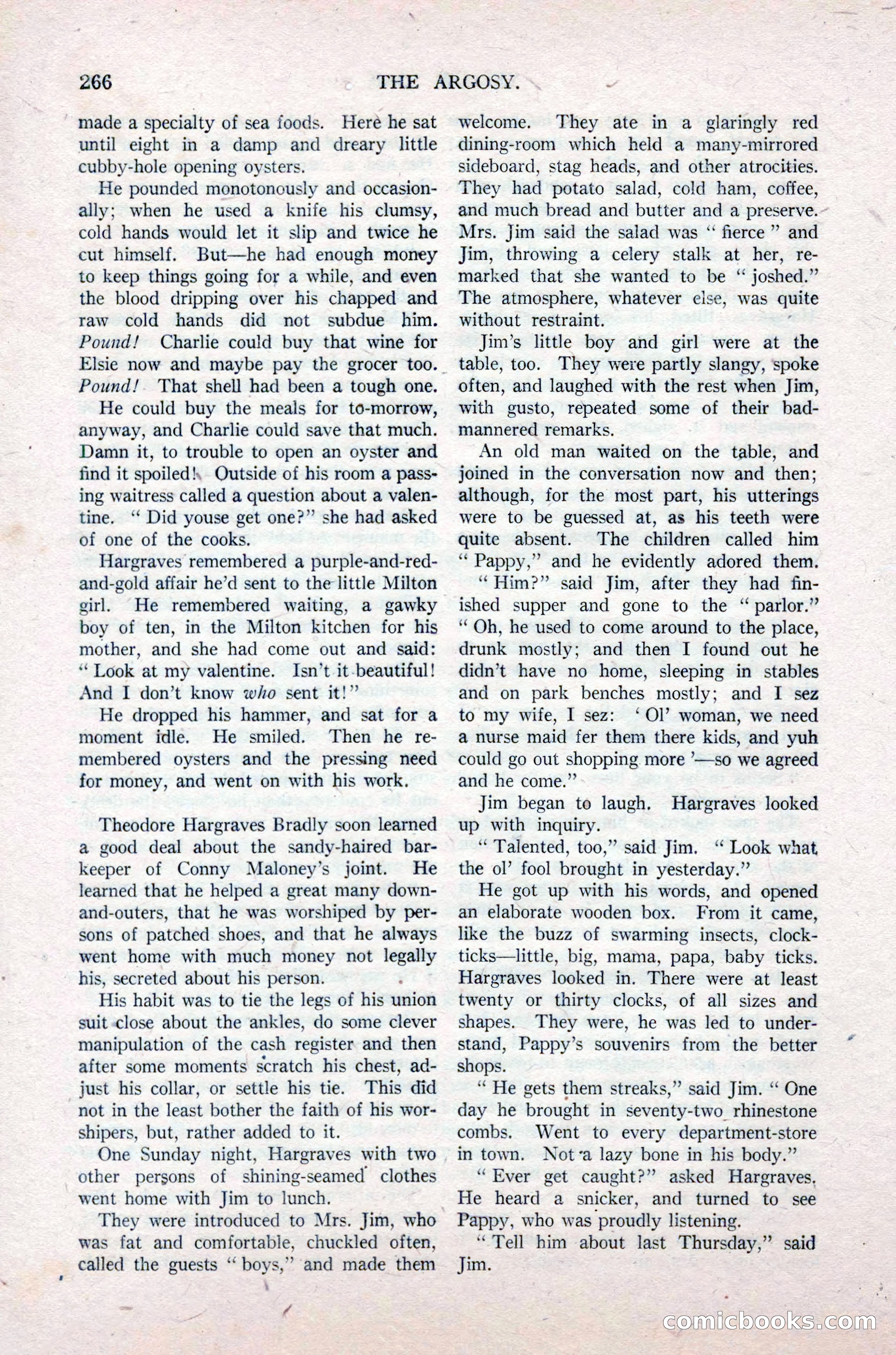
A restored page from Pulp Fiction, 1920. Page through the whole issue in the reader above.
📄 Transcribed text from this page (OCR, searchable)
Machine-transcribed from the original scan — historical spelling and the odd misread are preserved.
266 made a specialty of sea foods. Here he sat until eight in a damp and dreary little cubby-hole opening oysters. He pounded monotonously and occasion- ally; when he used a knife his clumsy, cold hands would let it slip and twice he cut himself. But—he had enough money to keep things going for a while, and even the blood dripping over his chapped and raw cold hands did not subdue him. Pound! Charlie could buy that wine for Elsie now and maybe pay the grocer too. Pound! That shell had been a tough one. He could buy the meals for to-morrow, anyway, and Charlie could save that much. Damn it, to trouble to open an oyster and find it spoiled), Outside of his room a pass- ing waitress called a question about a valen- tine. ‘‘ Did youse get one?” she had asked of one of the cooks. Hargraves remembered a purple-and-red- and-gold affair he’d sent to the little Milton girl. He remembered waiting, a gawky boy of ten, in the Milton kitchen for his mother, and she had come out and said: ‘Look at my valentine. Isn’t it-beautiful! And I don’t know who sent it!” He dropped his hammer, and sat for a moment idle. He smiled. Then he re- membered oysters and the pressing need for money, and went on with his work. Theodore Hargraves Bradly soon learned a good deal about the sandy-haired bar- keeper of Conny Maloney’s joint. He learned that he helped a great many down- and-outers, that he was worshiped by per- sons of patched shoes, and that he always went home with much money not ore his, secreted about his person. His habit was to tie the legs of his union suit close about the ankles, do some clever manipulation of the cash register and then after some moments scratch his chest, ad- just his collar, or settle his tie. This did not in the least bother the faith of his wor- shipers, but, rather added to it. One Sunday night, Hargraves with two other persons of shining-seamed clothes went home with Jim to lunch. They were introduced to Mrs. Jim, who was fat and comfortable, chuckled often, called the guests “‘ boys,’ and made them A THE ARGOSY. welcome. They ate in a glaringly red dining-room which held a many-mirrored sideboard, stag heads, and other atrocities. They had potato salad, cold ham, coffee, and much bread and butter and a preserve. - Mrs. Jim said the salad was “ fierce ” and Jim, throwing a celery stalk at her, re- marked that she wanted to be “ joshed.” The atmosphere, whatever else, was quite without restraint. Jim’s little boy and girl were at the table, too. They were partly slangy, spoke often, and laughed with the rest when Jim, with gusto, repeated some of their bad- mannered remarks. An old man waited on the table, and joined in the conversation now and then; although, for the most part, his utterings were to be guessed at, as his teeth were quite absent. The children called him ‘* Pappy,” and he evidently adored them. ‘“ Him?” said Jim, after they had fin- ished supper and gone to the “ parlor.” ‘Oh, he used to come around to the place, drunk mostly; and then I found out he didn’t have no home, sleeping in stables and on park benches mostly; and I sez to my wife, I sez: ‘Ol’ woman, we need a nurse maid fer them there kids, and yuh could go out shopping more ’—so we agreed and he come.” Jim began to laugh. Hargraves looked up with inquiry. “Talented, too,” said Jim. ‘ Look what, the ol’ fool brought in yesterday.” He got up with his words, and opened an elaborate wooden box. From it came, like the buzz of swarming insects, clock- ticks—little, big, mama, papa, baby ticks. Hargraves looked in. There were at least twenty or thirty clocks, of all sizes and shapes. They were, he was led to under- stand, Pappy’s souvenirs from the better shops. ‘He gets them streaks,” said Jim. “‘ One day he brought in seventy-two rhinestone combs. Went to every department-store in town. Not-a lazy bone in his body.” “Ever get caught?” asked Hargraves. He heard a snicker, and turned to see Pappy, who was proudly listening. ‘Tell him about last Thursday,” said Jim. (€(0) v.OoOK (E@)