
Pulp Fiction, 1919 · page 24 of 196
Argosy, Vol. 112, No. 2 — page 24: what you’re looking at
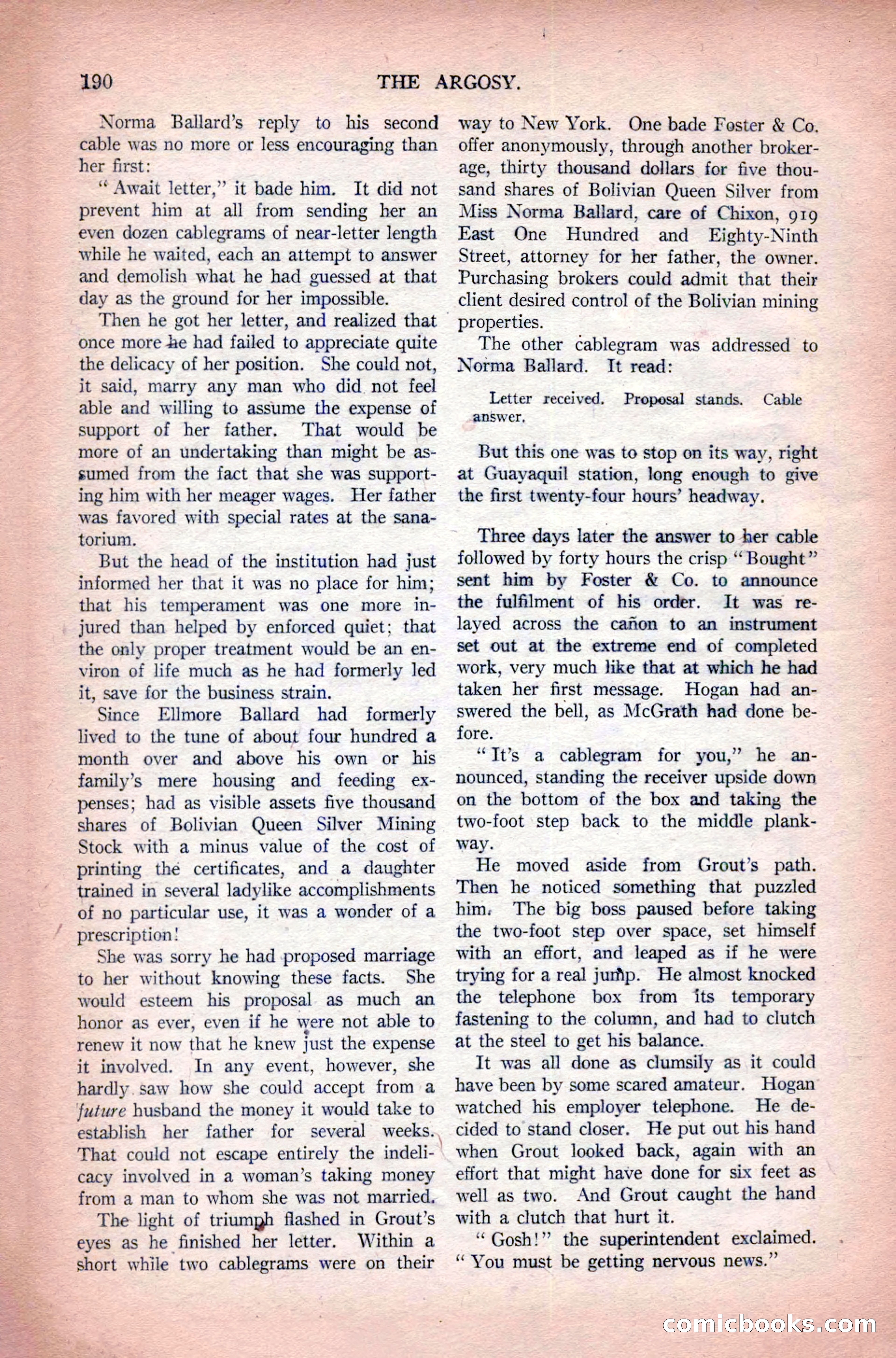
A restored page from Pulp Fiction, 1919. Page through the whole issue in the reader above.
📄 Transcribed text from this page (OCR, searchable)
Machine-transcribed from the original scan — historical spelling and the odd misread are preserved.
190 Norma Ballard’s reply to his second cable was no more or less encouraging than her first: ‘ Await letter,” it bade him. It did not prevent him at all from sending her an even dozen cablegrams of near-letter length while he waited, each an attempt to answer and demolish what he had guessed at that day as the ground for her impossible. Then he got her letter, and realized that — once more ke had failed to appreciate quite the delicacy of her position. She could not, it said, marry any man who did not feel able and willing to assume the expense of support of her father. That would be more of an undertaking than might be as- sumed from the fact that she was support- ing him with her meager wages. Her father was favored with special rates at the sana- torium. But the head of the institution had just informed her that it was no place for him; that his temperament was one more in- jured than helped by enforced quiet; that the only proper treatment would be an en- viron of life much as he had formerly led it, save for the business strain. Since Ellmore Ballard had formerly lived to the tune of about four hundred a month over and above his own or his family’s mere housing and feeding ex- penses; had as visible assets five thousand shares of Bolivian Queen Silver Mining Stock with a minus value of the cost of printing the certificates, and a daughter trained in several ladylike accomplishments of no particular use, it was a wonder of a prescription ! She was sorry he had proposed marriage to her without knowing these facts. She would esteem his proposal as much an honor as ever, even if he were not able to renew it now that he knew just the expense it involved. In any event, however, she hardly.saw how she could accept from a future husband the money it would take to establish her father for several weeks. That could not escape entirely the indeli- cacy involved in a woman’s taking money from a man to whom she was not married. The light of triumph flashed in Grout’s eyes as he finished her letter. Within a short while two cablegrams were on their Se ag te —— Te Pn BN gb a sg a ee a an = ~ _ ey = pera Sb . —— % + > = Sie eee Ya etn eee = — eae a = , Le <> - “Tt > > = — ae > ‘ A = : THE ARGOSY. way to New York. One bade Foster & Co. offer anonymously, through another broker- age, thirty thousand dollars for five thou- sand shares of Bolivian Queen Silver from Miss Norma Ballard, care of Chixon, 919 East One Hundred and Eighty-Ninth Street, attorney for her father, the owner. Purchasing brokers could admit that their client desired control of the Bolivian mining properties. The other cablegram was addressed to Norma Ballard. It read: Letter received. Propesal stands. Cable answer, But this one was to stop on its way, right at Guayaquil station, long enough to give the first twenty-four hours’ headway. Three days later the answer to her cable followed by forty hours the crisp “ Bought” sent him by Foster & Co. to announce the fulfilment of his order. It was re- layed across the canon to an instrument set out at the extreme end of completed work, very much like that at which he had taken her first message. Hogan had an- swered the bell, as McGrath had done be- fore. ‘Tt’s a cablegram for you,” he an- nounced, standing the receiver upside down on the bottom of the box and taking the two-foot step back to the middle plank- way. He moved aside from Grout’s path. Then he noticed something that puzzled him. The big boss paused before taking the two-foot step over space, set himself with an effort, and leaped as if he were © trying for a real jurip. He almost knocked the telephone box from its temporary fastening to the column, and had to clutch at the steel to get his balance. It was all done as clumsily as it could have been by some scared amateur. Hogan watched his employer telephone. He de- cided to stand closer. He put out his hand when Grout looked back, again with an effort that might have done for six feet as well as two. And Grout caught the hand with a clutch that hurt it. “Gosh!” the superintendent exclaimed. “You must be getting nervous news.” Gomichbooks (E(9)