
Pulp Fiction, 1919 · page 23 of 196
Argosy, Vol. 112, No. 2 — page 23: what you’re looking at
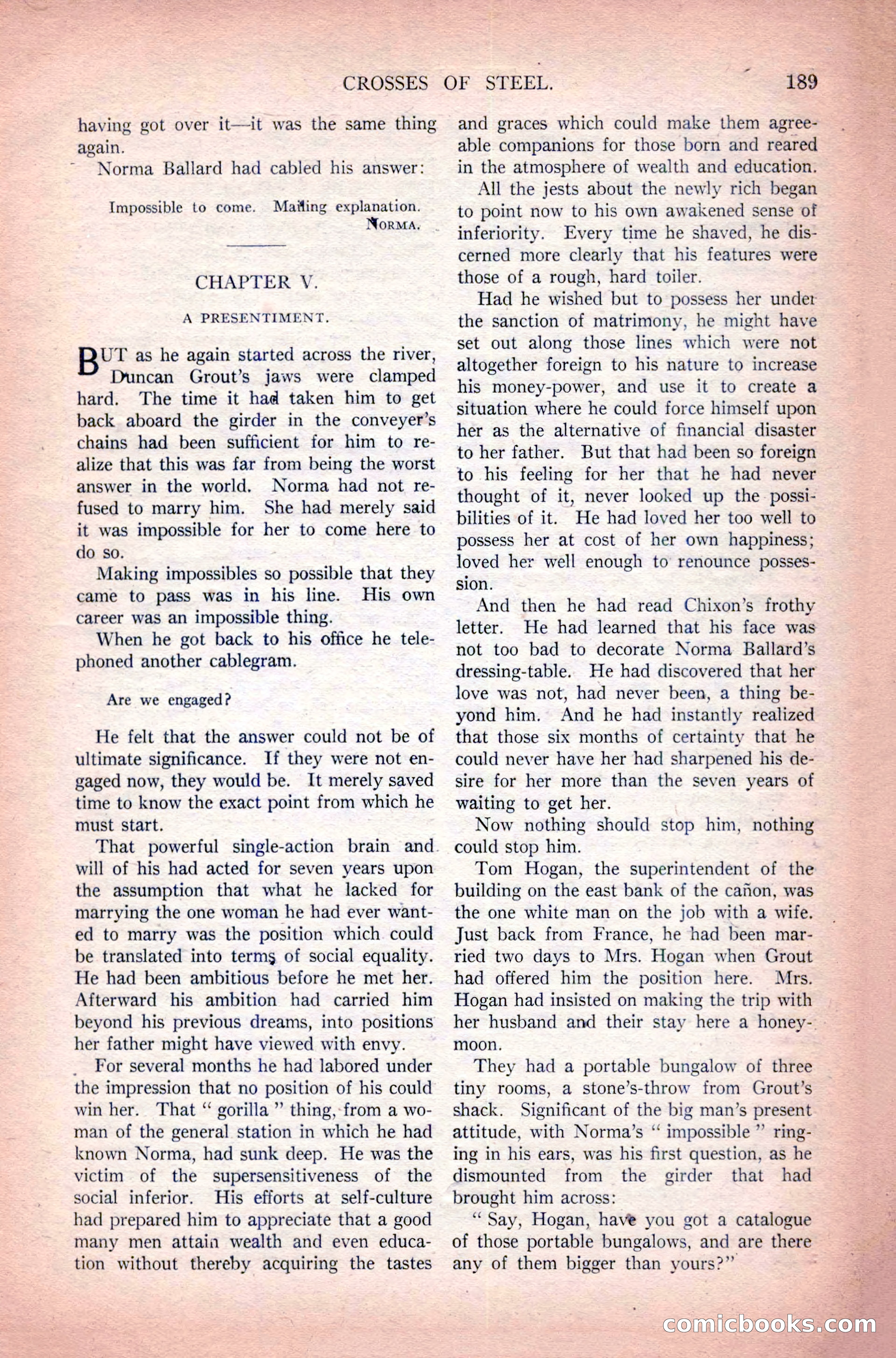
A restored page from Pulp Fiction, 1919. Page through the whole issue in the reader above.
📄 Transcribed text from this page (OCR, searchable)
Machine-transcribed from the original scan — historical spelling and the odd misread are preserved.
CROSSES OF STEEL. 189 having got over it—it was the same thing again. Norma Ballard had cabled his answer: Mailing explanation. Impossible to come. NorMa. ooo CHAPTER V. A PRESENTIMENT. Ber as he again started across the river, Duncan Grout’s jaws were clamped hard. The time it had taken him to get back aboard the girder in the conveyer’s chains had been sufficient for him to re- alize that this was far from being the worst answer in the world. Norma had not re- fused to marry him. She had merely said it was impossible for her to come here to do so. Making impossibles so possible that they came to pass was in his line. His own career was an impossible thing. When he got back to his office he tele- phoned another cablegram. Are we engaged? He felt that the answer could not be of ultimate significance. If they were not en- gaged now, they would be. It merely saved time to know the exact point from which he must start. That powerful single-action brain and. will of his had acted for seven years upon the assumption that what he lacked for marrying the one woman he had ever want- ed to marry was the position which could be translated into terms of social equality. He had been ambitious before he met her. Afterward his ambition had carried him beyond his previous dreams, into positions her father might have viewed with envy. _ For several months he had labored under the impression that no position of his could win her. That “ gorilla” thing,-from a wo- man of the general station in which he had known Norma, had sunk deep. He was the victim of the supersensitiveness of the social inferior. His efforts at self-culture had prepared him to appreciate that a good many men attain wealth and even educa- tion without thereby acquiring the tastes and graces which could make them agree- able companions for those born and reared in the atmosphere of wealth and education. All the jests about the newly rich began to point now to his own awakened sense of inferiority. Every time he shaved, he dis- cerned more clearly that his features were those of a rough, hard toiler. Had he wished but to possess her under the sanction of matrimony, he might have set out along those lines which were not altogether foreign to his nature to increase his money-power, and use it to create a situation where he could force himself upon her as the alternative of financial disaster to her father. But that had been so foreign to his feeling for her that he had never thought of it, never looked up the possi- bilities of it. He had loved her too well to possess her at cost of her own happiness; loved her well enough to renounce posses- sion. And then he had read Chixon’s frothy letter. He had learned that his face was not too bad to decorate Norma Ballard’s dressing-table. He had discovered that her love was not, had never been, a thing be- yond him. And he had instantly realized that those six months of certainty that he could never have her had sharpened his de- sire for her more than the seven years of waiting to get her. Now nothing should stop him, nothing could stop him. Tom Hogan, the superintendent of the building on the east bank of the canon, was the one white man on the job with a wife. Just back from France, he had been mar- ried two days to Mrs. Hogan when Grout had offered him the position here. Mrs. Hogan had insisted on making the trip with her husband and their stay here a honey- - moon. They had a portable bungalow of three tiny rooms, a stone’s-throw from Grout’s shack. Significant of the big man’s present attitude, with Norma’s “ impossible ” ring- ing in his ears, was his first question, as he dismounted from the girder that had brought him across: ‘““Say, Hogan, have you got a catalogue of those portable bungalows, and are there any of them bigger than yours?” Comicbooks.com —